2026 Rookie Dynasty Wide Receiver Rankings
Wide Receiver Rookie Model
My Wide Receiver Rookie Model evaluates prospects through the traits I have identified as historically and statistically translating best to three-year fantasy production (dynasty focus). In addition to the model scoring, I have created context flags. These flags use efficiency data (YPRR, adjusted catch rate, etc), catch depth usage/production, age, breakout thresholds, and other analytics to flag elite, good, and busts/sleepers. For this version, the historical testing window was the 2016-2023 draft classes.
To get there, I tested a lot. Thousands of data points. Production metrics, efficiency data, dominator thresholds, target-based performance, elusiveness stats, yards per route run, catch-rate concepts, age/context ideas, breakout indicators, draft capital, and honestly hundreds of other WR profile indicators. Some of them were even created by me.
To identify the strongest predictive traits, I tested the model using multiple statistical and validation approaches, including Pearson and Spearman correlation analysis, cross-validation, leave-one-year-out testing, Ridge regression, and XGBoost challenger models. I also ran incremental/ablation testing, bucket testing, Bayesian smoothing, score-band calibration, percentile-based feature scaling, and player-level sanity checks to make sure the results were predictive and practical.
Statistically, these were the final results when testing the model against three-year fantasy success:
Pearson: 0.662
Spearman: 0.588
AUC Strong+ (Starter+/WR:24+): 0.946
In plain English, the model showed a strong historical relationship with future fantasy success. When the model scored a wide receiver higher, that player generally went on to produce better fantasy results over his first three NFL seasons. While the overall ranking score was lower, this was less about overall rank, and more about hitting the starter, stud, and league winning WR.
The end result is a ranking system designed to separate stronger WR prospects from weaker ones while still being honest about risk, landing spot, and price. I want to be clear, this is not a crystal ball. Wide receivers bust. Good prospects land in bad situations. Bad prospects land in good situations. Bad situations can suppress good players. You get the point.
But the purpose of the model is to give us a much, much better starting point than using vibes or baseline stats. Here is an example of the 2024 class ranking using my model, and Malik Nabers player card. While not perfect, I think it is pretty impressive. It also really shows how strong the 2024 class was.
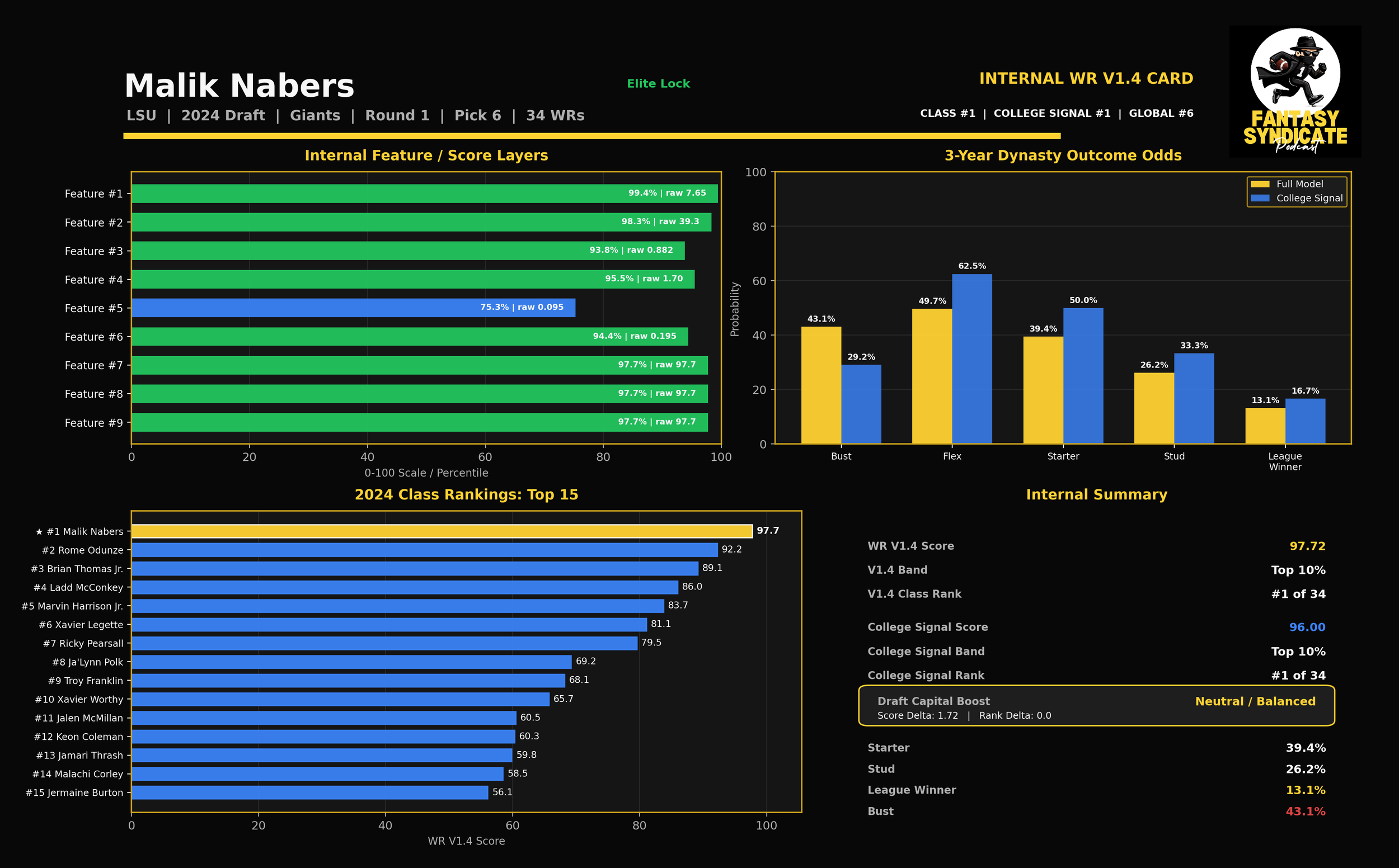
Malik Nabers Rookie Draft Player Card
I will be referencing my Poni Team Fit and Conflict Pressure Score in this article. If you don’t know what those are, I encourage you to take 5 minutes to read this article to understand the scores. After you follow the link, scroll to the bottom of that article (if you don't care about methodology) to learn about the scores. I also wrote a 10,000+ word article on Team Fit and Competition you can find here. I will reference these in this article.
Below are my current dynasty rookie wide receiver rankings using my WR V1.4 model as the baseline. I am also layering in additional context that a model cannot always fully capture (yet), including landing spot, role, team fit, target competition, quarterback situation, and rookie draft cost. Because of that, my final official rankings may not perfectly match the model order, but the model remains the foundation of my process.
Lastly, I will be using a tiering system when ranking these wide receivers. This means just because I rank a guy my WR6, I might decide to take them in place of my WR4 based on my risk tolerance that day. Or take my WR2 over my WR1. As you read this article, I want you to keep this in mind. We each have different risk thresholds, player expectations, and overall perspective. I will be making some controversial picks in this article, so buckle up!
TL:DR
Here is my TL;DR version of this post. If you want to see a deep dive on each of these players, as well as my full rankings, continue to read on.
Tier 1: WR1A: Makai Lemon
Best overall WR prospect profile, franchise QB
Tier 1: WR1B: Carnell Tate
Elite NFL WR prospect profile, young QB to grow with
Tier 1.5: WR3: Jordyn Tyson
Mixed WR prospect profile, young QB to grow with, elite scheme
Tier 2: WR4: Omar Cooper Jr.
Great WR prospect profile, bad landing spot, long term bet
Tier 2: WR5: Elijah Sarratt
Elite WR prospect profile, bad draft capital, talent based bet
Tier 2: WR6: KC Concepcion
Mixed WR prospect profile, good opportunity, great scheme fit
Tier 2: WR7: De'Zhaun Stribling
Terrible WR prospect profile, good draft capital, elite scheme
Tier 3: WR8: Antonio Williams
Solid WR prospect profile, great role fit, elite opportunity
Tier 3: WR9: Denzel Boston
Better WR prospect profile than KC, good opportunity, great scheme fit
Tier 3: WR10: Germie Bernard
Okay WR prospect profile & great scheme fit (slot)
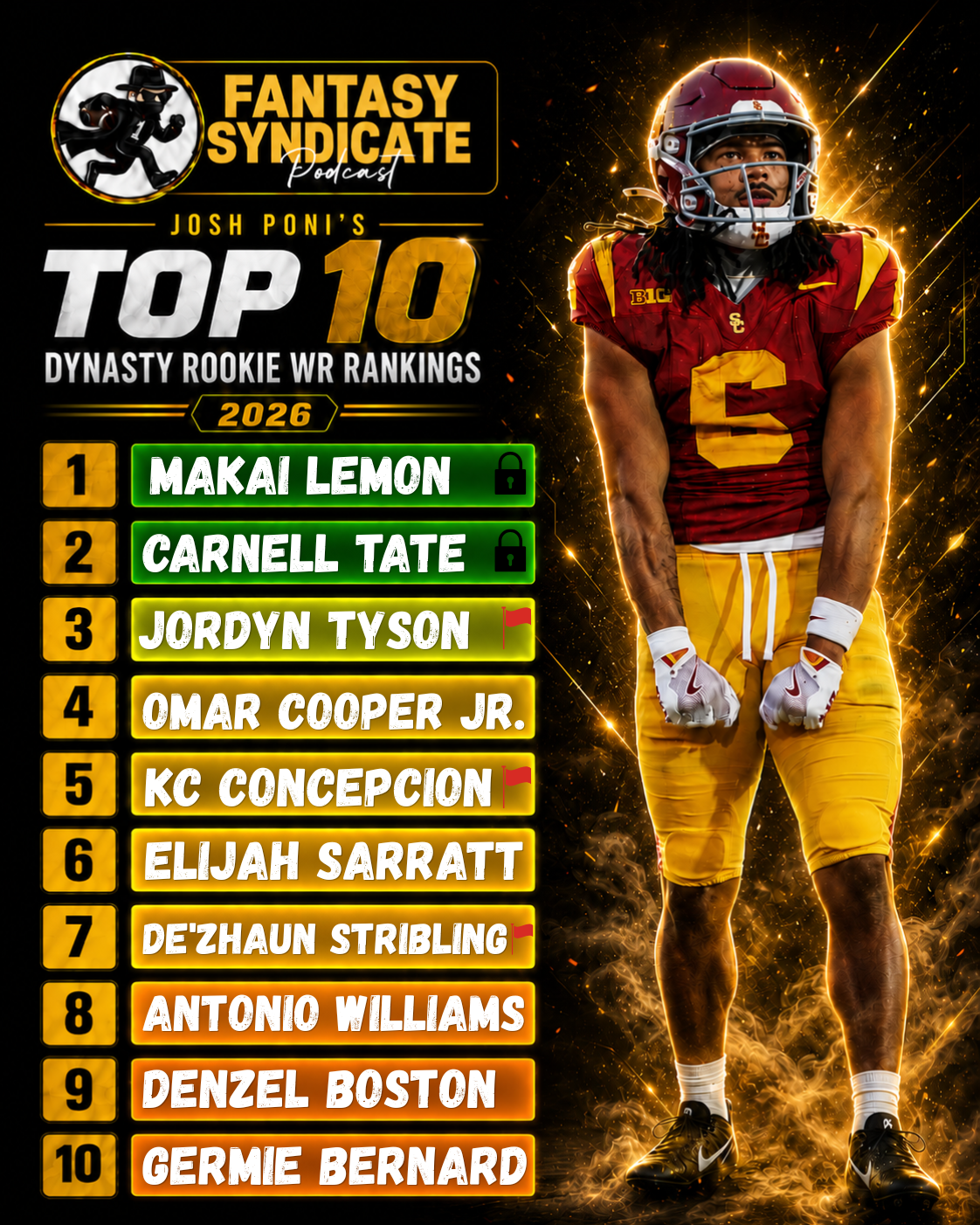
Top 10 2026 Dynasty WR Rankings
Tier 1: The Model Winners
Of the top 20 wide receivers in my model I’ve had 3 major busts (2016-2023). It hurts me to even write their names. Kadarius Toney, John Ross, and Henry Ruggs III (Ruggs is a wash).
The two wide reciever that I am going to write about next, fall into the top half of this top 10% bucket. This is an important threshold for my model. This is where my model is most predictive (not perfect).
The very top of the model has historically been the premium range. The top 10 ranked WR prospects produced an 80% flex-hit rate, a 70% Starter+ hit rate, a 50% Stud+ hit rate, and a 30% League Winner rate. Only 20% of that group landed in the bust range.
The broader Top 10% score band is still a strong range, but it is a wider bucket and comes with more volatility. Top 10% score-band WRs posted a 45.8% positive-hit rate, a 37.5% Starter+ hit rate, a 25.0% Stud+ hit rate, and a 12.5% League Winner rate. The bust rate was 41.7%, which is why I treat the Top 10% band as a premium signal, not an automatic hit label.
The main takeaway is that the model has been most powerful at identifying the very top of the board. Once you expand from the Top 10 ranked players into the full Top 10% score band, the hit rate remains strong relative to the position, but the miss rate rises because the bucket includes more volatile profiles.
This is why these players are tier 1. I am trusting the 3 year fantasy success window of my model.
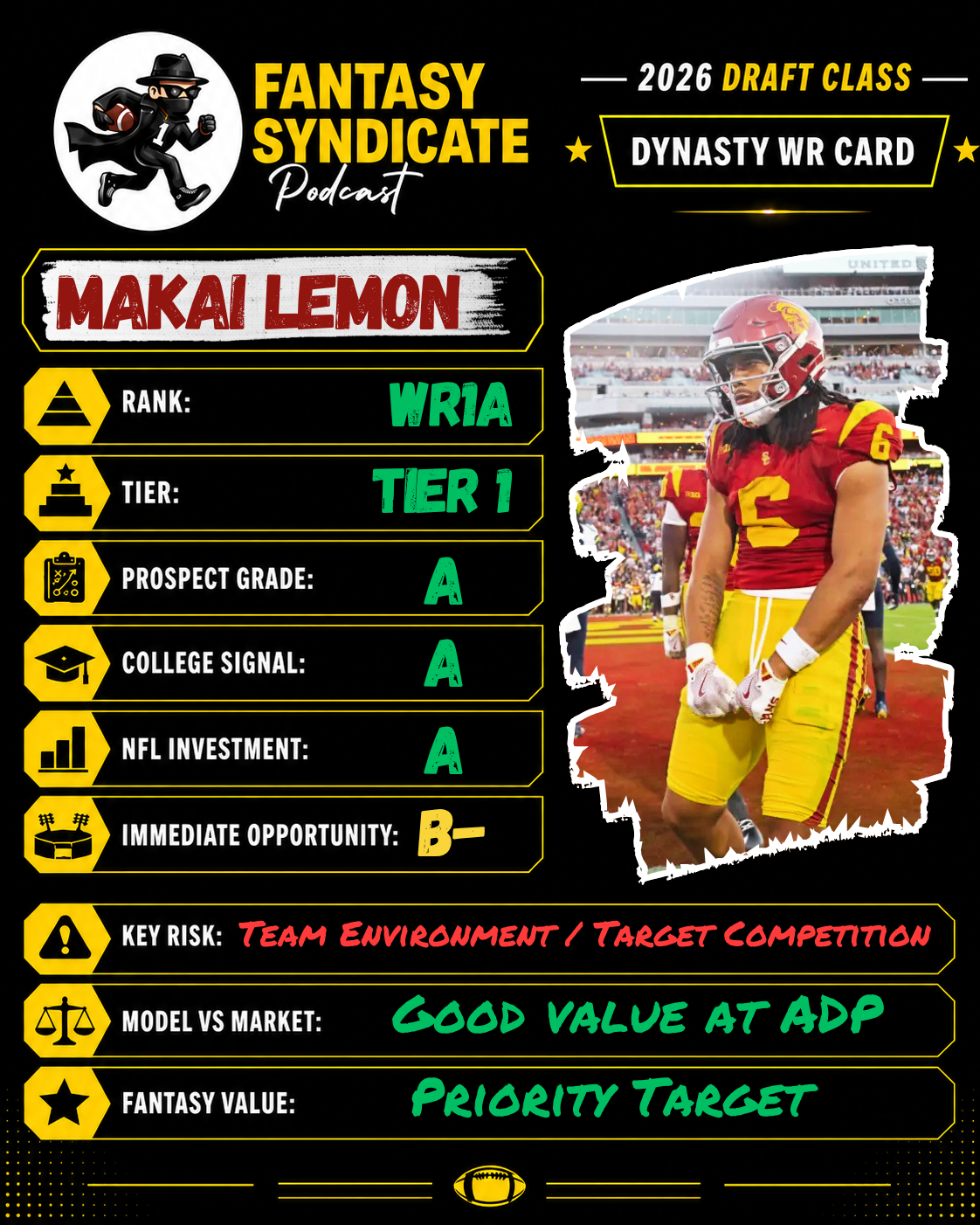
Tier 1 - WR1A: Makai Lemon,
Philadelphia Eagles
The Model
My model loves Makai Lemon. I was really conflicted over this, and went back and forth for days making the decision to move him to my top spot. But if you decided to take Tate over him, I get it. Tate is a much safer option, and my model does likes him more.
What I will say, is that I am worried about his heavy slot receiving role. Philadelphia runs a lot of 12 personnel sets, and with the the league seemingly shifting to 13 personnel it is a realistic concern. But, he checks nearly every major box I care about: draft capital, production, efficiency, and the elusiveness/catchability side of the profile. Lemon is not being carried by one outlier strength. He shows up well across the board, which is exactly what I want from my top-ranked rookie WR. He is also one of the cleaner prospects in this class based on their college production. There is not a single WR prospect that matches his overall consistency and high level analytics in the entire class.
He also received a “Top-20 Solid Lock” context label. Had he been top 10 (missed it by 1) he would have been an “elite lock” which has hit at almost a 90% rate. But since he was below that threshold, the top-20 solid indicator means he passed 3 different thresholds, using 3 different models, that assess similar but different things. Which is very very good.
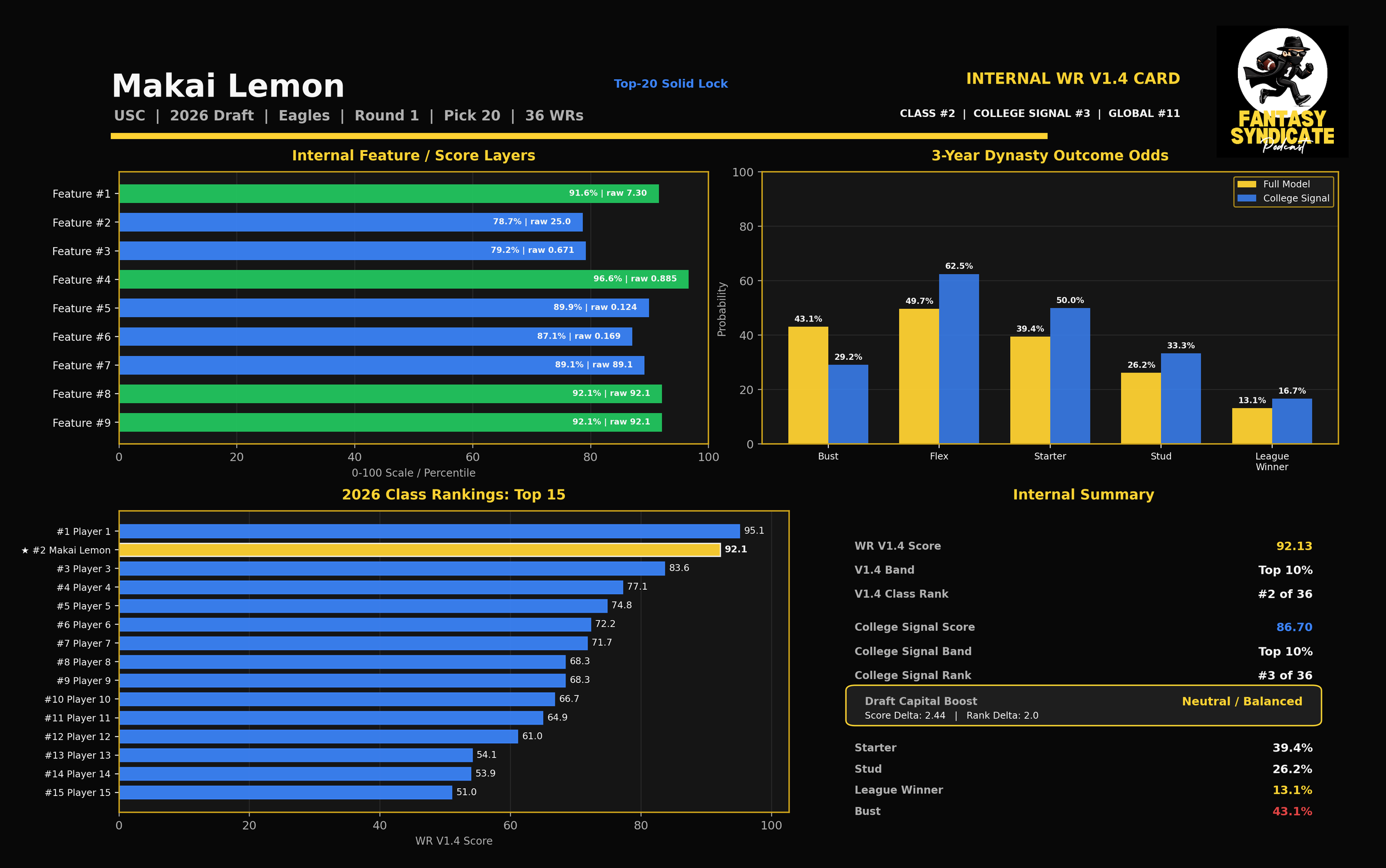
Makai Lemon v1.4 WR Player Card
Draft Capital
The Eagles traded up to the 20th pick by making a deal with the Cowboys for pick 23 and two fourth-rounders. The Eagles literally stole Lemon from the Steelers, who were on the phone with him because they had the 21st pick. The Eagles do not make that move without believing in Lemon. This is a big investment by the organization.
College Production
Lemon was limited as a freshman, but took over the wide receiver room the following year as a sophomore when he broke out (green flag). That year, he led the team in receiving yards over Zachariah Branch (pick 79) and Ja'Kobi Lane (pick 80). By junior year he was in full control of the room, finishing with an impressive 79 receptions, 1,156 yards, and 11 touchdown stat line.
Lemons YPRR vs man was 3.29 and vs zone it was 3.09. He dominated at USC in his final year, accounting for:
28% of his teams receptions
25% team targets
20% of teams TDs
19% of the entire offense
30% of the teams receiving yards
Led the class in 20+ yard explosive plays and career receiving yards
While these data points aren’t necessarily predictive of NFL success, he has one of the cleaner college production profiles of the 2026 WR class.
Key Concerns & What I Like
The things people are worried about are immediate opportunity, team fit, and him being predominantly a slot wide receiver. All are certainly worth noting, but I think some are accurate and some are being blown out of proportion. It is worth noting that Lemon started to play more on the outside his final year in college.
DeVonta Smith, Dallas Goedert, and Eli Stowers, who was Pick 54, are Lemon’s three main target competitors entering 2026. I gave Lemon a 19.5 Conflict Pressure Score, which is moderate. Smith’s depth profile is the most alarming because it strongly aligns with Lemon’s strengths. There will be competition in the short part of the field, which is where Lemon has found the most success. There is also slot crowding with DeVonta at 58% in 2025, Goedert at 49%, and Stowers at 66%. This tells me the Eagles have to decide how they want to use some of these guys. This is not great, but our model also isn’t built on a one-year sample size.
WR target usage (Slot: 76.4%, Wide: 22.6%):
Deep: 21.8%
Intermediate: 16.5%
Short: 39.4%
BLOS: 22.4%
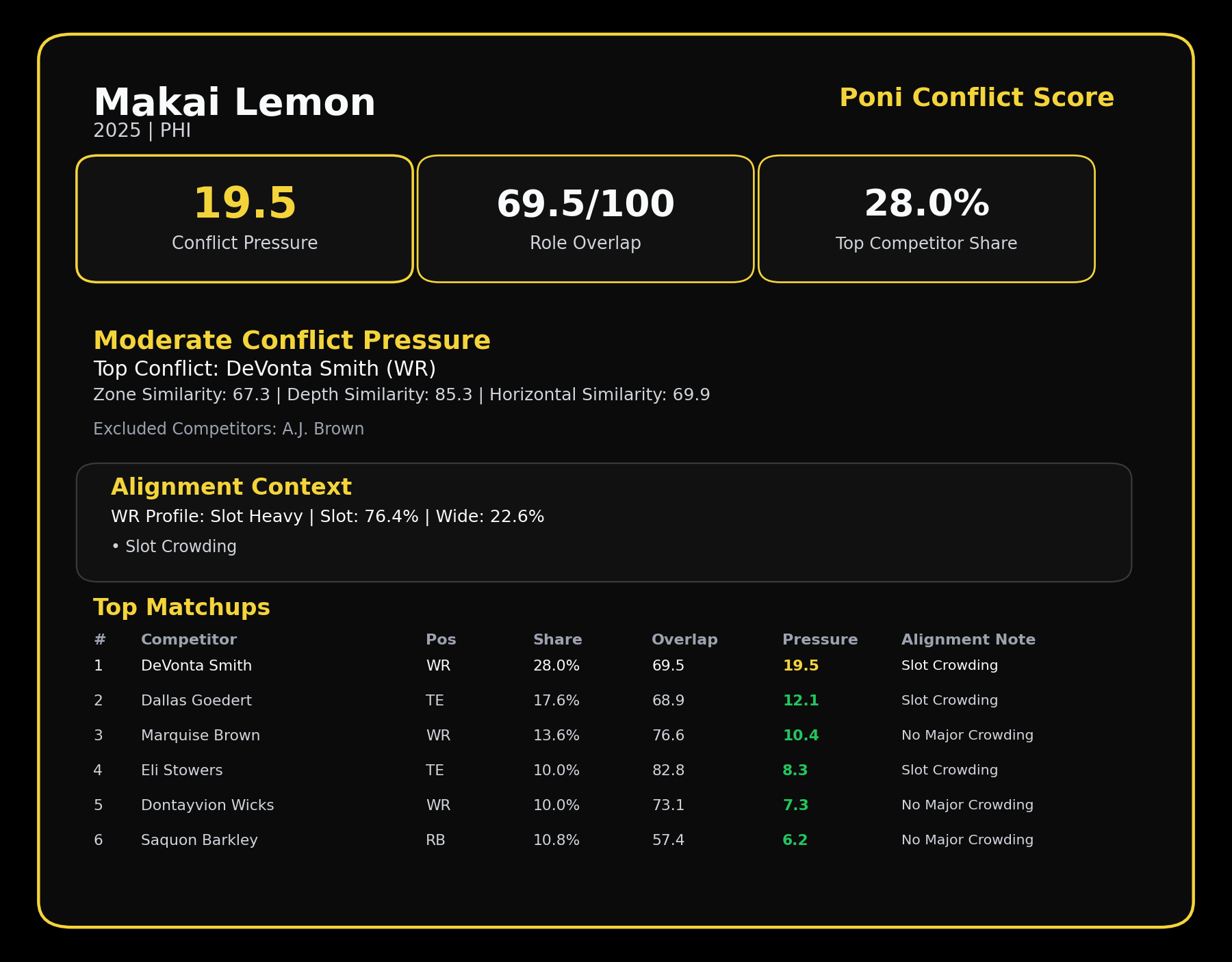
Lemon Conflict Card
Lemon also unfortunately isn’t a great fit with Jalen Hurts based on Hurts’ passing tendencies. He received a 76/100 on the Poni Fit Score, which is a Neutral/Mixed fit. The biggest issue is that Hurts legitimately doesn’t throw to the middle of the field. Like, almost never. He ranked 43rd out of 45 quarterbacks in center-field passing. This is a major concern when 67% of Lemon’s college usage came in the middle of the field.
What I will say is that this transition is normal from NCAA to NFL usage. The NFL uses the left and right side of the field significantly more than the NCAA (101 WR sample from 2020-2025 NCAA usage to NFL usage). So while the fit isn’t great, I am much less worried about this because Hurts also ranked 9th out of 45 in short-area attempt share and 5th in 2025. This lines up with Lemon’s strengths perfectly.
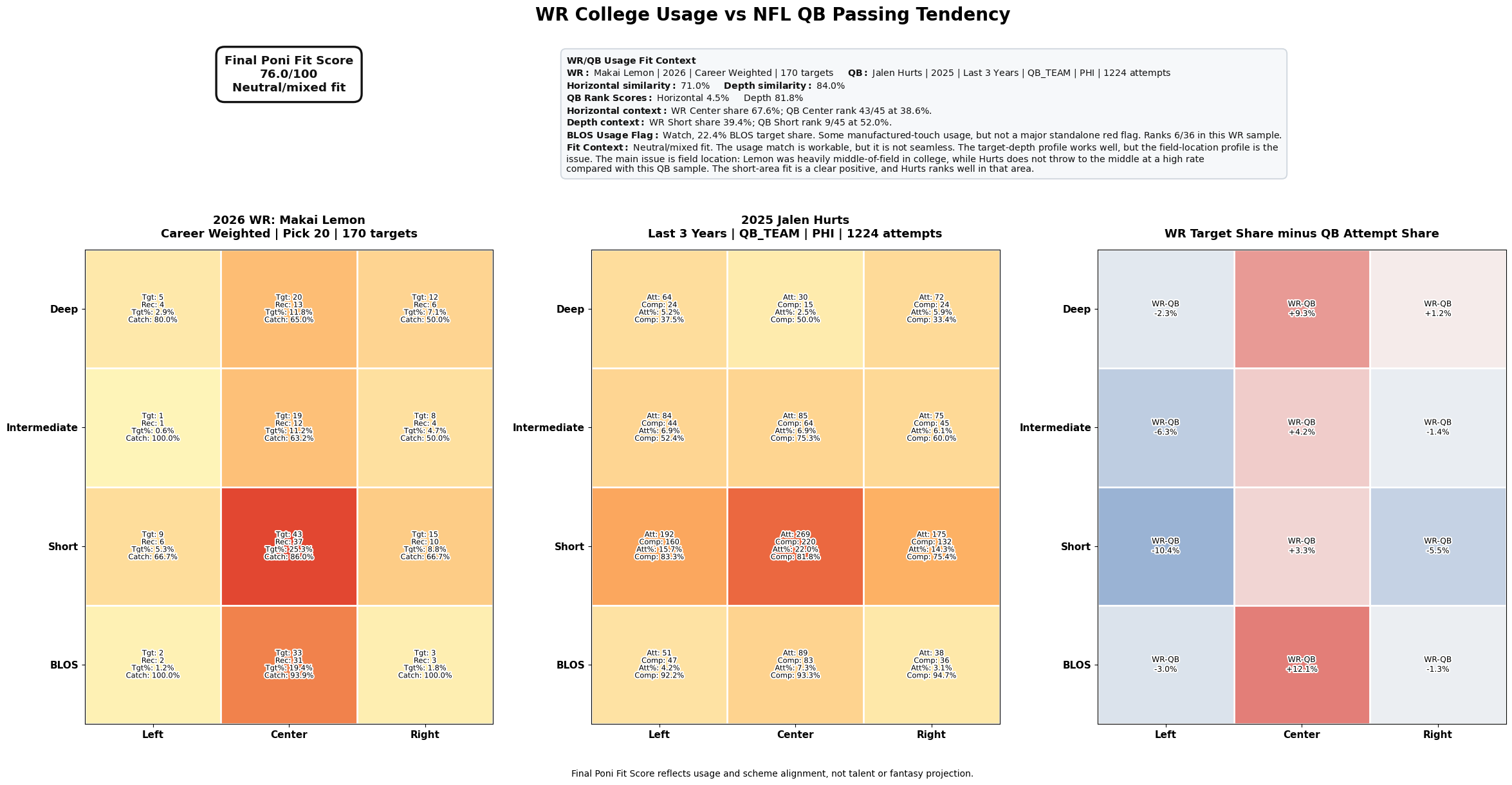
Lemon Fit Card
Lastly, the slot debate. Lemon played 75% out of the slot in college. For whatever reason, we seem to remember slot players as being busts in the NFL. But when we actually take a moment to look at 1st and 2nd round picks who played over 60% of their snaps from the slot in college, we get guys like Jaylen Waddle, Drake London, Malik Nabers, Jerry Jeudy, Jordan Addison, and Wan’Dale Robinson. I believe the upside exists for Lemon, and the narrative about slot wide receivers (who are considered elite) is not backed up by the data. The only thing holding him back is DeVonta Smith & potential role usage.
Final Takeaway
Lemon is going to a franchise that has been very good and invests in its players, coaches, and team. He has a franchise quarterback. Not only do I believe in the player, but I believe in the organization. When you invest in a player, you are also investing in the franchise. While there are concerns, this is an easy click for me, especially at ADP.
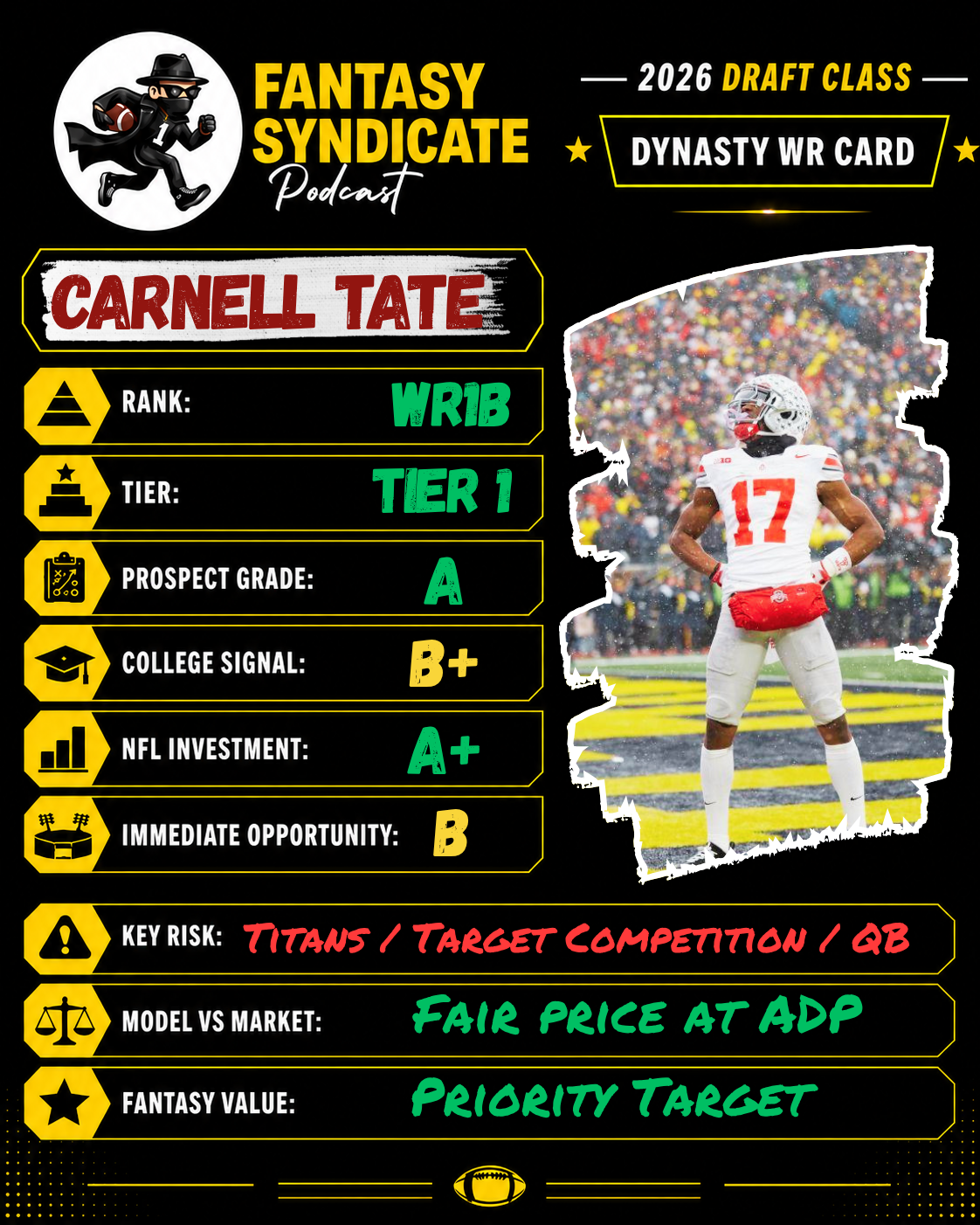
Tier 1 - WR1B Carnell Tate, Tennessee Titans
The Model
Carnell Tate comes in as one of the strongest wide receivers in the class according to my model. While Tate dips in some efficiency and elusiveness metrics, he makes up for it with his elite ability to catch the ball anywhere on the field and of course his insane draft capital. Add that to his stereotypical NFL WR profile, and he becomes my clear WR1B. I will be taking Tate over Lemon in some leagues. Both are elite.
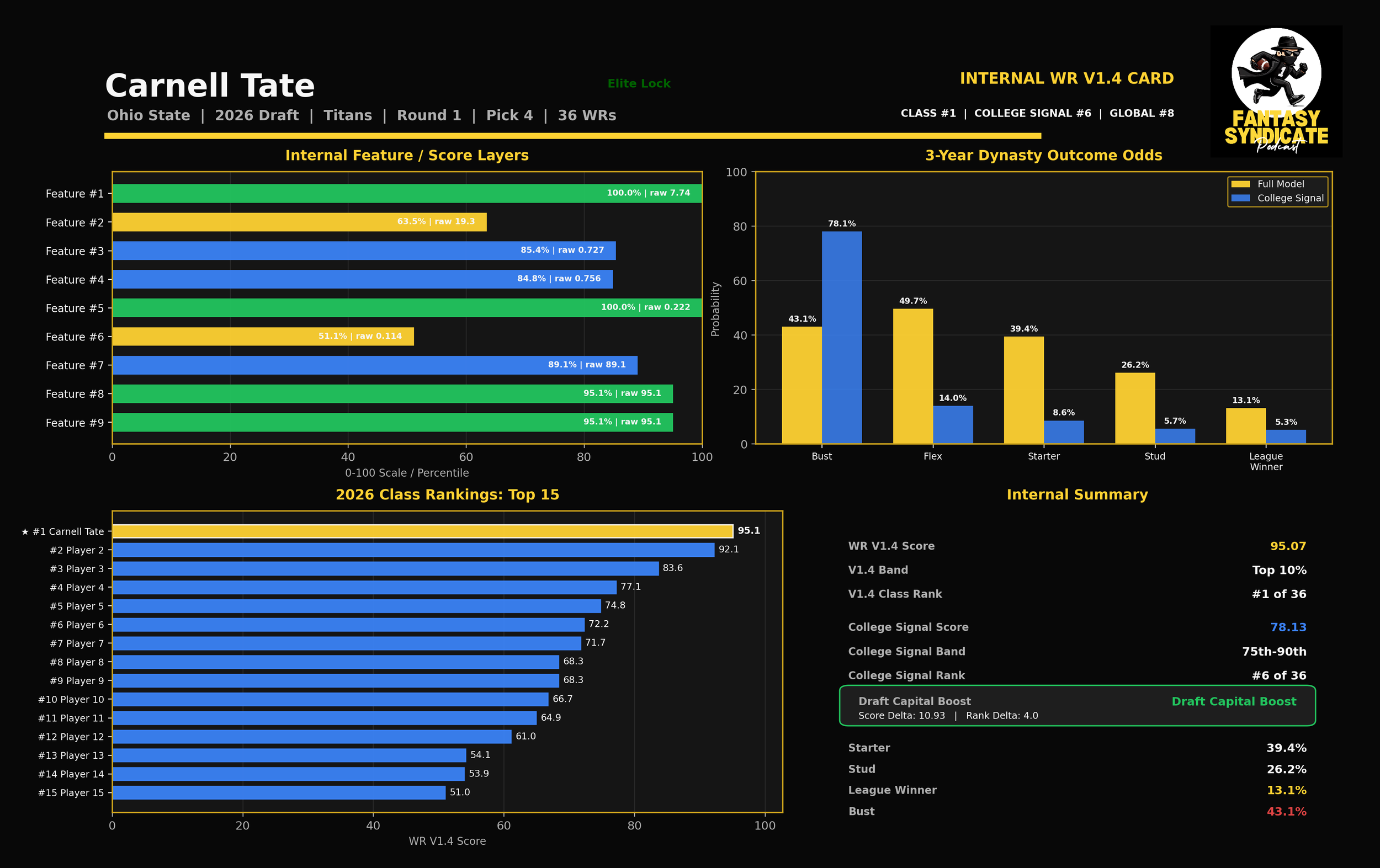
Carnell Tate v1.4 WR Player Card
Draft Capital
Tate was taken as the highest wide receiver drafted in the class going at pick 4. The last time the Titans drafted a receiver this high was in 2017 when Corey Davis was selected with the 5th pick. When you get selected this high in the draft, your team doesn’t give up on you easily. Usually the plan is to make you the focal point of the offense, or at the very least a core part of it.
College Production
Tate is an interesting case study, because every year in college he was surrounded by elite talent at the wide receiver position. He never was the alpha because Marvin Harrison Jr, Emeka Egbuka, and Jeremiah Smith existed. He was WR3 in 2024 and WR2 in 2025. Even though he never could break into that alpha role, he did hold his own with these 1st round talents.
He finishes his career with 121 receptions, 1,872 career receiving yards, and 14TDs. While this is underwhelming it shows the difference between a WR1 and WR2/WR3 throughout college. But, all is not bad. His final year he finished with 51 receptions, 875 receiving yards, and 9TDs. He averaged 80 yards a game, and had he not missed 3 games due to injury, his overall stats would have looked much better on the surface. But these are surface level stats.
Looking deeper he had a 3.12 YPRR vs man coverage and a 2.71 YPRR vs zone coverage. He was 3rd in the class for his final year yards per reception (17.2) and 4th in the class with eleven 20+ yard explosive plays. These two stats alone really show off his strengths as a player and where he should find success with Cam Ward.
His ability to catch the ball at all levels of the field is insane. He is legitimately one of the best to do it. From 2016-2026 and looking at 359 wide receivers coming out of college, he was #2 overall in my model. This doesn't directly show up in the stat sheet, but it’s literally the entire purpose of the position and a drastically underrated datapoint.
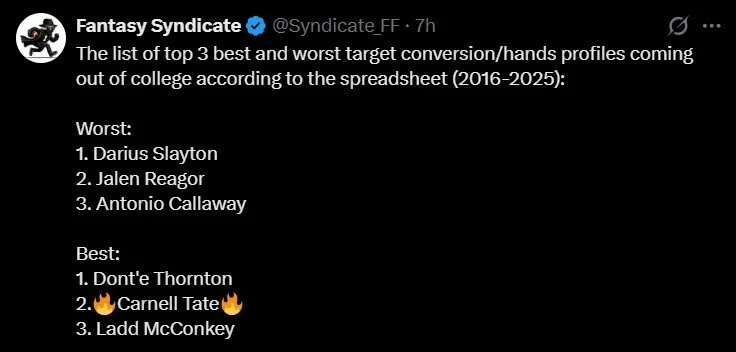
Tweet
Key Concerns & What I Like
I believe people are way over confident in Tate's landing spot and target competition.
First off, he is going to the Titans organization. Who quite frankly doesn’t instill much confidence in me. If I am buying shares of a dynasty player, it doesn’t feel great being connected to a franchise thats success is towards the bottom of the league. If you are a Titans fan reading this, I am sorry but that's the reality of the situation. Since 2010 they have 111 wins and 150 losses. Mike Vrabel turned it around for a couple of years and AJ Brown finished as WR14 (best WR finish for the organization since 2005). While I know fantasy success doesn’t correlate with how good or bad a franchise is, as a whole, it absolutely can cap upside.
Now, The Titans do appear to be in a much better position moving forward. Previous Chiefs Assistant GM Mike Borgonzi is at the helm. They hired not one, not two, but three failed ex-head coaches with a collective record of 56-129-1 (Robert Saleh, Brian Daboll, Gus Bradley). The Jaguars will still find a way to lose to them twice a year (If you know you know).
This might be cherry picking but, excluding Daboll's time with Josh Allen (who has continued to be elite, so who carried that relationship?), this is Daboll's offensive:
2009: Cleveland Browns OC: 29th
2010 Cleveland Browns OC: 31st
2011 Miami Dolphins OC: 20th
2012 Kansas City Chiefs OC: 32nd
2022 New York Giants Head Coach: 20th
2023 New York Giants Head Coach: 30th
2024 New York Giants Head Coach: 31st
2025: New York Giants Head Coach: 14th
So while the situation looks better moving forward for the organization, it is still worrisome.
Tate’s quarterback situation is also shaky. The good news is, he has a young rookie quarterback to hopefully grow with. If Cam Ward can turn a corner, this alone could be a catalyst for Tate's fantasy success for years to come. But it could also go the other direction. If that never happens, we are stuck with a Bryce Young and Tetairoa McMillan situation with capped upside. The good news is that Tate’s college usage and Ward’s offensive passing tendencies line up very well, earning a Poni Fit Score of 81. Their horizontal similarity is 88.3% and depth similarity is 83.3%. The depth is where Tate will shine.
Depth of targets:
Deep: 18.6%
Intermediate: 33.3%
Short: 37.2%
BLOS: 10.9%
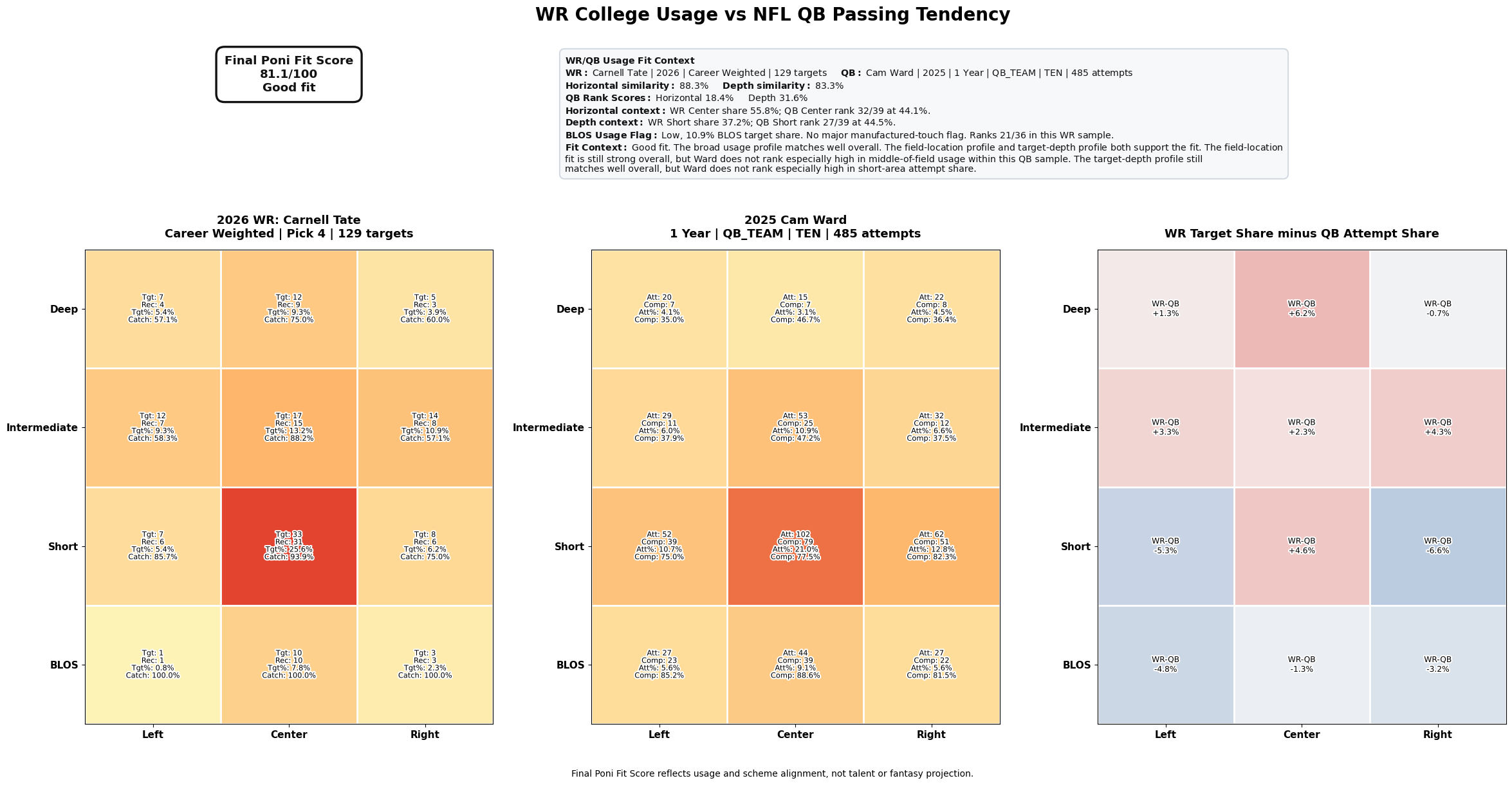
Carnell Tate & Cam Ward Usage 12-Zone Map
The last thing I want to mention is Wan’Dale Robinson is serious target competition for Tate. He earned a 20 Conflict Pressure Score. Remember, a score of 20 or higher is a red flag based on testing. Players who crossed the 20.0+ threshold averaged 2.8 - 4 percentage points lower in year 1 target share. While that may seem small, it can have a real impact on a rookie’s first-year fantasy production when they are already fighting for opportunities.
Wan’Dale just signed a big money deal, reunited with his last offensive coach Brian Daboll, is 25 years old, and is going into year 5 (prime fantasy window of most wide receivers careers).
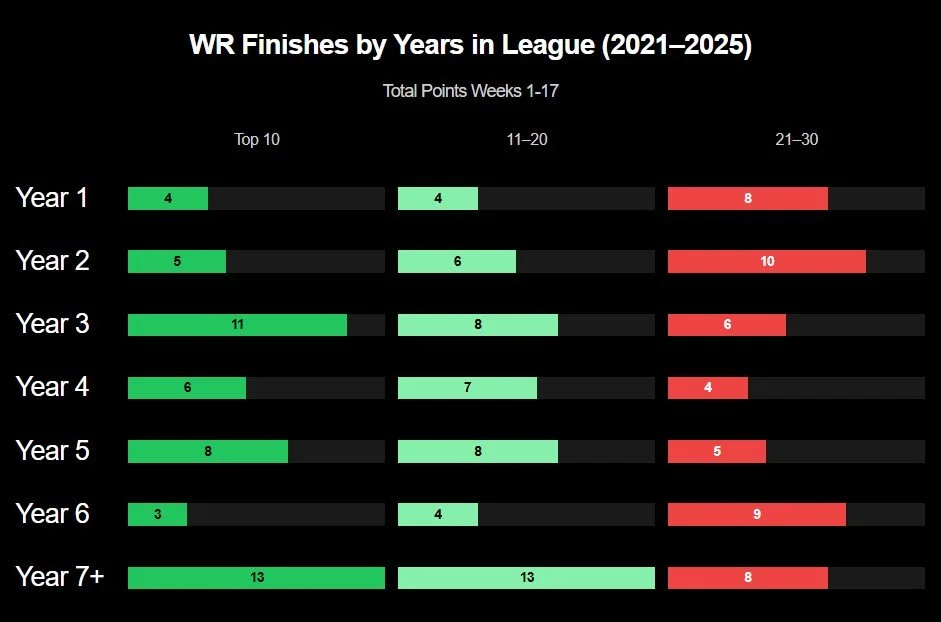
WR Breakout Thresholds
You might scoff at that, but lets compare Malik Nabers to Wan’Dale Robinson 2025 target competition when they were both on the field.
Wan’Dale: TPRR: 0.22, 237 yards, 25% team yards
Nabers: TPRR: 0.25, 271 yards, 30% team yards
The good news is that there is significantly less role overlap in usage. Especially when we talk about the usage depth. This sets up a nice opportunity for the duo to work together and not be competing for similar targets. This also helps Cam Ward.
Similar to almost every other player in this draft class, there is nothing clean about the assessment. The college profile is questionable, the situation is murky, and we are left relying on advanced analytics and film to help guide us the best we can.
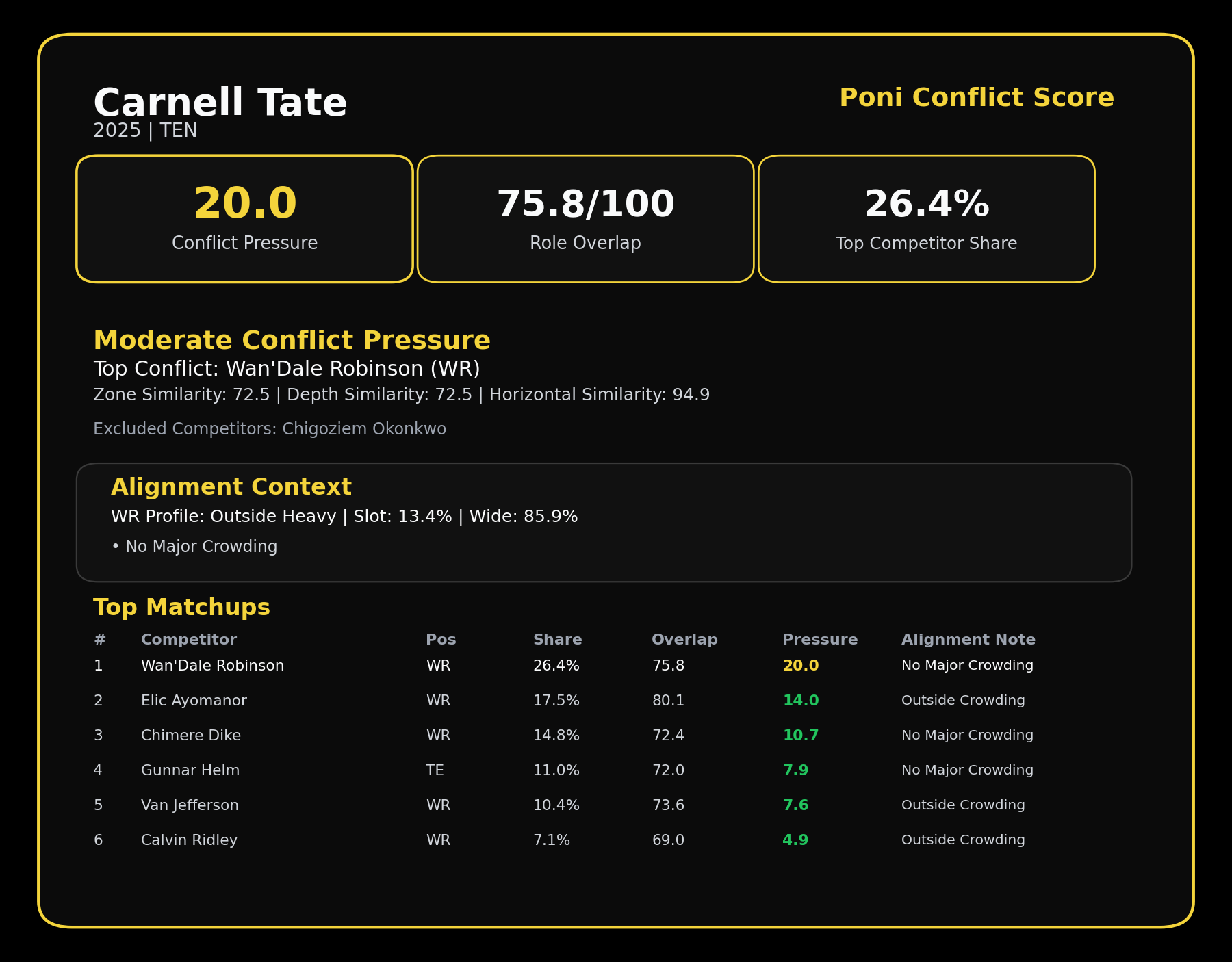
Tate & Robinson Conflict Card
Final Takeaway
Tate an amazing talent with the profile of an NFL wide receiver. He has the potential to become the alpha in pass focused offense and tied to a young quarterback with a fresh coaching staff for at least the next 3 years. While it isn’t clean, the upside exists and there is a big path to fantasy relevance if things go right.
Tier 1.5 & 2: The Situation & Signal Bets
This tier is a bit of a hodgepodge. These are players who are missing something, but I like them for different reasons. Some get a bump because of draft capital. Some get a bump because of landing spot or opportunity. Others are more of a model/talent bet. The profiles are not all built the same way, but each player has enough going for them to separate from the dart-throw tier. But if I am being honest, I’d trade away every pick (except for my sleeper) after tier 1 if I could.
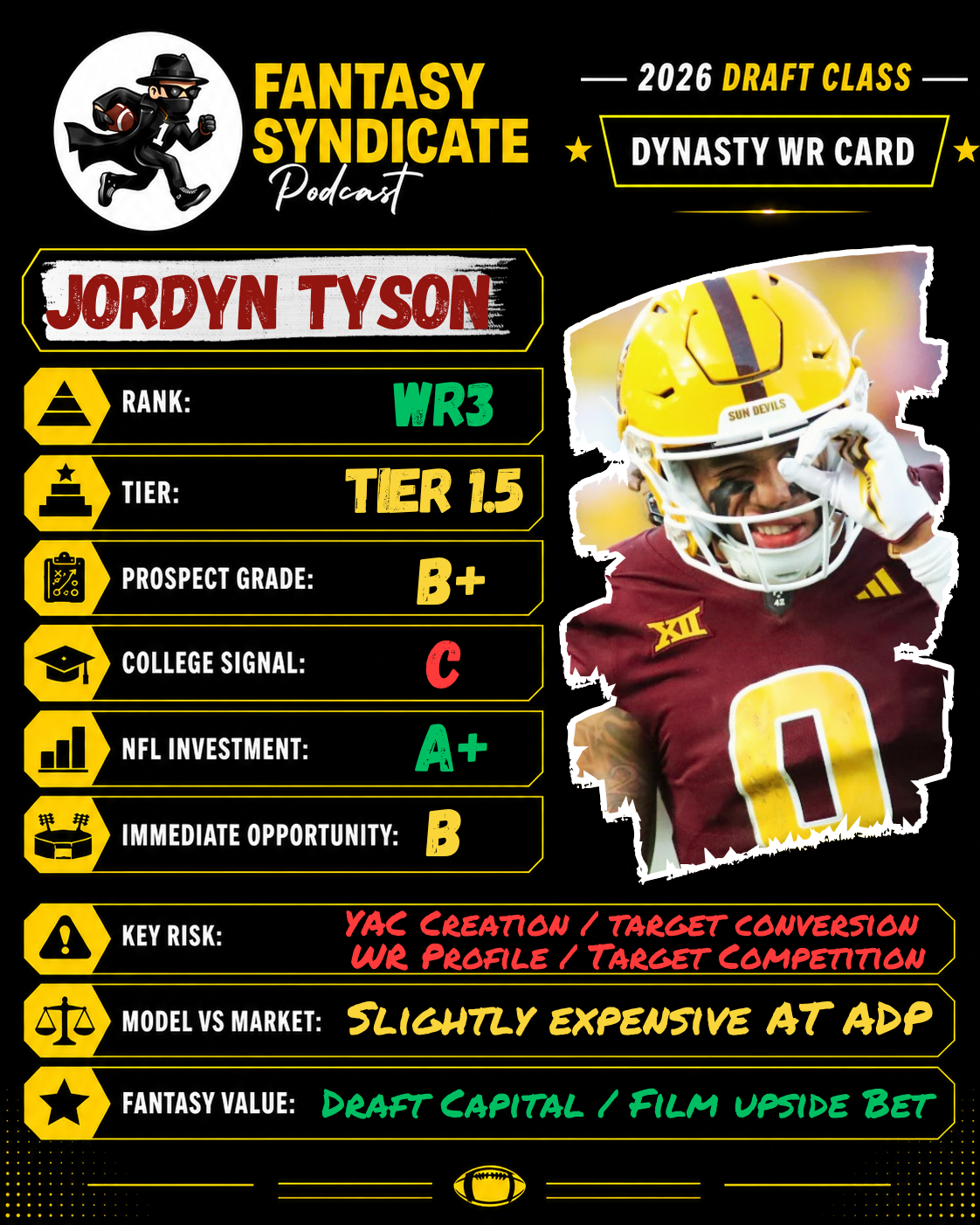
Tier 1.5* - WR3
Jordyn Tyson
New Orlean Saints
The Model
The model really doesn’t like Tyson as a first round draft talent. The biggest misses for Tyson are his target conversion/hands profile. It is one of the worst I have seen as a top 10 pick. On top of that, his lack of elusiveness or ability to create yards after the catch, is bad bad. You can’t catch and you can’t gain yards after you make the play. Not a great start. I have him in Tier 1.5 because he certainly doesn't deserve tier 1, but his draft capital, college situation, and film doesn’t fit with who is in tier 2 this year. He really is his own tier.
The last time I saw a 1st round pick with a similar issue, his name was Marvin Harrison Jr. Not necessarily a bad company to be in, but MHJ is currently significantly underperforming his draft capital fully healthy.
I really considered moving him to my do-not draft list due to ADP. In addition to the draft capital propping up his profile, he earned a “Major Review” flag. Youll notice these tags at the top of my model card. This flag is based on a model that runs behind my current model. This model is much better at spotting elite talents and busts. While not perfect, it essentially is saying this profile is a red flag and needs to be reviewed more in depth because something is missing from the profile that the other studs have. It also helps with identifying players who potentially were overdrafted and had a weaker analytical profile.
These are the top players in my model who received this Major Review flag (2016-2024); Kadarius Toney, Marvin Harrison Jr., Xavier Legette, Nico Collins, Ricky Pearsall, Chris Olave, Corey Coleman, Michael Pittman Jr., Corey Davis, Wan'Dale Robinson, Jahan Dotson, Treylon Burks, Josh Doctson, Ja'Lynn Polk, Quentin Johnston, Travis Hunter, Tetairoa McMillan, Alec Pierce, and many lower level guys. Again, not perfect, but it also spotting some landmines.
Even with all that, this class falls off so quickly, with so many bad landing spots, it just didn’t make sense to bump a top 10 pick down that far.
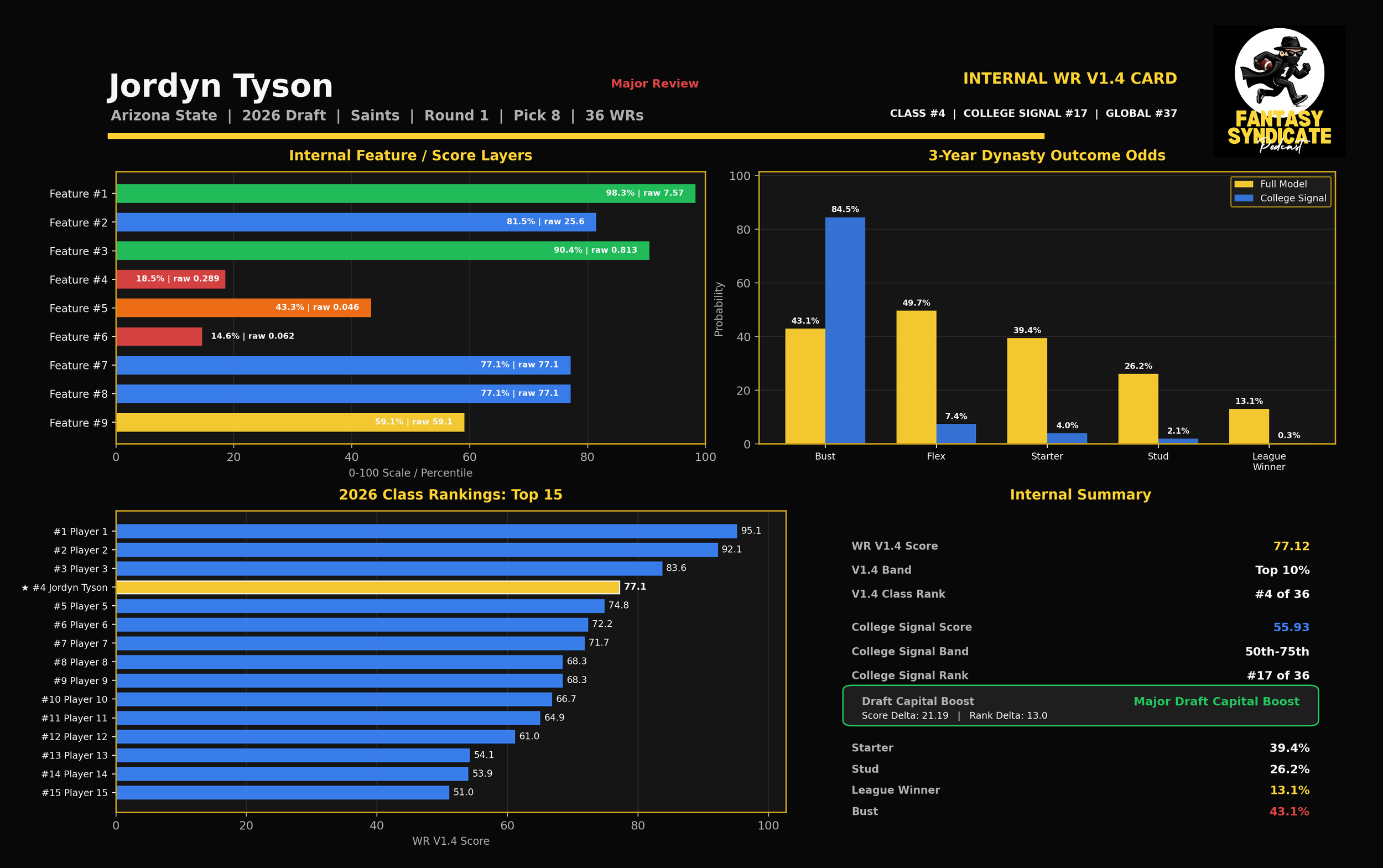
Jordyn Tyson v1.4 WR Player Card
Draft Capital
Tyson was taken with the 8th overall pick, garnering top 10 draft capital as a wide receiver. This is a big deal, and one of the reasons he makes it as my WR3, even if his profile has holes. Just like Tate, this investment means your team doesn't give up on you easily and wants you to be a big part of the offense.
Kellen Moore and Tyler Shough are two other reasons why I like Tyson. Kellen Moore has operated one of the fastest offenses on a play per second basis in the NFL since he has developed as lead play caller. He also historically doesn’t draw up passing plays for his running backs. If you don’t believe me, go look at Saquons receiving stats before/after K.Moore. Then throw the death of 2025 Alvin Kamara into the mix. Of all the wide receivers drafted this year, Tyson easily has one of the best landing spots.
College Production
Before getting into the analytics, it’s important to note Tyson has had significant injury issues throughout his career. He suffered a torn ACL, MCL, and PCL in 2022. This led him to only play in 3 games in 2023 with zero receptions. In 2024, he broke his collarbone that forced him to miss the last couple of games of the season. Then in 2025, he had two hamstring injuries, one in each leg (seems like a Key & Peele skit), missing the final three games.
As a Freshman, Tyson broke out even with how bad the offensive situation was in Colorado. Unfortunately, as you read, he was derailed by an injury that would remove him from play for the next year.
When he returned in 2024 and was healthy, he dominated at ASU for the next two years. Again making the best of the offensive situation. He ended his career with 158 receptions, 2,282 yards, and 22 touchdowns. His YPRR was 3.02 vs man coverage and 2.18 vs zone coverage. He dominated his teams reception, receiving, and touchdown share, all coming in at over 21%.
Some negative stats, which come through in his profile, are his yards per reception. This came in with the 25 percentile in the class (11.7 - 34/44). This aligns with his poor YAC ability, and you can see why the model wasn't a huge fan.
Now, while the model doesn’t like him, and I will be avoiding Tyson when possible, the NFL and film nerds love him. This is one of those picks that due to his unique college situation, I am going to lean on the assessment of people that are supposed to be much smarter than me. Pair that, with his draft capital and a bad class, and you see why he’s my WR3.
Key Concerns & What I Like
If you can believe it, Tyler Shough is not one of my concerns. I believe in the guy…but really I believe in Kellen Moore. We have seen it all over the league that elite play callers elevate mediocre quarterback play. Caleb Williams & Trevor Lawrence are prime examples of this. Also, Tyson and Shough earned a 83.7/100 on the Poni Fit Score which is a good fit for usage. Shough ranked 13th out of 39 quarterbacks in intermediate attempt shares, which gives Tyson a real path to keep winning in the area where his profile is strongest. You love to see it.
Depth of targets (Slot: 31.5%, Wide: 67.9%):
Deep: 21.0%
Intermediate: 36.3%
Short: 28.6%
BLOS: 14.1%
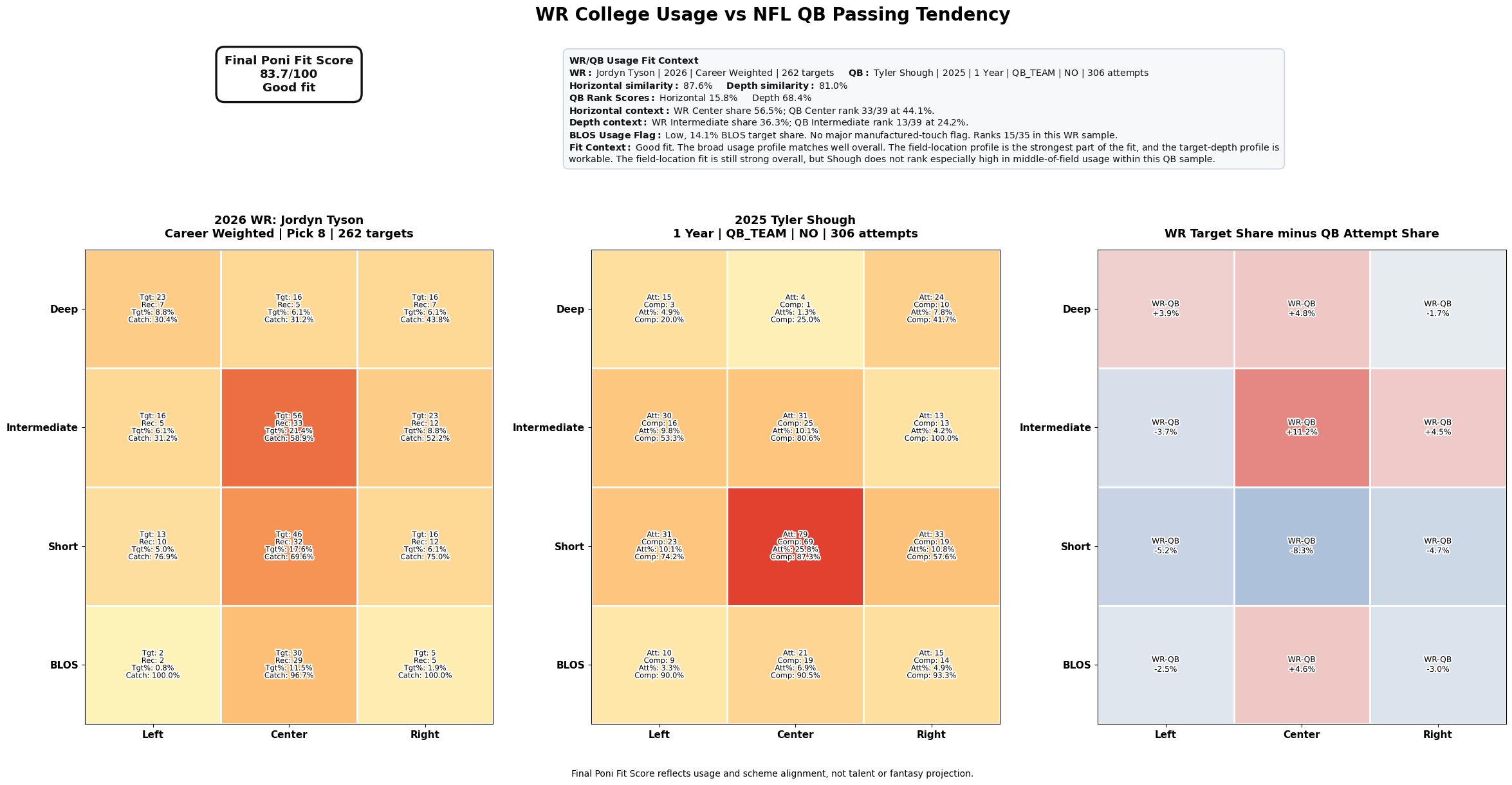
Jordyn Tyson & Tyler Shough 12-Zone Usage Map
What worries me more, aside from the WR profile, is Chris Olave. I have never understood the Olave hate. He is a true wide receiver one target hog. The kid broke 1000 yards as a rookie, with dusty ass Andy Dalton throwing him passes. He then proceeds to earn over 1100 receiving yards in the next 2 out of 3 seasons. I get the concussion concerns, but it’s time to move on. You can't predict these types of injuries so it's a weak argument supported with very little data.
While Olave is in the last year of his contract, we have seen Kellen Moore sign two massive deals before to keep his pass catching guys. While I do expect Olave to get resigned during training camp, I am worried. It isn’t because of Tyson. It is actually because of Bryce Lance. Lance actually profiles significantly better than Tyson. That is all I will say here, but I wrote a bit about him below, so make sure to check his profile out. Obviously, if Olave doesn’t resign, this situation gets so much better for Tyson, and would move him into my tier 1.
In the usage game, Tyson had a Conflict Pressure Score of 21.4, which is a strong conflict. Tyson and Olave usage profiles are very similar in both depth and horizontal similarity. Their depth similarity at 86% is one of the strongest matches in the class. This might be the sign K.Moore is moving on from Olave, but regardless there will be serious competition in 2026.
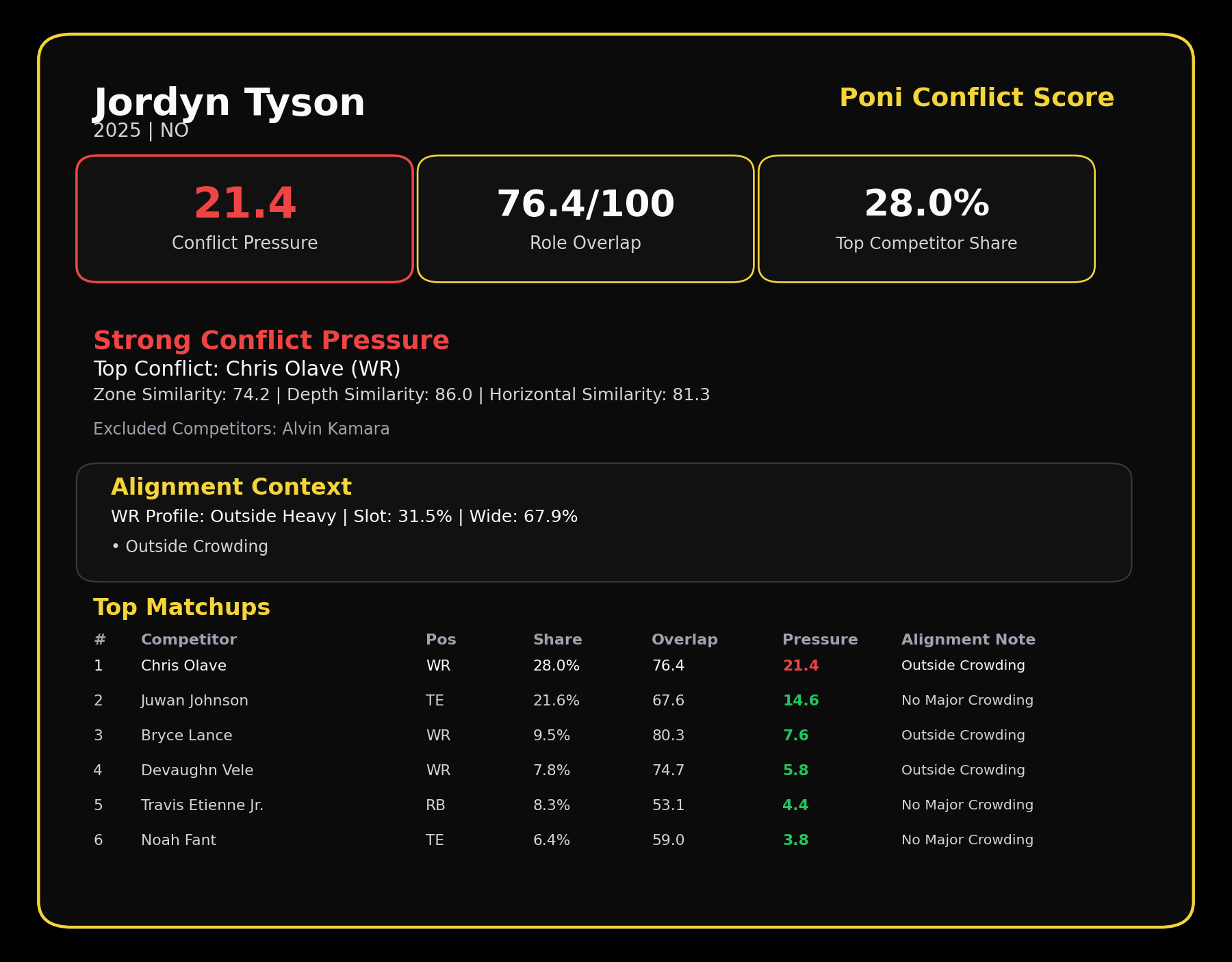
Jordyn Tyson Conflict Card
Final Takeaway
Tyson is a mixed bag. He has an insane injury history, questionable wide receiver profile, and goes into a competitive pass catching room. But, he checks many of the boxes in the model, the NFL/film guys love him, Olave's future is currently questionable, and he moves into a fast paced Kellen Moore offense. He is the perfect dynasty rookie WR3 who carries a high risk and high reward profile.
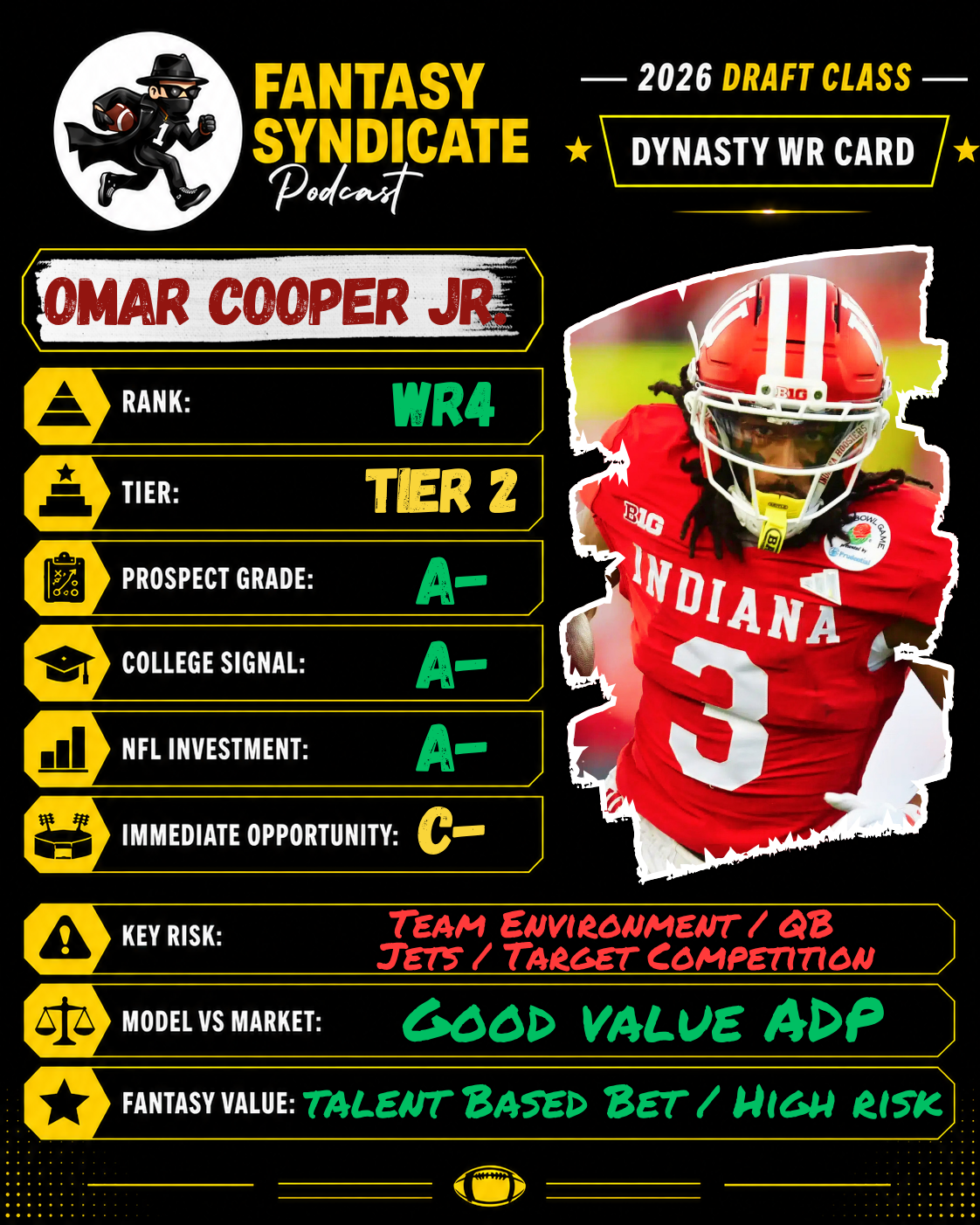
Tier 2 - WR4
Omar Cooper Jr.
New York Jets
The Model
This is going to be a spicy take because of his ADP across the dynasty community, but Omar Cooper Jr. is the #3 wide receiver according to my model. He creeps into the mid-bottom of the 10% tier. He hits above 90 percentile in two of my major features, and has a mixed bag of efficiency and average target conversion. He is great at generating yards after the catch. If Tyson’s college profile wasn’t so messy and he wasn't a top 10 pick, I would have moved Omar up to my WR3 with a better landing spot. But, he went to the “god damn Jets”. (Name that movie!)
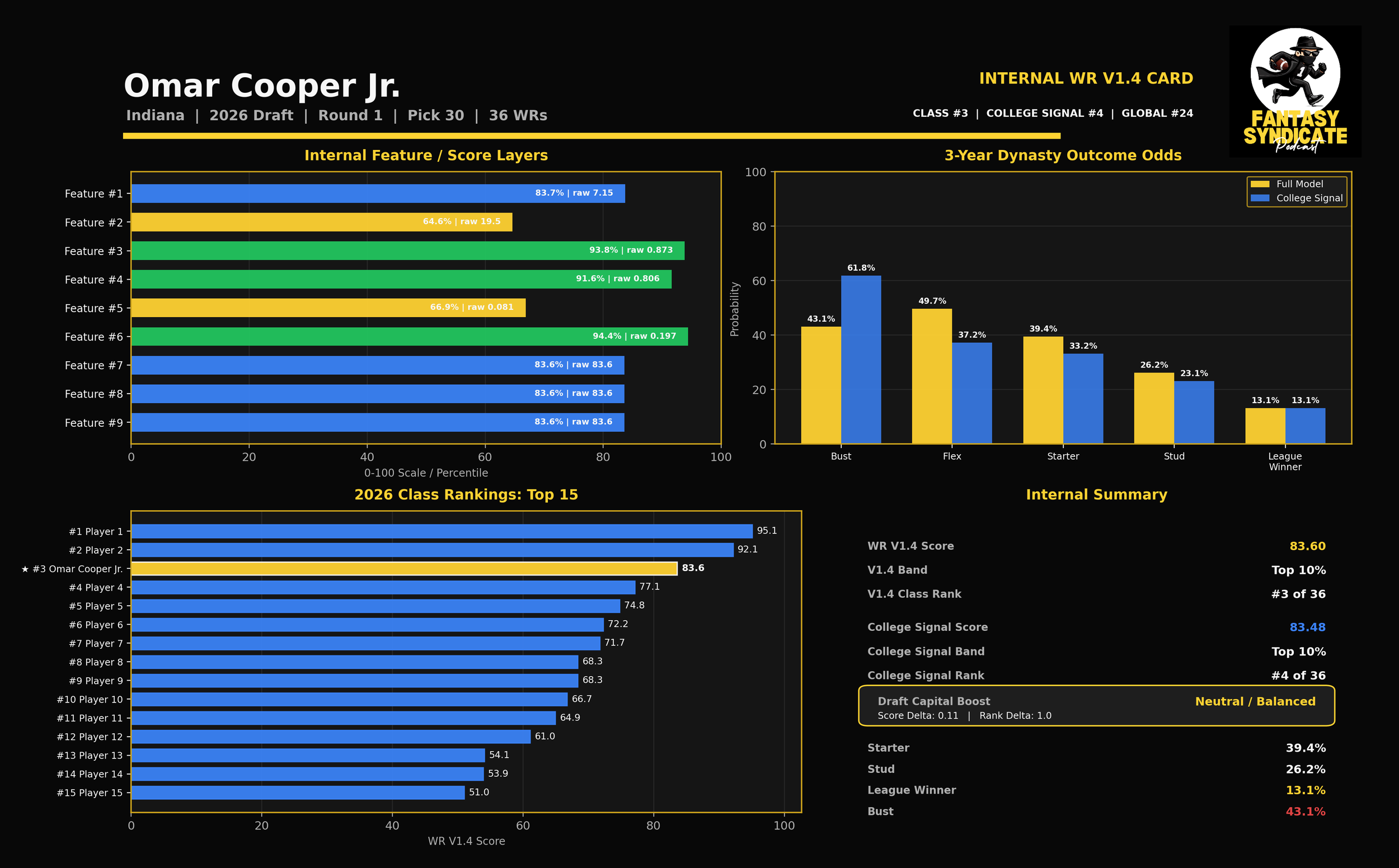
Omar Cooper Jr. v1.4 WR Player Card
Draft Capital
Omar Cooper Jr. went at the end of the first round when the Jets traded up to get him. Going into the draft, I talked with my buddies about how Cooper would surprise a lot of people by going in the 1st round as a top 3 wide receiver. While that didn’t exactly happen, him getting drafted in the first round wasn't a surprise to me. The shock came when the Jets drafted him. To be honest, I thought my Niners were going to take him at pick 30. I think they got greedy by trading back. There is no way they thought the Jets would draft him there. Either way, by the end of the night, he had a 1st round talent grade. I thought this was appropriate given the state of this class and his profile.
College Production
Omar Cooper Jr. was productive in his final college season. He had 66 receptions, 937 receiving yards, 13 touchdowns, and won a national championship with Indiana. The red flag is that he got outplayed by Elijah Sarratt in 2024. But, I believe Sarratt is the best talent at the wide receiver position in this class. If he was drafted in the 1st and maybe early 2nd, he would have been my clear cut wide receiver one in the 2026 class. So, I am less worried about the non-production by Cooper in his junior year.
In 2025 Cooper was the focal point of the offense and accounted for 24% of the team's target share, 25% reception share, and 26% of Indiana's receiving yards. He was right behind Lemon in yards after the catch, and this is where he shines. His elusiveness and ability to produce after the catch is why I like him so much. He is one of the best in the class at producing after the catch. This is where upside lives.
His YPRR vs man was 1.81 and YPRR vs zone was 3.15 (3rd in the class). The good news is that the league predominantly plays zone coverage. Being a zone beater was the role he played in Indiana's offense. Sarratt was their man beater and Cooper dominated vs zone. While the man YPRR is worrisome, it is a flag and not bad enough to ruin his overall profile.
Key Concerns & What I Like
I don’t think there is anything I can say here that you do not already know. His situation is, let's just say, less than ideal.
**Sarcastic tone…He is joining the most elite franchise in the past two decades, the New York Jets! He has an elite head coach Aaron Glenn with newly added 64 year old offensive coordinator Frank Reich (even if I do like the scheme fit with Cooper). Then add 35 year old premiere passer Geno Smith to the mix.
His situation sucks right now. I am interested in Cade Klubnik (QB) at cost, but even if he finds a way to be successful this year, it will take some time to develop. I fully expect the entire coaching staff and Geno to be replaced in 2027 if not sooner. This is what I love this for Coopers future value.
Omar Cooper Jr. is in a mixed/ neutral fit with Geno Smith earning a Poni Fit Score:72.2/100. This isn't exciting. His intermediate and deep target share was 54.8%, which gives him one of the cleaner downfield profiles in this group. The issue is that Geno ranked 49th out of 57 quarterbacks in intermediate attempt share. So the exact area where Cooper was strongest in college is not an area Geno has leaned into heavily.
Depth of targets (Slot: 44.6%, Wide: 54.9%):
Deep: 22.6%
Intermediate: 32.3%
Short: 31.6%
BLOS: 13.5%
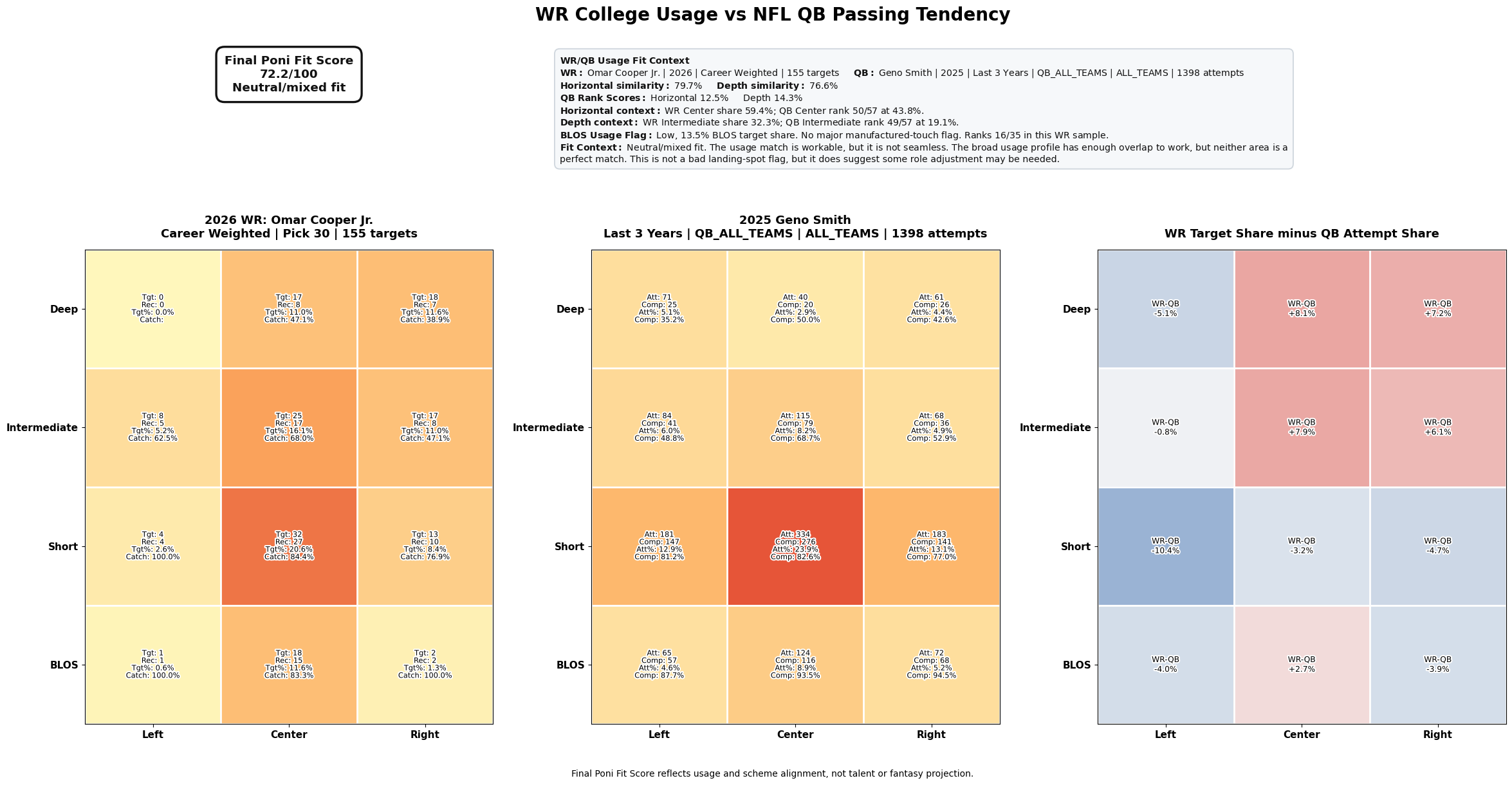
Omar Cooper Jr. to Geno Smith 12-zone Map
Lastly, there is real target competition. We have Garrett Wilson who is on a long term contract. At the very least this will run through 2027, but the deal is technically good until 2030. Adonai Mitchell, who is talented in his own way and separates from his defenders as literally one of the best in the entire NFL. First round tight end Kenyon Sadiq who is an athletic freak (all I'll say for now). And 2nd round Mason Taylor who is a talented tight end pass catcher.
So in short, the alpha role is taken for at least the next two years, he has a lot of other competition around him, and the ceiling is probably WR2 with Garrett Wilson around. Cooper's conflict pressure score was 19.4, moderate conflict, but I do not believe he has the chops to overtake GW. At least not over the next two years.
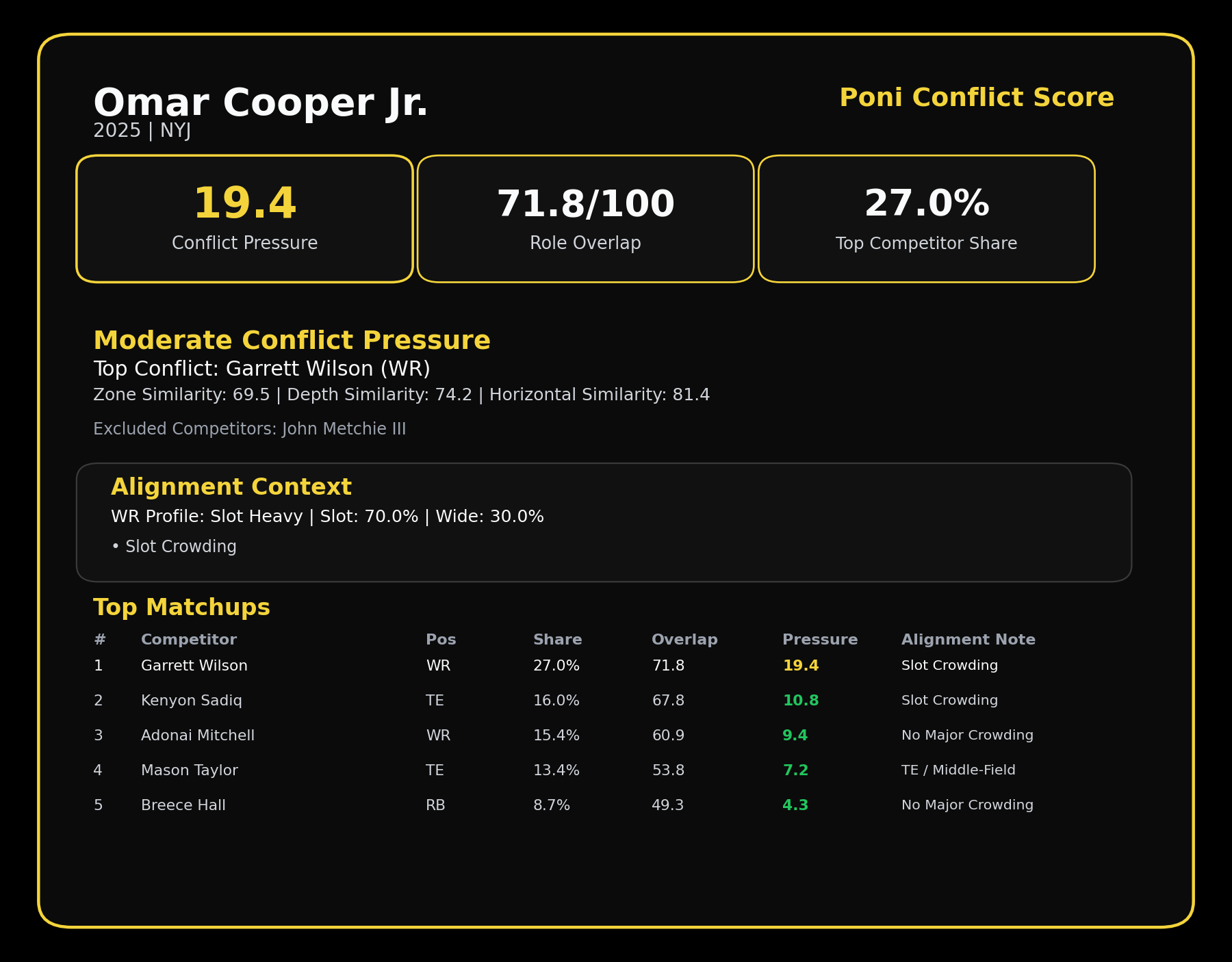
Omar Cooper Jr Conflict Card
Final Takeaway
Cooper is a long term bet, in a bad situation, with a lot of talent around him. This is a wait and see dynasty bet. In my opinion the talent is there, and worth the pick. In a bad class, sometimes betting on talent is the best move. If you don't want to wait to see what happens, then you can move on to my WR5. He has a much better path to early wide receiver production and early success. I could easily see him being taken ahead of Cooper based on your dynasty goals.
Tier 2 - WR5
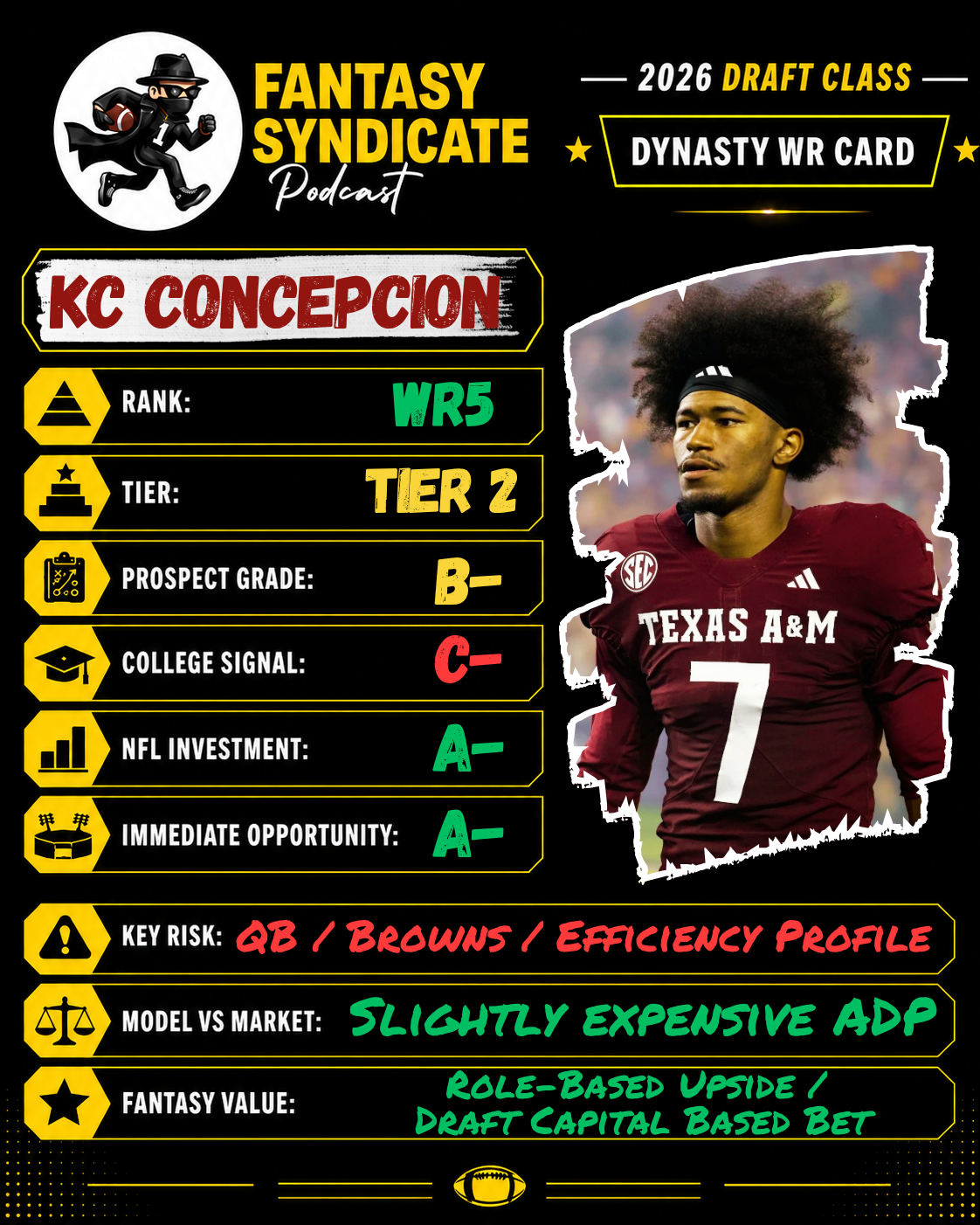
KC Concepcion
Cleveland Browns
The Model
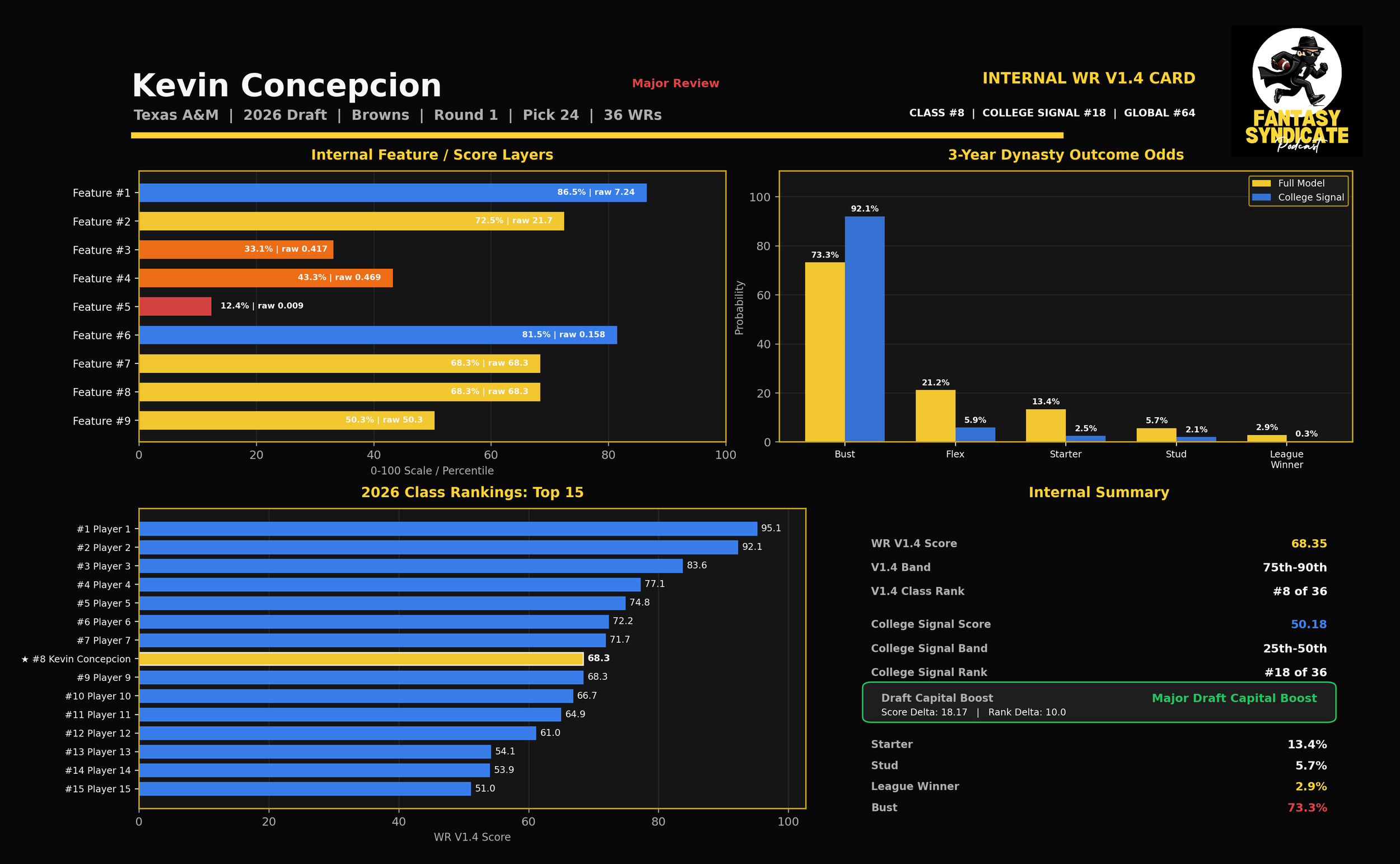
Concepcions draft capital does not align with his actual talent profile. In my model he was 18/36 wide receivers in the 2026 class. He was mediocre in the efficiency metrics I care about, and his target conversion rate was bottom 5 in the class. This aligns well with his 7 drops last year and low depth profile. But, he did have a strong ability to make plays after the catch and create space. Either way, the draft capital and landing spot trumps the model.
As I mentioned before, my model isn't perfect. One of my bigger misses in the model is Zay Flowers. While I still had him as my WR3, he did not profile well. Concepcion has eerily similar comparisons. If you keep reading, you will find out why that is important.
KC Concepcion v1.4 WR Player Card
Draft Capital
Concepcion was drafted as the 24th pick by the Cleveland Browns who are desperate for pass catchers. They fell into Harold Fannin in 2025, and are trying to add to their room. They made two calculated picks for the wide receiver position. While Concepcion wasn’t an analytical marvel, some rankings had him as one of the best wide receivers in the class. The film nerds love the guy. He is able to get in and out of breaks quickly, he is considered a high level separator, and has formation flexibility. As we have seen happen a lot in this class, the film has trumped the analytics.
College Production
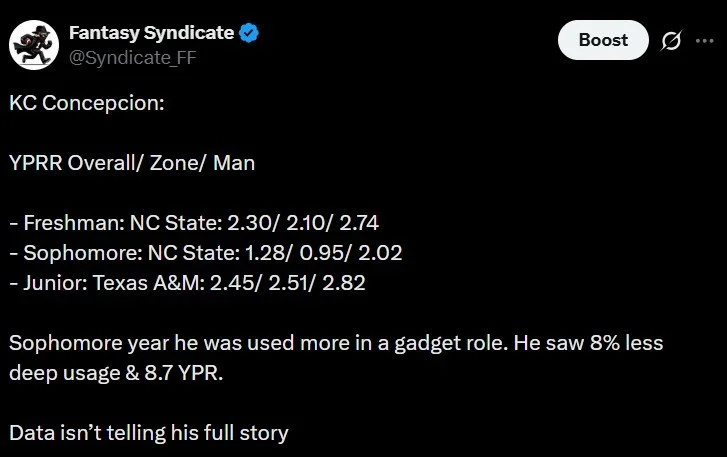
People forget this, but Concepcion broke out as a freshman. This is typically a huge green flag. He had a 71/839/10 stat line at NC State and was looking like an elite option for the 2026 class. Then the following year he didn't break 500 yards and was out-produced by Justin Joly, the 152nd TE pick by the Broncos. Now, it is important to note that during his Sophomore year he was used in a gadget role, which significantly impacted his overall analytics. I don’t believe the data is telling the full story.
Tweet
For his junior year he transferred to Texas A&M and put up a respectable 61 receptions, 919 receiving yards, and 9 touchdowns. Sophmore Mario Craver (this will be a name we will be talking about in the 2027 class) gave him a run for his money for the alpha position finishing with 917 receiving yards.
KC accounted for 25% team target share, 25% team reception share, 27% team receiving yards, and 16% of the teams total offense. He finished with 2.83 YPRR vs man and 2.52 YPRR vs zone. It's another mixed college profile, that comes with the good and the bad.
Key Concerns & What I Like
He was drafted by the doo doo Browns. But the more glaring issue is that they currently have zero quarterback identity. Shedeur Sanders has been in the lab weekly trying to get better for the team. Deshaun Watson who last saw a snap 600 days ago (10/20/2024) is also in the mix to potentially take over the starting role. If Sanders starts and remains the starter the entire year, this would be good news for Concepcion.
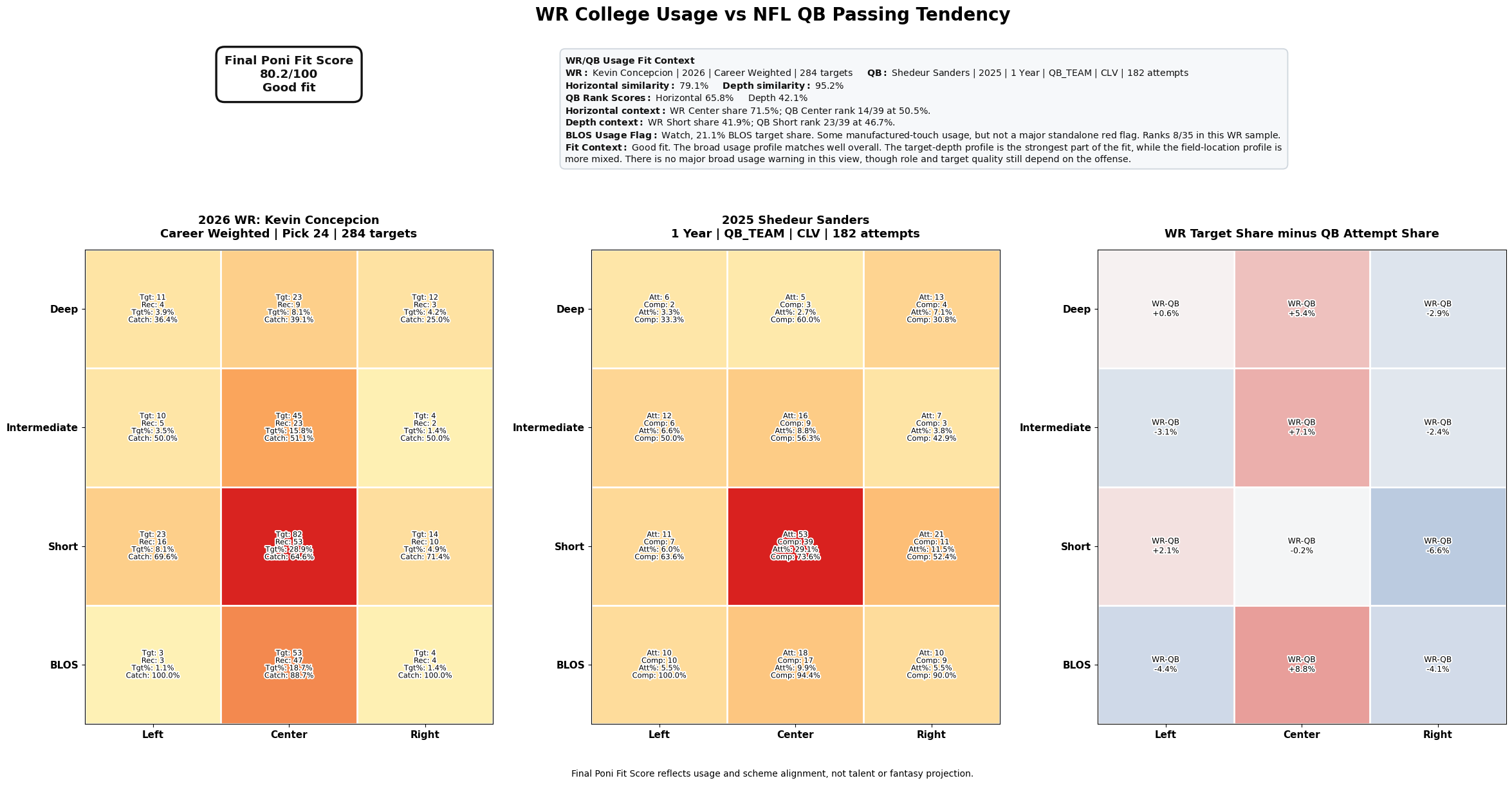
While it is a small sample size, the Poni Fit Score came in as an 80.2/100 and a good fit. The main reason these two connected well was because Sanders short depth passes consisted of 46.7% of his usage. This is KC’s bread and butter. Overall, it is a good fit on paper.
Depth of targets (Wide: 65%, Slot:35%):
Deep: 16.2%
Intermediate: 20.8%
Short: 41.9%
BLOS: 21.1%
KC & Sanders 12-Zone Usage Map
His role in the offense is also a concern due to breakout tight end Harold Fannin Jr. But I’m not too worried. The conflict pressure score came in at a 17 which is a light conflict.
Concepcion lined up out wide in college, but the majority of his usage came from underneath. His intermediate/deep share was only 37%, actually lower than Lemon’s at 38%. I think he could fill the Z role exceptionally well leading to consistent usage as a rookie. I believe Todd Monken drafted him for this exact purpose. A year from now, we might be talking about KC being a poor man's Zay Flowers. This is one of the reasons he is here. Because of Todd Monken and the potential opportunity.
The downside is that he hasn’t shown to be able to win on intermediate or deep routes. This is worrisome because if he is unable to play the X role on 13 personal sets, this could impact his fantasy results significantly.
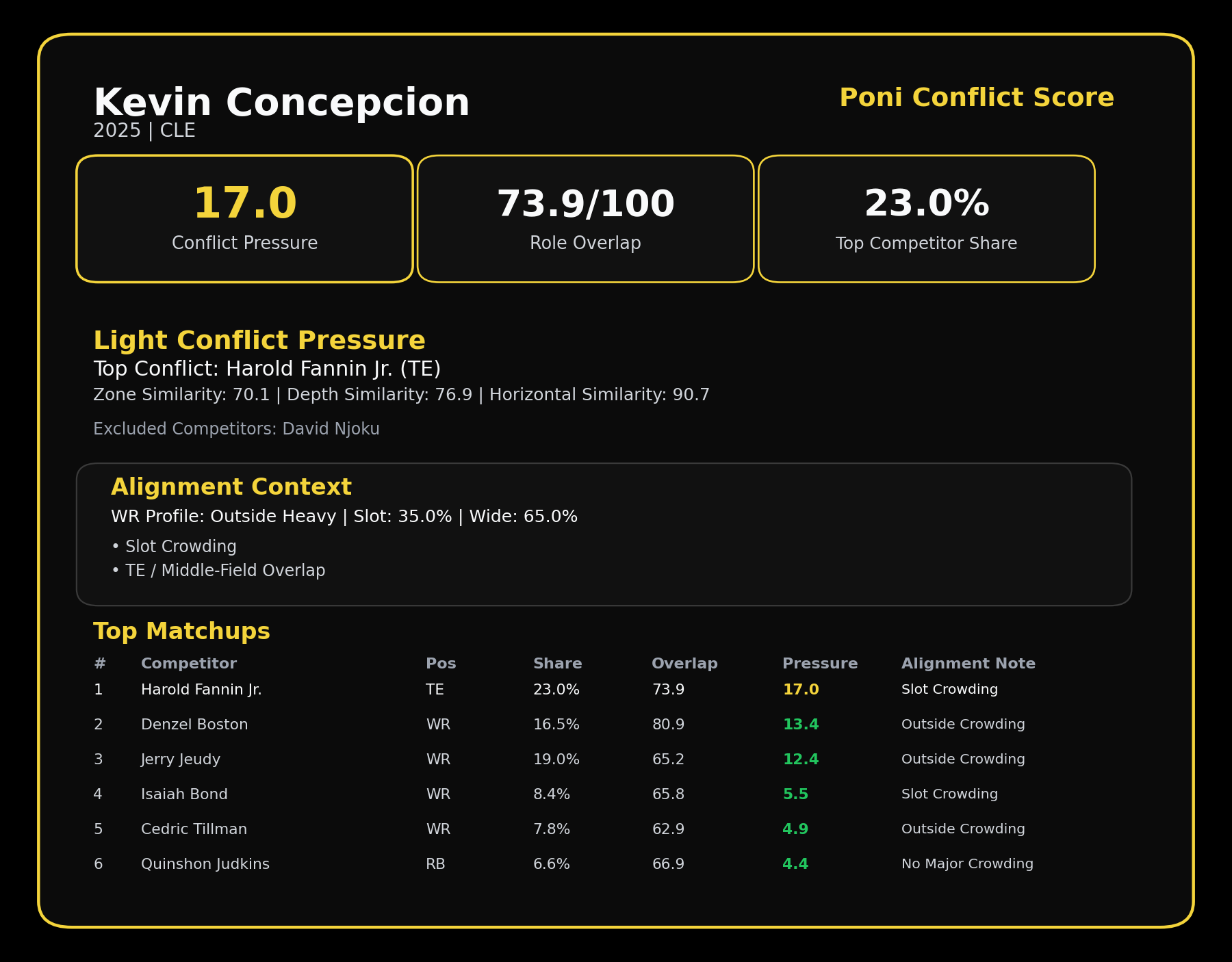
KC Conflict Card
I went back and compared KC to Zay Flowers college profile to see how different they might be. The glaring difference I noticed was that Zay was much more of an intermediate/deep threat (49%). I could easily see Monken playing Concepcion at the Z and Denzel Boston at X. Their archetypes align with these roles perfectly. The question will come down to if Concepcion plays on 13 personnel sets. If he does, this is easily the best role on that offense. Simply due to opportunities, his rookie receiving production should easily be better than Coopers and potentially top 3 in the class. There is a path to early production.
Final Takeaway
While Concepcion didn't profile well in my model, there are a lot of green flags. He has a direct path to the wide receiver one role, he has 1st round draft capital, and he is an good fit in the Todd Monken offense.
Just be aware, that in a Monken offense his ceiling is Zay Flowers. Basically a WR2 who averaged 10.8 PPG throughout his career. This might sound good, but Zay had Lamar Jackson throwing him passes. At his current ADP of pick 6, it just feels gross.
Additional Note
KC is the first big analytical tier break using career zone YPRR of below a 2.2. Over the past 10 years, of 1st and 2nd round WR picks, only BTJ has broken the 1000+ reciving yard threshold in their career. Other than him, Chase Claypool and Van Jefferson are the only other two to show up who cleared 600+ yards. So 3 people total!
When you look across all drafted WRs, career Overall/Zone/Man YPRR does not create a clean universal threshold. This is due to Puka, ARSB, Tyreek, etc. BUT, once you drop late WR outlier hits around pick 100+, it becomes a much stronger separator.
After dropping late-round outlier hits (pick 100+):
WRs below 2.2 career zone YPRR hit 600+ yards at 8.0% (7/88), vs 36.6% (49/134) above it.
WRs below 2.2 career Zone YPRR hit 1,000+ yards at just 4.3% (4/93), vs 20.6% (29/141) above it.
This means that the odds say, if you miss this threshold within the top 100 picks, your likelihood of being a fantasy relevant WR is bleak. Below is the 2026 WR class and their career YPRR for reference.
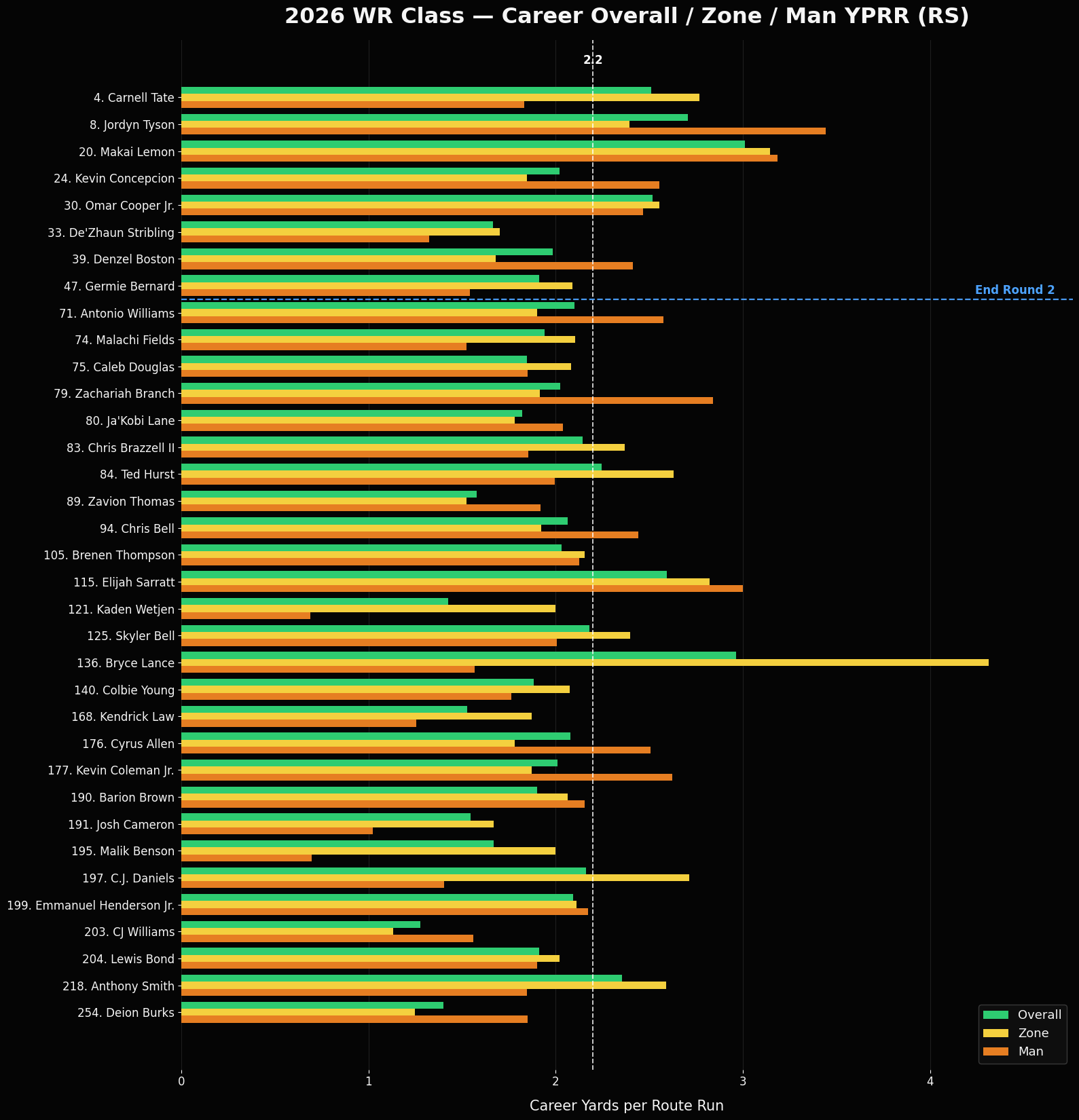
2026 Draft Class Career YPRR
This got me curious so I went back and looked at older classes. This is how it turned out with players within the top 100 picks and below the 2.2 career zone YPRR threshold:
2026: 11
2025: 4
2024: 7
2023: 4
2022: 2
2021: 2
This tells you how bad this WR class is. It also tells you to hold onto your WR studs in dynasty and how much we need the 2027 class to get here!
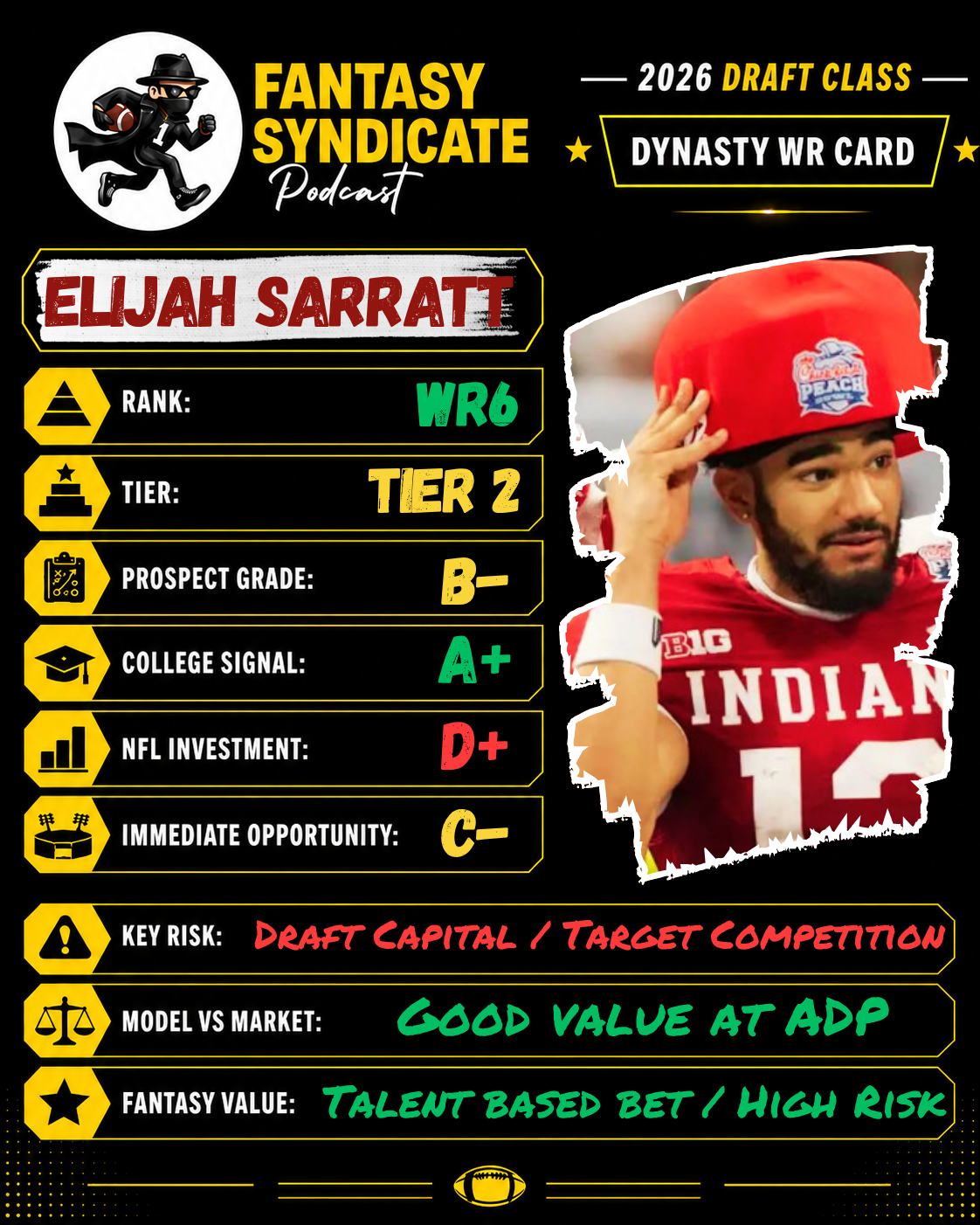
Tier 2 - WR6 Elijah Sarratt Baltimore Ravens
The Model
Honestly, this is more of me calling my shot and ego pick than anything else. A sane person would see this pick, scoff at it, and move on. But damn does my model love Sarratt. While I didn't beautify this image, these are the top 12 college adjusted profiles from my model 2016-2025. Right at the end of that elite list, to both our surprise Elijah Sarratt. As you can imagine he checks all the college production indicators I am looking for in a receiver. Literally, the only thing missing is draft capital.
Also, his nickname is "Waffle House" because he is "always open". You can’t fade a guy with that nickname.
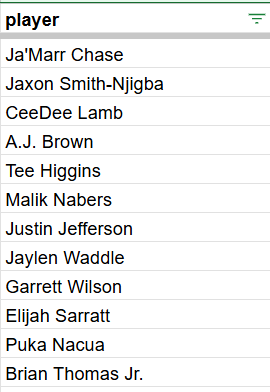
Spreadsheet screenshot
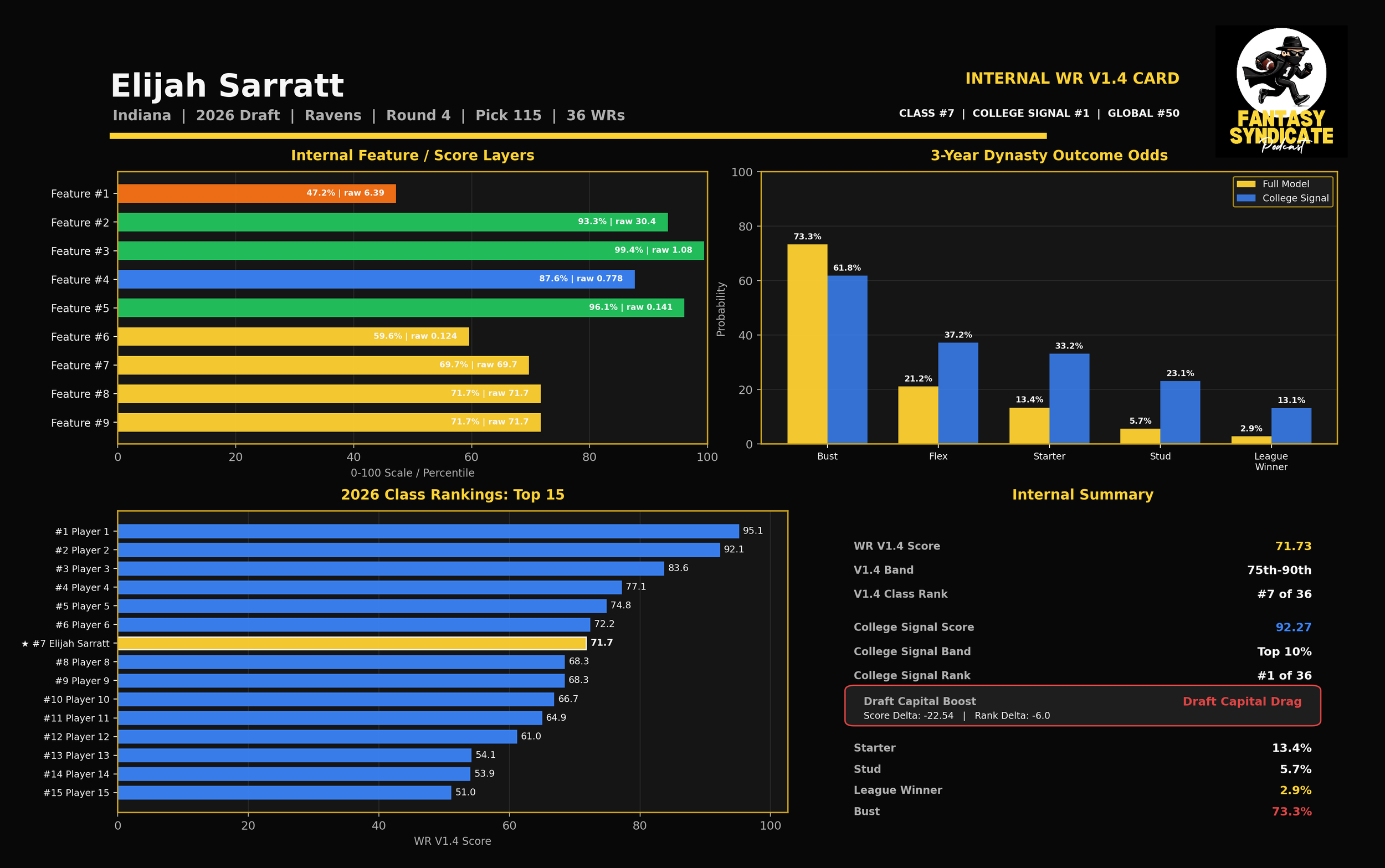
Elijah Sarratt v1.4 WR Player Card
Draft Capital
Sarratt was drafted by the Baltimore Ravens at pick 115. He was actually taken after Jakobi Lane who went 35 picks before Sarratt at pick 80. The draft capital is terrible. Falling out of the first two rounds is normally a death sentence. Unfortunately, he even fell out of the top 100, making it even worse. Add that Sarratt wasn't even their #1 but #2 WR in the class. He is going to have to fight and separate himself in camp early to earn a spot. It is going to be an uphill battle that 9 times out of 10, draft capital wins, and the player loses. This is a risky pick, but he is so damn good.
College Production
Below is a breakdown of all four years of his college production.
Freshman: Saint Francis University, 42 receptions, 700 yards, 13 touchdowns.
Yes, I understand this is a D3 but I’m absolutely counting it.
Sophomore: James Madison University, 82 receptions, 1191 yards, 8 touchdowns
Yes, it's at JMU…I DO NOT CARE.
Junior: Indiana University, 53 receptions, 957 yards, 8 touchdowns
WR1, ahead of 1st round draft pick Omar Cooper Jr.
Senior: Indiana University, 65 receptions, 830 yards, 15 touchdowns
Missed 3 games.
The trend that you noticed from Sarratt is that he dominates wherever he goes. Do you want a wide receiver who has a history of being one of the best players on his team, regardless if it's D3, G5, or the Big Ten? I do.
He arguably out alphaed 1st round pick Omar Cooper Jr. for multiple years, met the breakout age sleeper threshold, is clearly a dog, has a nose for the endzone, and fits exceptionally well alongside Zay Flowers and Lamar Jackson.
Just counting FBS schools, he finished his career with 200 receptions, 2,978 yards, and an absolutely silly 31 touchdowns. While touchdowns aren’t typically sticky, having elite red-zone prowess and physical, contested-catch ability is. At Indiana he accounted for 23% team target share, 23% team receptions, 23% team receiving yard share, and 19% team receiving TD share. He finished his career with 3.03 YPRR vs man and 2.24 YPRR vs zone.
He has produced every single year, meets all the thresholds, has the talent, showed he can dominate at each level of the sport, and has everything we want in a prospect. The only thing missing is draft capital. That screams sleeper pick to me.
Key Concerns & What I Like
Clearly, the biggest concern is draft capital. Late round wide receivers are normally terrible bets. If this was a year ago, I would have told you to not even think about it because its a late round WR.
Sarratt and Lane were both players who were mostly outside receivers in their last college season (Lane 80%, Sarratt 86%). So from an alignment standpoint, they conflict. But the usage map tells us Sarratt is stronger with Lamar in a key area. His Poni Fit Score was 84/100, which was close to a great fit.
Sarratt’s top depth area was intermediate, with 39.6% of his targets coming there and 56.1% of his usage came in the intermediate/deep areas. Lamar ranked 6th out of 45 quarterbacks in intermediate attempt share. There is real usage overlap here. I truly wonder if the reason for the Ravens to go back to back with wide receiver picks in the 3rd and then 4th round, was because of Sarratt's fit and their shock at him falling. Lane’s main depth usage was short. He also was never the best wide receiver on his team in college (1st round pick Makai Lemon). Sarratt looks like the better match to one of Lamar’s stronger passing areas.
Depth of targets (Slot: 16.1%, Wide: 83.9%):
Deep: 16.5%
Intermediate: 39.6%
Short: 38.3%
BLOS: 5.6%
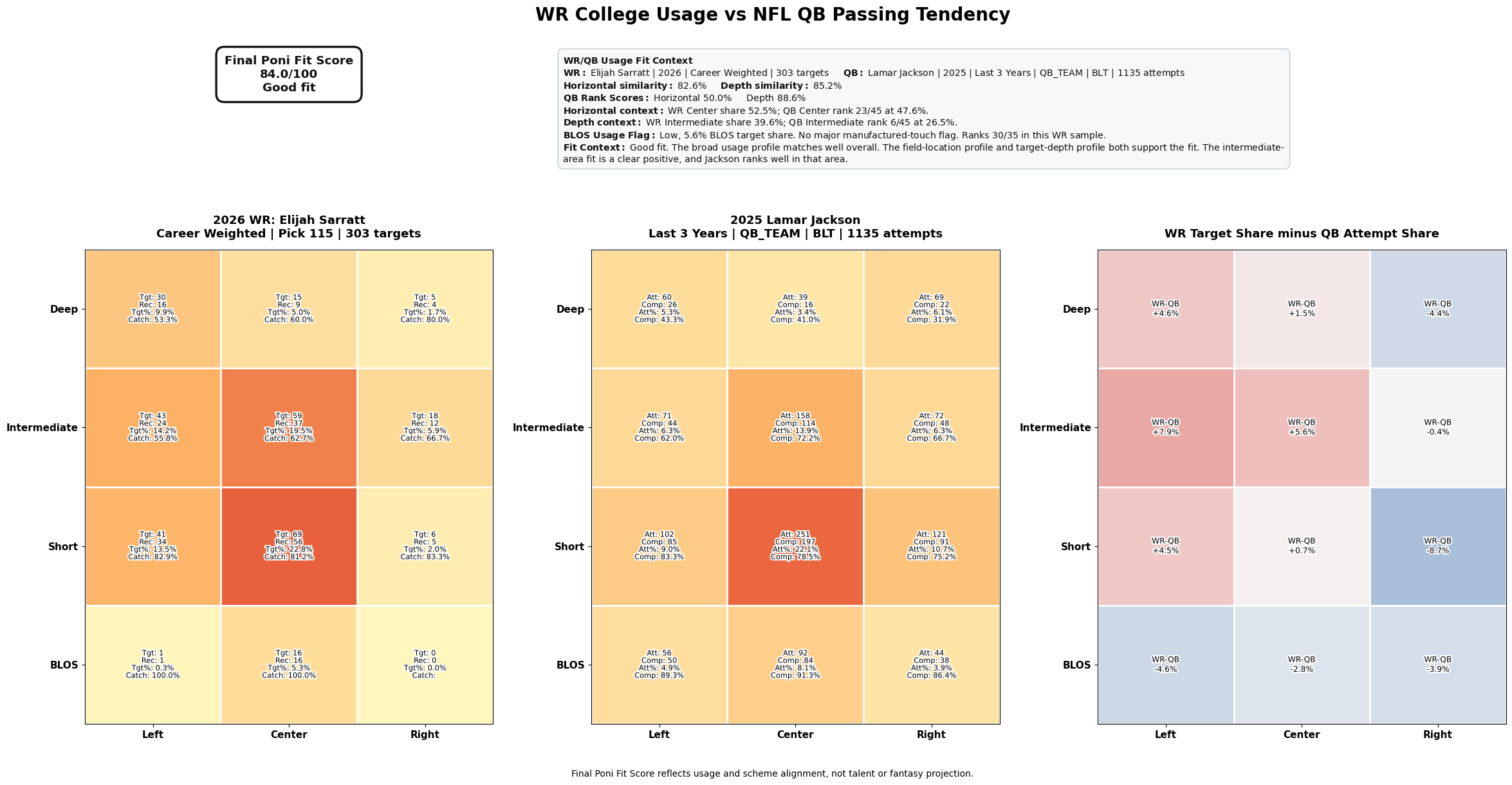
Elijah Sarratt & Lamar Jackson 12-Zone Usage Map
Zay Flowers and Rashod Bateman are the real conflicts. Zay alone has a conflict pressure score of 21, which is a strong conflict. They match up on 89% of their depth usage and 82% on horizontal usage. They would essentially be competing for the same targets. This might sound crazy, but I believe there is a route for Sarratt to take over as the alpha. The good news about the situation is that their old OC Todd Monken played 2 or more TE sets at the highest in the league. With new OC Declan Doyle, all the wide receivers should have breathing room to get on the field more consistently.
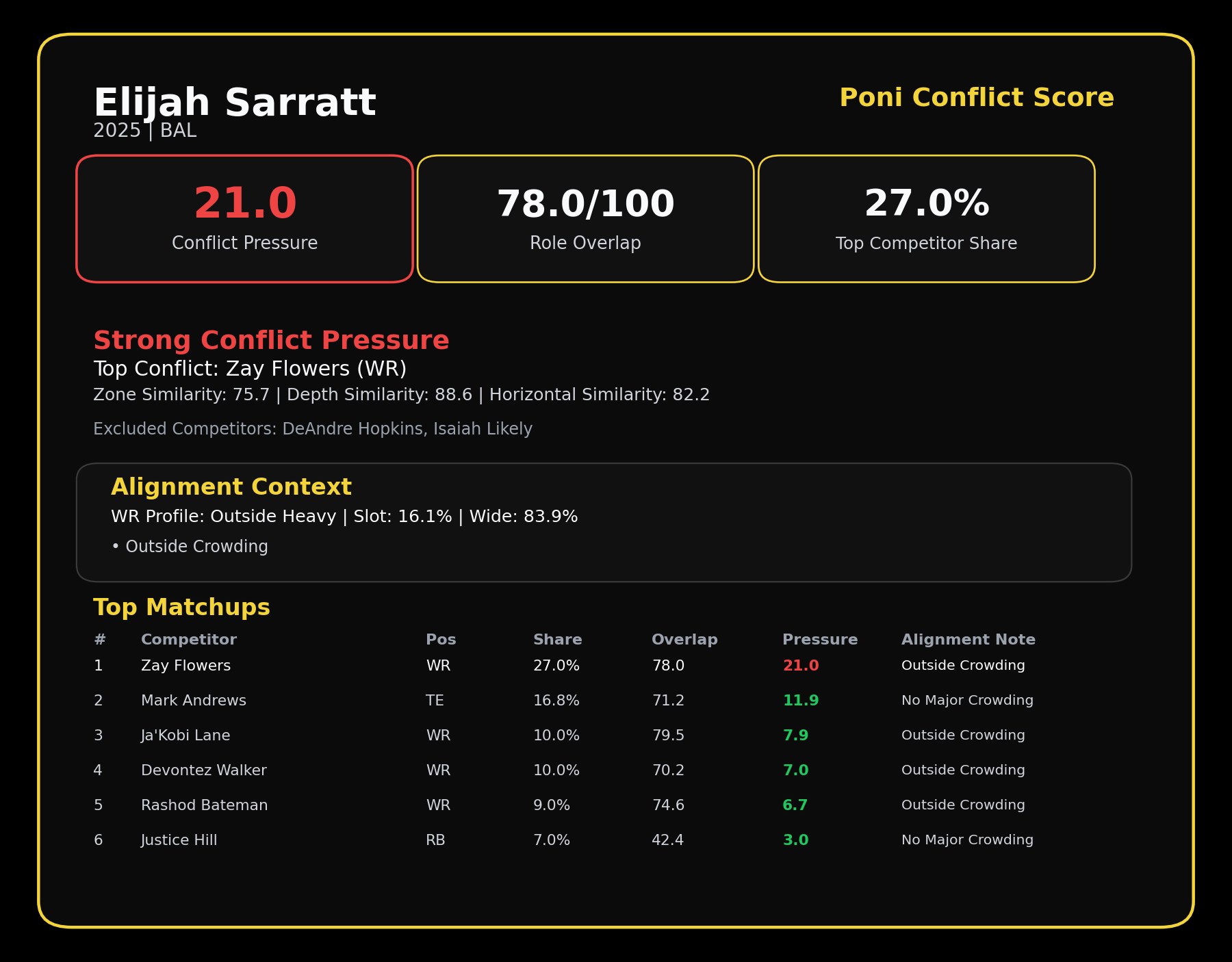
Elijah Sarratt Conflict Card
Final Takeaway
This is a very risky pick, but Sarratt checks a lot of my boxes. The most important box for me is that he is a good football player. Sarratt meets that through his profile, film, career stats, and career path. Lamar Jackson being his quarterback is just a bonus.
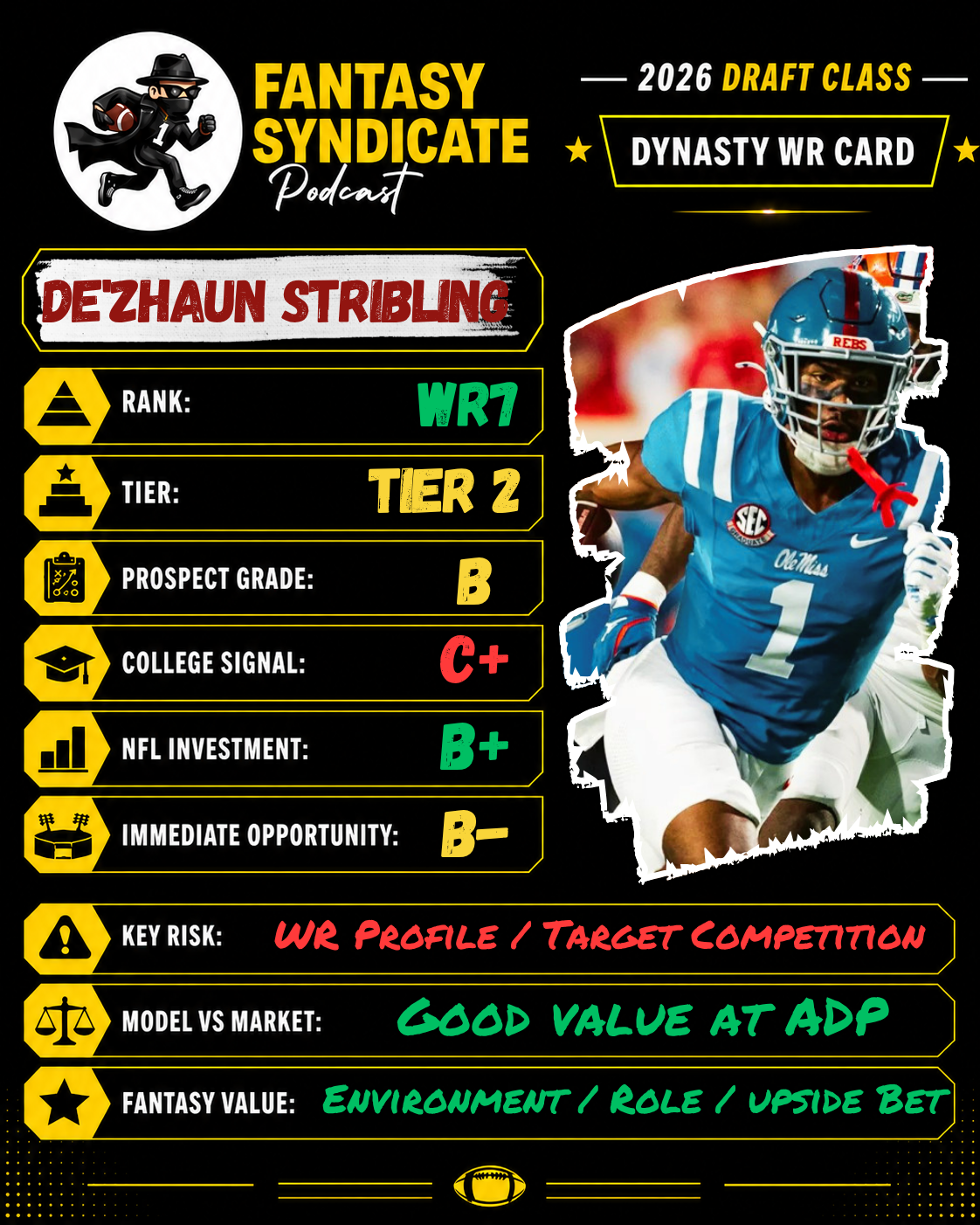
Tier 2 - WR7 De'Zhaun Stribling
San Francisco 49ers
The Model
Stribling came in as WR6 in the class according to the model. He had a mixed bag when it came to efficiency, target conversion/hands profiles, and elusiveness. His efficiency was his best trait. This appears to be another college prospect propped up by draft capital. He was another player with a “Major Review” tag. When you zoom out and look at his overall analytics, it gets even worse.
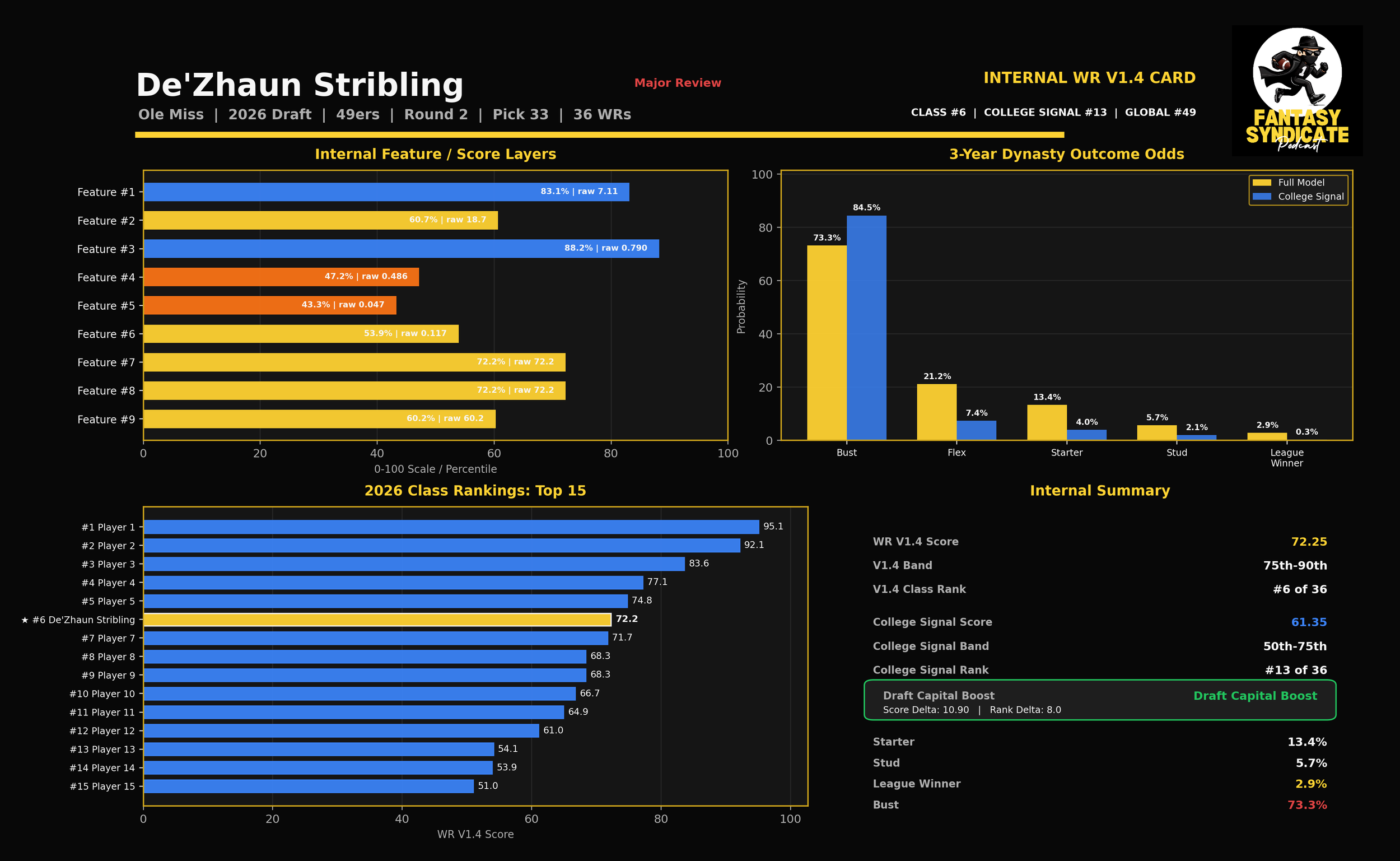
De'Zhaun Stribling v1.4 WR Player Card
Draft Capital
The 49ers drafted Striblingat pick 33 after they traded back twice, out of the first round. Other than Ty Simpson being taken with pick 13, this was the second biggest headscratcher early in the draft. Many felt they reached on him and the model would agree. Just like we say in fantasy, you need to take your guys. Even if it isn't a consensus or matching ADP. The 49ers do that pretty much every year, and they are easily one of the worst drafting teams with high picks in the entire NFL. As a Niners fan, I hate it.
College Production
As a freshman with Washington State he put on a strong performance with 471 receiving yards and 5 touchdowns. He then followed it up with 602 yards and 5TDs as a sophomore, which doesn't seem like much, but he led his team with Cam Ward at the helm. Things were looking promising going into junior year.
He then transferred to Oklahoma State and was injured in week 4 in 2023. He then came back strong with Oklahoma State as a redshirt junior, leading his team with 882 receiving yards.
For his final transfer he went to Ole Miss, finishing with a 55/811/6 stat line. The main issue is that Harrison Wallace out performed him in receiving yards and receptions. You are probably thinking, who is that guy? He was signed as an URFA by the Cardinals after the draft. Yep, terrible.
Stribling played with three different teams over 5 years. Entering the league as a 23 year old super senior. Who really never dominated on his team with little receiving competition. These are huge reg flags. His final year YPRR vs man was 2.50 and YPRR vs zone was 1.99. His career YPRR vs man and zone is one of the worst in the ENTIRE draft class.
Key Concerns
For me, the biggest concern is his college profile due to everything I just went over. So you're probably wondering why I ranked him so high. There are actually a couple of reasons to like this pick, and it doesn't have to do with his production profile.
Kyle Shanahan is the first reason. He poops out WR1s, RB1s, TE1s at one of the highest rates in the league. It literally does not matter who plays that role on the team, they produce at a high level.
Brock Purdy and Striblingfit like a glove. Of all the wide receivers in this class, he had the best usage fit with a 85.7 score and strong fit. This is the only reason I can think of as to why Shanahan decided to pick him. He thought he was a great fit in the offense.
Depth of targets (Slot: 18.9%, Wide: 80.6%)
Deep: 18.2%
Intermediate: 32.1%
Short: 40.4%
BLOS: 9.3%
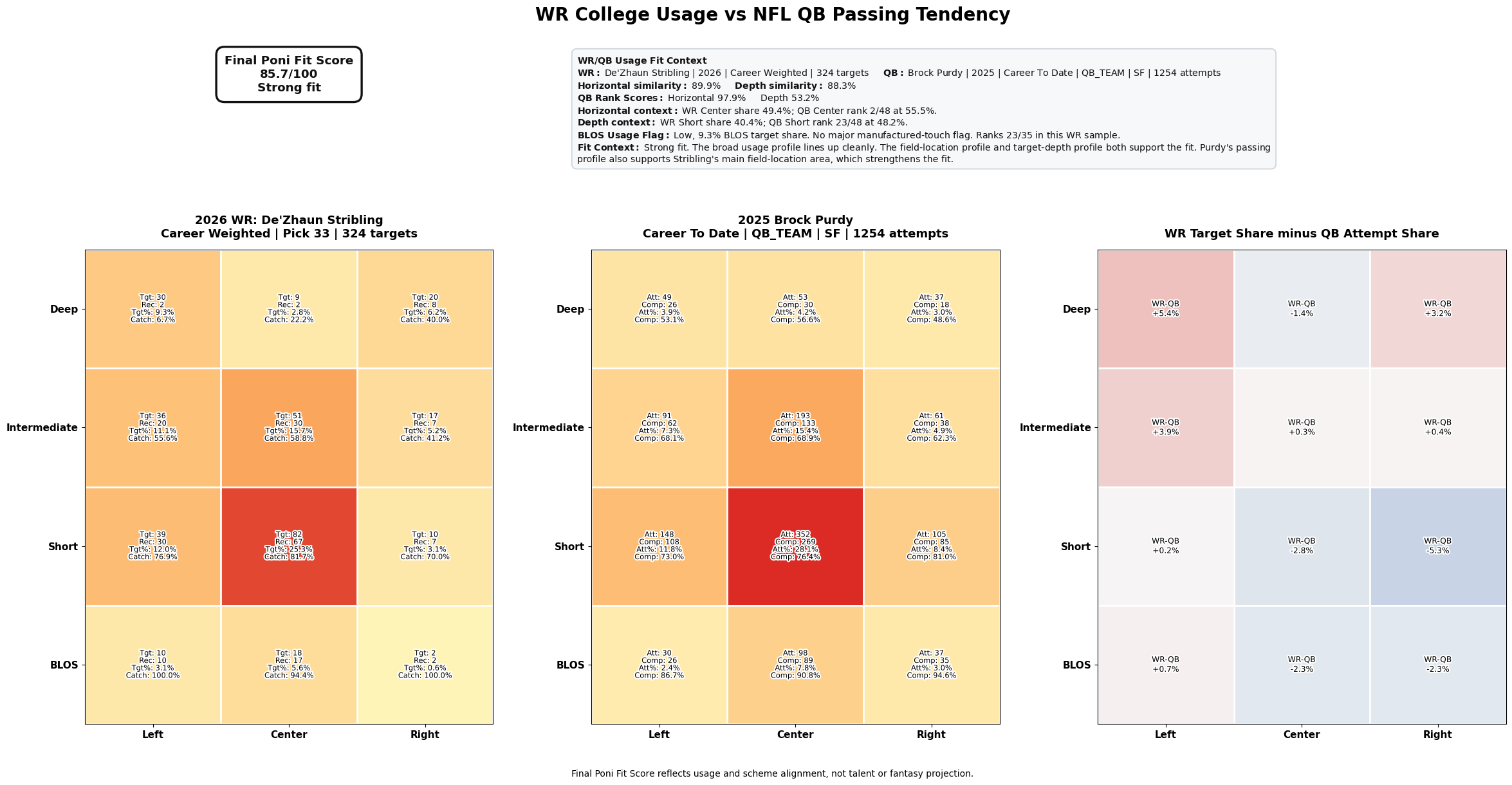
De'Zhaun Stribling & Brock Purdy 12-Zone Usage
The third and final reason I like him is because his path to being the alpha is much better than people believe. While this year looks bleak, it is dynasty and not redraft. George Kittle and Mike Evans are both turning 33 years old this year. Ricky Pearsall has shown flashes, but in a WR room that has been open for the taking, Jauan Jennings out alphaed him for multiple years at the position. I like the path to opportunity, even if everyone else doesn’t.
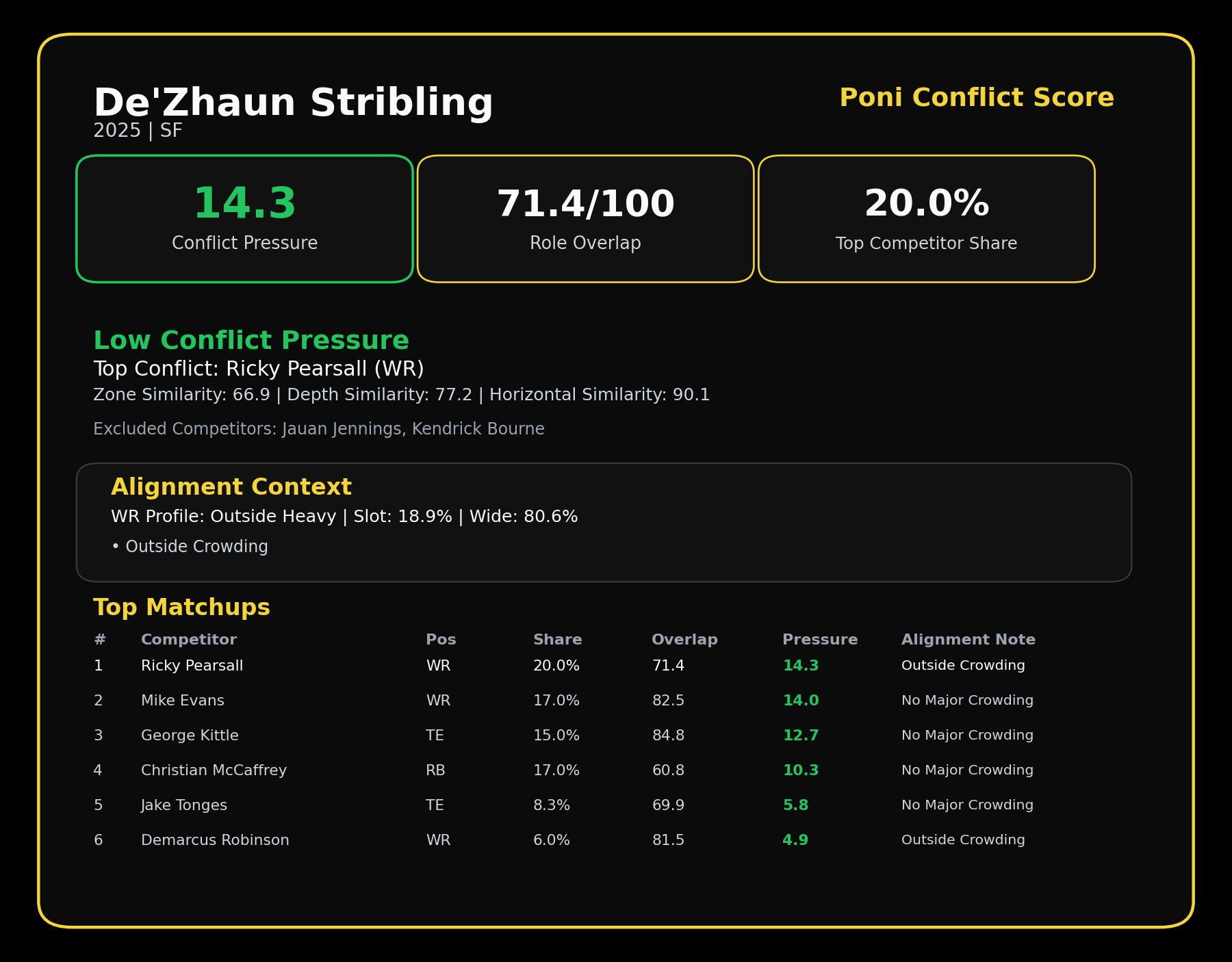
De'Zhaun Stribling Conflict Card
Final Takeaway
This is a clear situation bet over player profile. It is the reason he comes in at the end of my tier 2. Even if you hate the player, you cannot ignore how juicy of a situation he falls into with the insane upside potential. And I love upside.
Tier 3: Lets Role the Dice
This tier and basically every other tier below this, we are really getting into risky territory. We remember Tyreek Hill, Amon-Ra St. Brown, and the Puka Nacua’s of the world. But in reality, these are the exception, not the rule. Any wide receiver taken outside the 1st or 2nd round have around a 3-5% chance of making a real fantasy impact long term. The good news is that we have some solid talent and opportunity guys in this tier that you might be able to squeeze some value out of, even if it isn’t for very long.
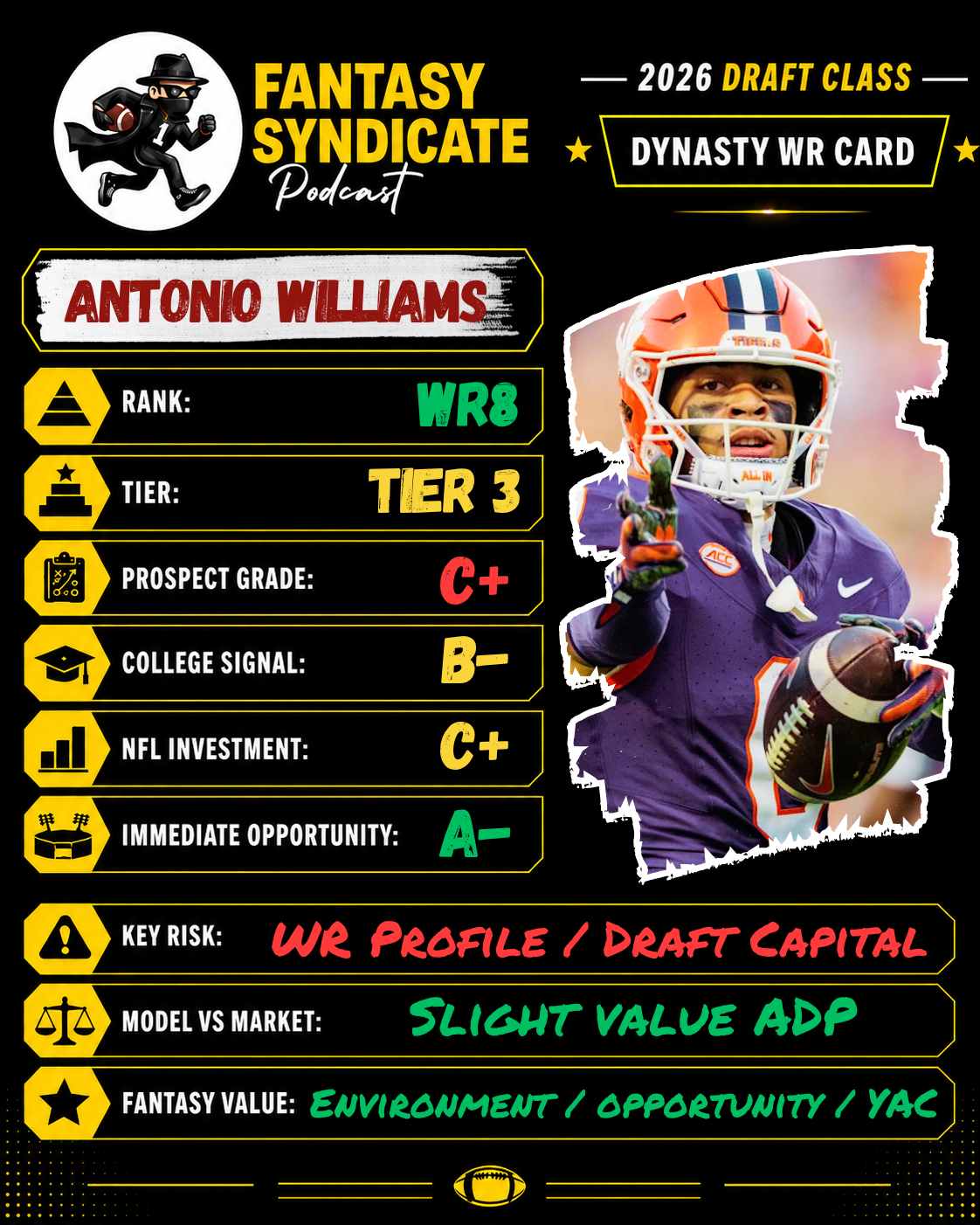
Tier 3 - WR8
Antonio Williams Washington Commanders
The Model
This is the part of the model where things get murky. There ends up being a lot of players closely clustered based on ranking due to a combination of data points. While it can help us identify sleepers and player strengths, it becomes less predictable as a whole. The model has Williams as WR11, but the good news is that he has an overall average profile. His real strength comes from his overall yard after catch and elusiveness when he has the ball. While he didn't lead the league in overall yards after catch, his YAC efficiency was on par with Omar Cooper Jr. when he had the ball. This is where the model likes Williams, and why I have him starting my tier 3.
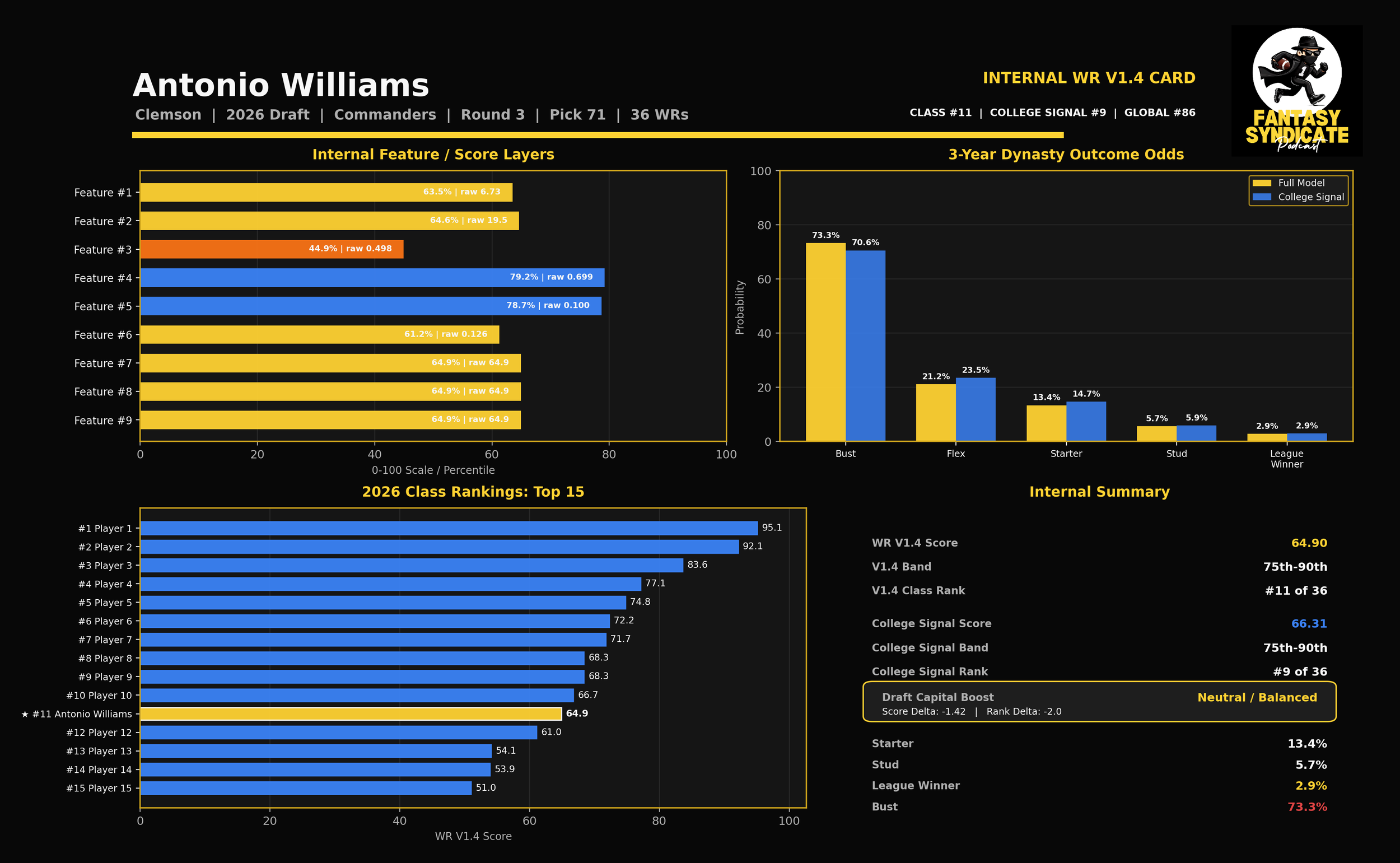
Antonio Williams V1.4 Player Card
Draft Capital
The Commanders had two picks within the top 100 this year. They didn't have their 2nd round pick, and they decided to use one of those picks to try and get Jayden Daniels some help. General Manager Adam Peters praised Williams by saying he has “pro-ready route running, separation ability, and competitive toughness.” While the 3rd round draft capital isn't great, in context, it shows that the Commanders had a vision with Williams.
College Production
Unlike many prospects, Williams played all four years of his college career at one location, Clemson. Had he not been riddled with injuries, he would have been a top pick in the 2025 class.
As a true freshman, he led Clemson with 56 receptions and 604 yards. Unfortunately, during his second year he had multiple injuries, only being able to play in 5 games. He returned his junior year, again dominating the receiving room, finishing with 75 receptions, 904 yards, and 11 touchdowns. Again, similar to his junior year, he started the season with a hamstring injury during the season opener, missing multiple games, but then bounced back. He averaged 60 yards a game through the next 9 games, and finished with 55 receptions for 604 yards.
His final year he produced a 2.64 YPRR vs man coverage and 1.98 YPRR vs zone; which aligns with his career profile. He is a man beater and a true slot wide receiver. Ignoring that he is a slot WR, his college situation matches up with Jordyn Tyson. A talented WR who was sidelined by injuries. The Commanders might have gotten a steal.
Key Concerns & What I Like
His draft capital, college profile, and injuries are all a concern. I also don’t love he will predominantly be playing out of the slot. But there is some juicy role fit and opportunity he has in this offense.
Antonio Williams is one of the cleaner usage fits. The reason being is because his college usage lines up with where Jayden Daniels throws the ball!
Jayden Daniels ranked 5th out of 44 quarterbacks passing the ball over the middle of the field. 70% of Williams usage in college came from this part of the field. On top of that, they had a 93% in depth usage alignment. In layman's terms Daniels consistency throws the ball to where Williams thrives. The fit is honestly one of the best in the class.
Depth of targets (Slot: 79%, Wide: 21%)
Deep: 16.3%
Intermediate: 18.7%
Short: 43.3%
BLOS: 21.8%
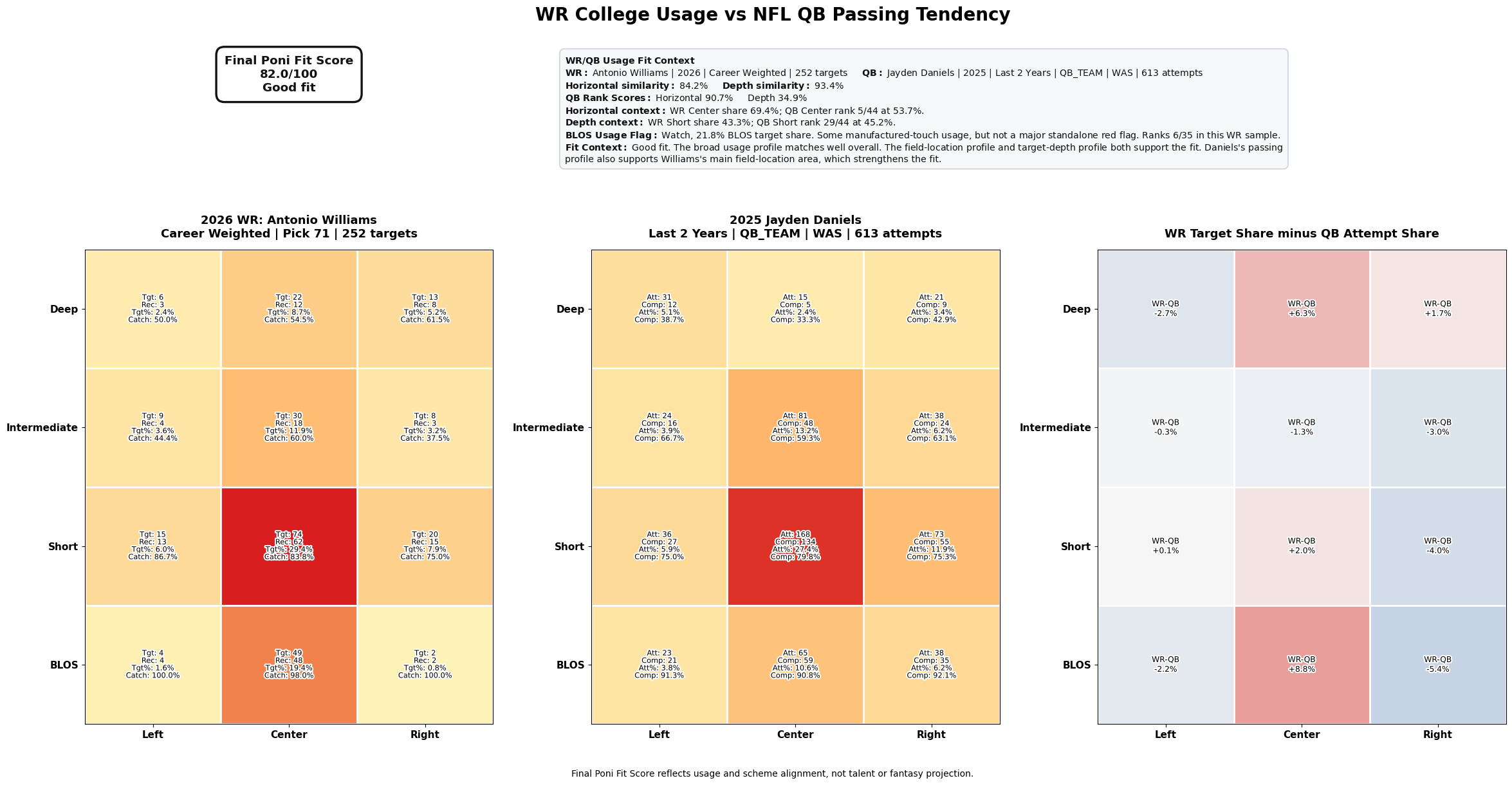
Antonio Williams & Jayden Daniels 12-Zone Usage Map
Due to Williams being a true slot, he will probably be benched during sets that aren't 11 personnel (3WR). The good news is that David Blough is the new offensive coordinator, who has spent time under guys like Ben Johnson in Detroit and Kevin O'Connell in Minnesota. I would imagine he had say in drafting Williams.
I also love the situation and competition he has. He ended up with a low conflict score. Right now, his competition is a 31-year old Scary Terry, Treylon Burks, and Chigoziem Okonkwo. I honestly see Chig as being his biggest role competition (I will be drafting him as a sleeper TE!). Terry and Burks play a completely different role in this offense. If we can see a Deebo esk role, where Williams dominates all the underneath work, he could be an easy value at his current ADP as a rookie.
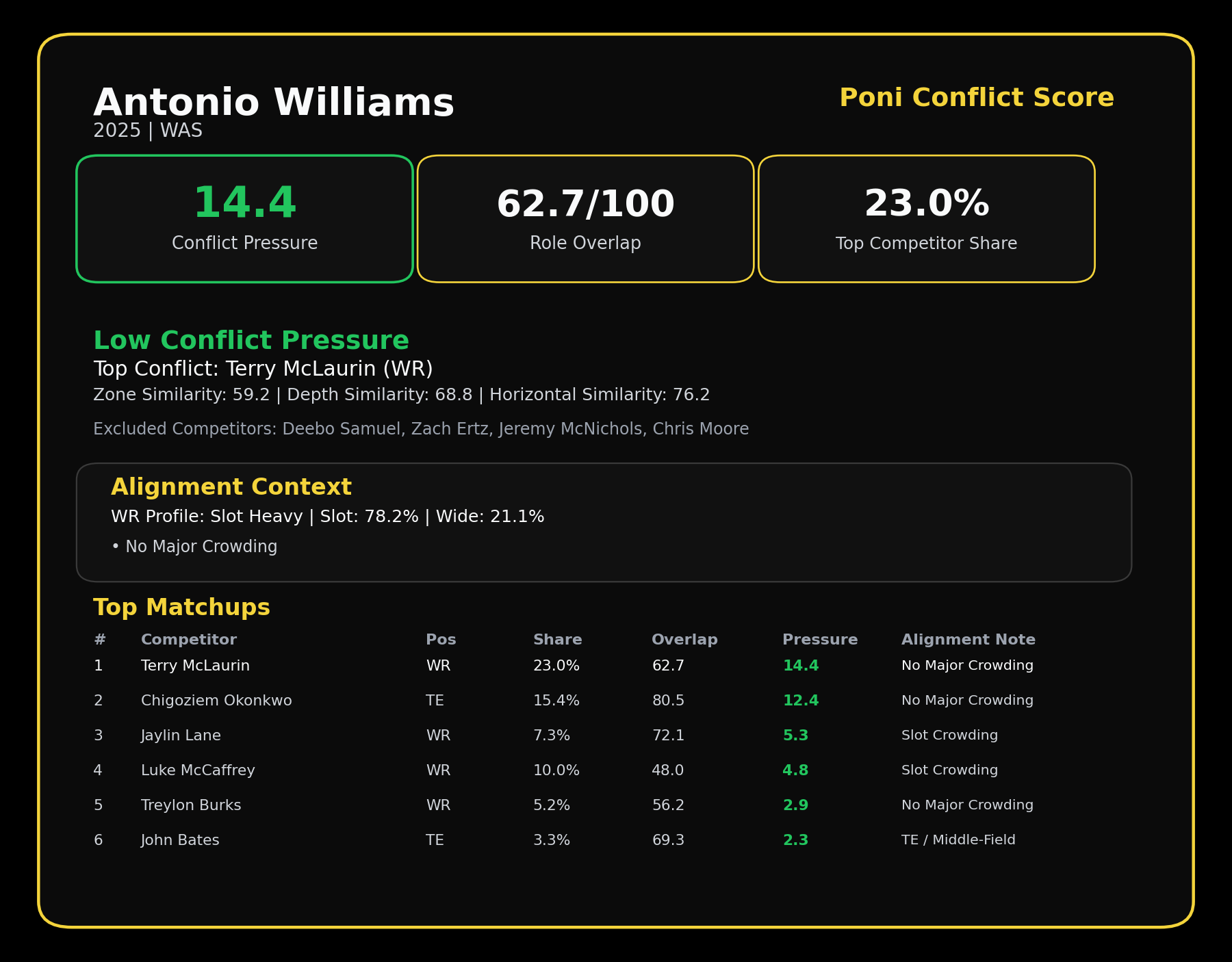
Antonio Williams Conflict Card
Final Takeaway
While his college prospect profile isn’t great, he was derailed by injuries and has a lot of green flags. He is going into one of the best situations from a QB usage standpoint with a clear path to opportunities. Seeing that he is going late in the 2nd round in rookie drafts, he meets the standards of a player that could be significantly more valuable this time next year. I like him as a late flyer.
Williams will be my last full write up, but these are the remainder of my rankings.
Tier 3 - WR9 - Denzel Boston - Cleveland Browns
Everything I said about KC, except Boston profiles much better as the X WR in this offense. He is presented with the opportunity to become the alpha, but has a lower pick grade and isn't a perfect fit in a Monken offense like KC.
Tier 3 - WR10 - Germie Bernard - Pittsburgh Steelers
The Steelers had the best slot WR in the draft stolen. There was a specific plan for Lemon in this offense, and this is where Germie Bernard comes in. He is obviously competing with DK Metcalf (I think his days are numbered) and Michael Pittman, so his upside is capped, but in a Mike McCarthy offense his role will be valuable.
Tier 4: Everyone Else
I won't be doing full write ups on these players, but this is how I would rank them in dynasty. The chance of finding a gem in this group is beyond low, so take your guy. You have just as good of a chance as finding the next Puka as literally any fantasy analysis in the game.
WR11: Chris Bell
WR12: Bryce Lance
WR13: Zachariah Branch
WR14: Kevin Coleman
WR15: CJ Daniels
Thanks for hanging out. If you want to show support go ahead and give us a follow on Youtube, Spotify, Twitter, or Reddit.
The way you win a fantasy championship and get an advantage isn’t by using platforms like FantasyPros. It’s by listening to the little guys that no-one else is. That’s your advantage.
Now go steal a championship!