2026: Wide Receiver Team Fit: The Poni Fit Score & Conflict Pressure Score
I wrote an article about the process and testing I have done to determine if a wide receiver fits with their new team and what competition they have to face. The goal was not to use general team context or narratives (still can be useful), but to use six years of data to help drive a model built around actual fit. Last year, my number one lesson was simple; use data to drive decisions. Analytics over noise.
While the model is far from perfect, it is the only model I have found that uses real usage data to create an analytical player fit score for wide receivers. I’ve coined it the “Poni Fit Score”. The question this score helps answer, is does this receiver’s college role naturally match the way his new offense/QB passes the ball?
If you want to read more about how I came up with the score, you can do that here. But this article is not about the methodology. It is about the 2026 draft class and how the Poni Fit Score views each wide receiver’s new team fit and the Conflict Pressure on the receiving side of the ball.
For a quick recap of my model, I created a 12-zone usage map focused on WR target share (not team target share), looking at depth (BLOS, Short, Intermediate, Deep), horizontal (left, middle, center), and QB tendencies rank vs the field.
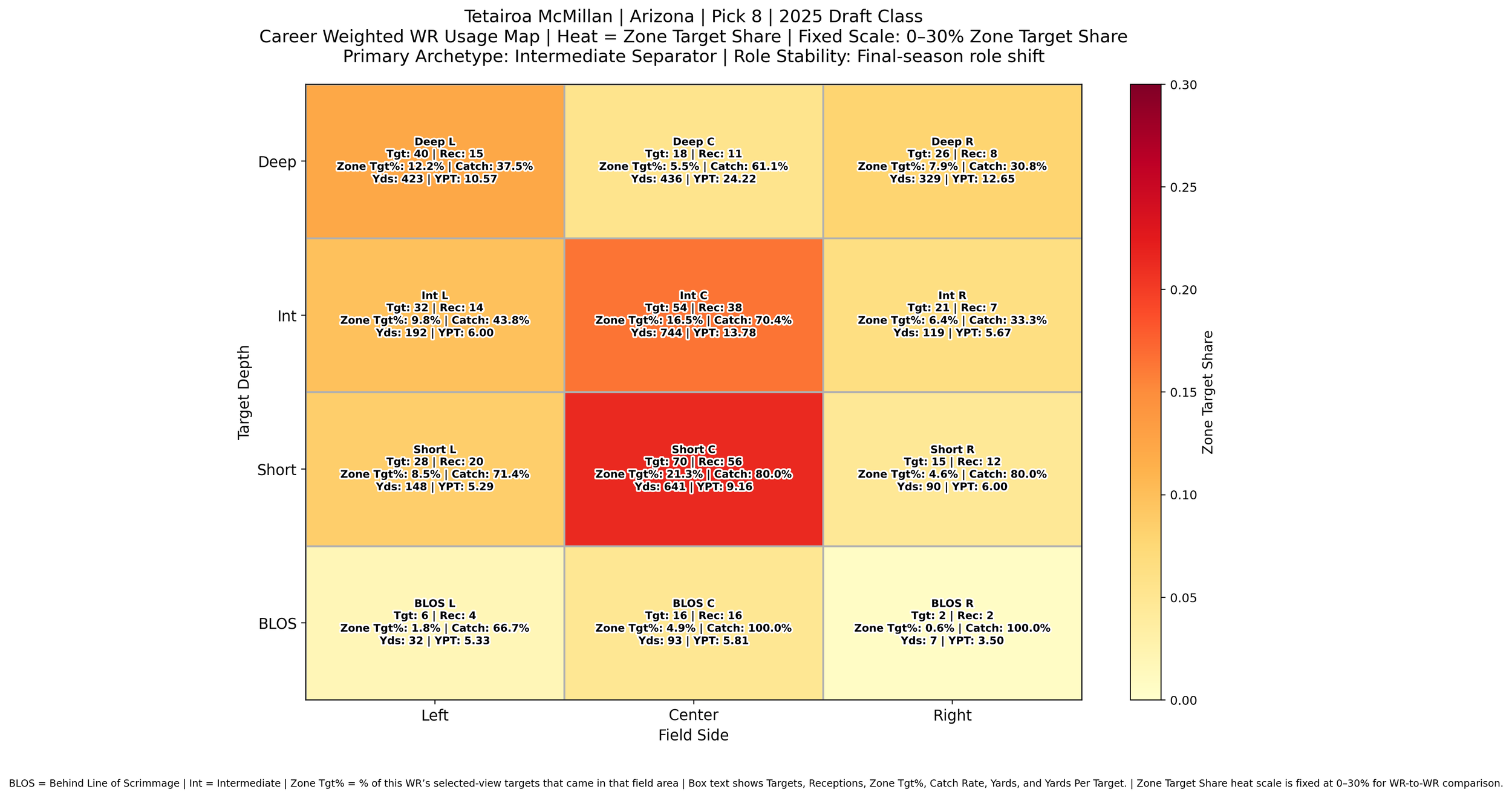
Tetairoa McMillan College Usage 12-Zone Map
These are my scoring ranges:
Strong fit, 85+
The WR’s college usage profile lines up very well with the QB/team passing tendency. His role should not require a major usage adjustment based on alignment and depth profile.Good fit, 78–84.9
The WR has a clear usage match with the QB/team, but it is not perfect. The main parts of his role translate well, though there may be one area where the fit is less clean.Neutral/mixed fit, 70–77.9
The fit is workable, but there are clear differences between the WR’s college usage and the QB/team passing profile. The WR may need to make adjustments, QB tendencies may need to change, or offensive scheme needs to change to best utilize the player’s strengths.Questionable fit, below 70
The WR’s college usage profile does not cleanly match the QB/team passing tendency. This could signal a significant role adjustment, usage uncertainty, or a much less natural scheme fit.
Let’s get into it!
TL;DR Version:
Carnell Tate: Tennessee Titans: Pick 4
Poni Fit Score:81.1/100 - Good Fit
Conflict Pressure Score: 20 - Moderate Conflict
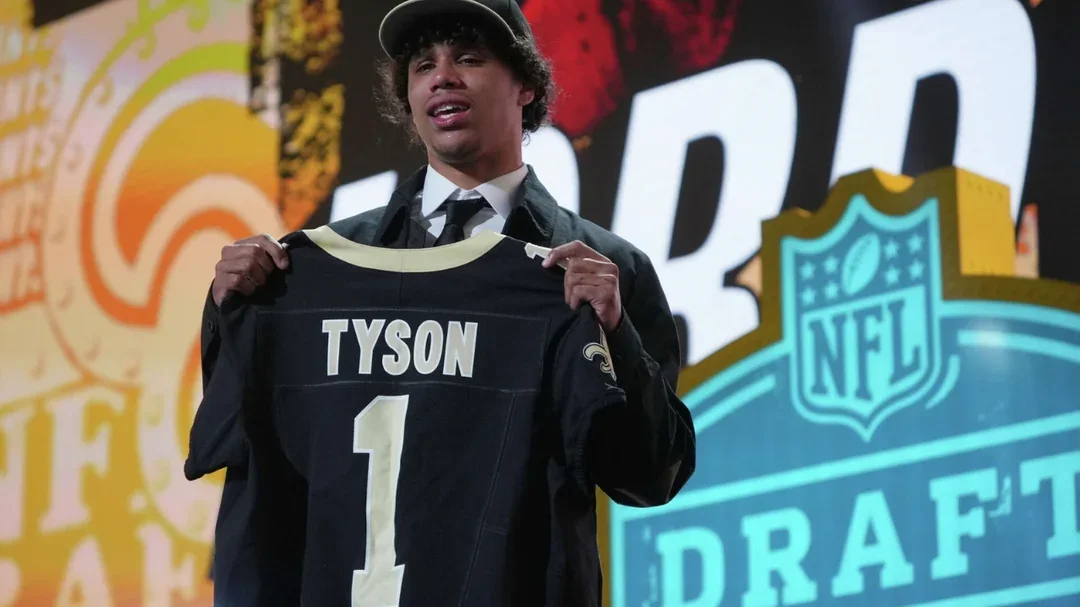
Jordyn Tyson: New Orleans Saints: Pick 8
Poni Fit Score: 83.7/100 - Good Fit
Conflict Pressure Score:21.4 - Strong Conflict
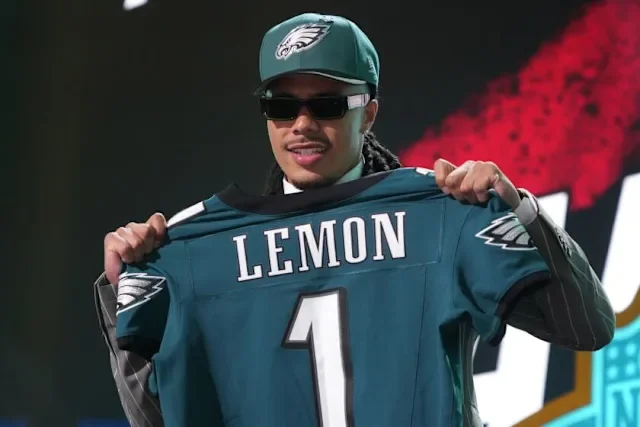
Makai Lemon: Philadelphia Eagles: Pick 20
Poni Fit Score: 76.0/100 - Neutral/Mixed Fit
Conflict Pressure Score:19.5 - Moderate Conflict
KC Concepcion: Cleveland Browns: Pick 24
Poni Fit Score: 80.2/100 - Good Fit
Conflict Pressure Score:17 - Light Conflict
Omar Cooper Jr.: New York Jets: Pick 30
Poni Fit Score:72.2/100 - Mixed/Neutral Fit
Conflict Pressure Score:19.4 - Moderate Conflict
De'Zhaun Stribling: San Francisco 49ers: Pick 33
Poni Fit Score: 85.7/100 - Strong Fit
Conflict Pressure Score: 14.3 - Low Conflict
Denzel Boston: Cleveland Browns: Pick 39
Poni Fit Score: 82.8/100 - Good Fit
Conflict Pressure Score:17 - Light Conflict
Germie Bernard: Pittsburgh Steelers: Pick 47
Poni Fit Score: 79.0/100 - Good Fit (barely)
Conflict Pressure Score: 17.6 - Moderate Conflict
Antonio Williams: Washington Commanders: Pick 71
Poni Fit Score: 82.0/100 - Good Fit
Conflict Pressure Score:14.4 - Low Conflict
Malachi Fields: New York Giants: Pick 74
Poni Fit Score: 78.9/100 - Good Fit (barely)
Conflict Pressure Score: 20.7 - Strong Conflict
Caleb Douglas: Miami Dolphins: Pick 75
*Poni Fit Score: 70.7/100 - Mixed fit/ Neutral (barely)
Conflict Pressure Score: 8.6 - Low Conflict Pressure
Chris Bell: Miami Dolphins: Pick 94
*Poni Fit Score: 66.6/100 - Questionable Fit
Conflict Pressure Score: 9.4 - Low Conflict
Zachariah Branch: Atlanta Falcons: Pick 79
Poni Fit Score: 63.7/100 -Questionable Fit: Michael Penix Jr.
Poni Fit Score: 82.7/100 - Good Fit: Tua Tagovailoa
Conflict Pressure Score: 16 - Light Conflict
Ja'Kobi Lane: Baltimore Ravens: Pick 80
Poni Fit Score: 82.7/100 - Good fit
Conflict Pressure Score:23.2 - Severe Conflict
Elijah Sarratt: Baltimore Ravens: Pick 115
Poni Fit Score: 84.0/100 -Good fit
Conflict Pressure Score: 21 - Strong Conflict
If there is a receiver you are curious about, hit me up on Twitter/X and I’ll be happy to post them.
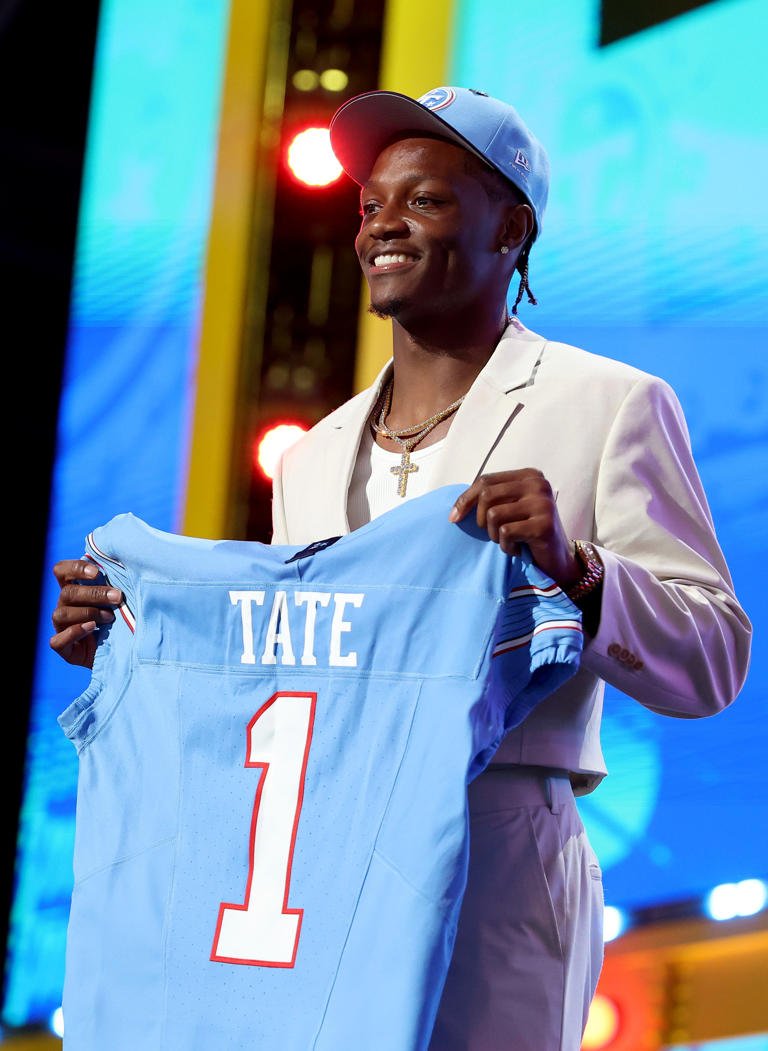
Carnell Tate
Tennessee Titans: Pick 4
Carnell Tate to Cam Ward:
Poni Fit Score: 81.1/100
Fit Label: Good fit
Conflict Pressure Score: 20 - Moderate Conflict
Horizontal similarity: 88.3%
Depth similarity: 83.3%
Horizontal rank sample: 32/39
Depth rank sample: 27/39
BLOS: Low manufactured touches, 10.9%
Carnell Tate comes in as a good fit with Cam Ward, but the new Brian Daboll offense is the part that makes this interesting. The data says Tate should not need a major role change to work with Ward. He was used a lot over the middle of the field in college, and that is where most of his best overlap with Ward shows up.
Tate was not just a screen guy or manufactured-touch player. Only 10.9% of his targets came behind the line of scrimmage, while more than half of his usage came in the intermediate and deep areas. He has a real route-running profile, and if Daboll builds this offense around Ward’s strengths while giving Tate access to the middle of the field, this landing spot could work quickly.
This is a positive fit, but not a flawless one. Ward was not one of the most middle-of-the-field-heavy quarterbacks in the sample, but the overall match is still strong. The model likes the usage overlap, and Daboll gives the offense a chance to evolve.
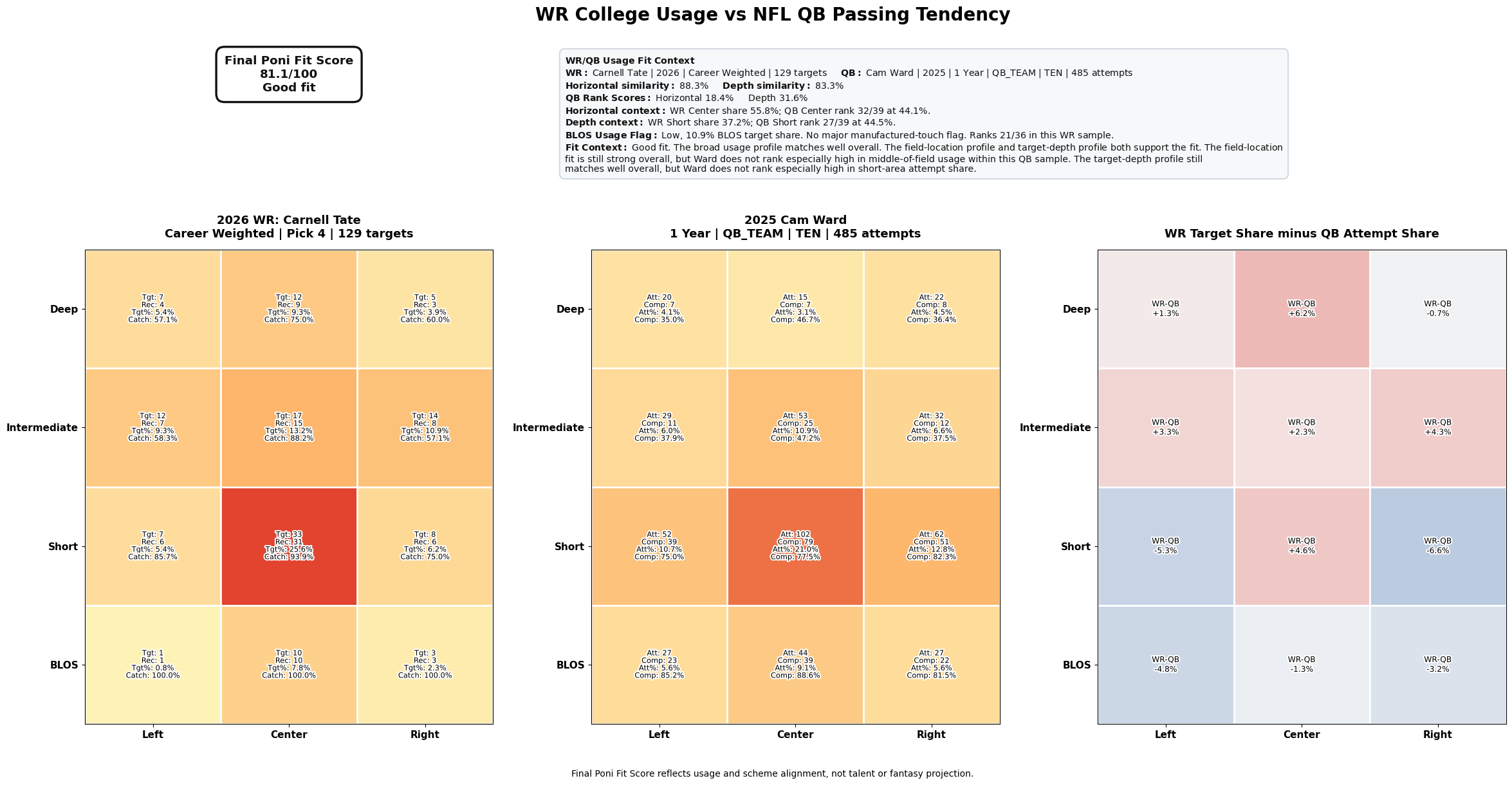
Carnell Tate & Cam Ward 12-Zone Map
For fantasy, I would view Tate as a strong talent and in a good fit. The biggest swing factor being the Wan'Dale Robinson competition and how quickly Tennessee lets him become a real part of the passing game. Spoiler alert…
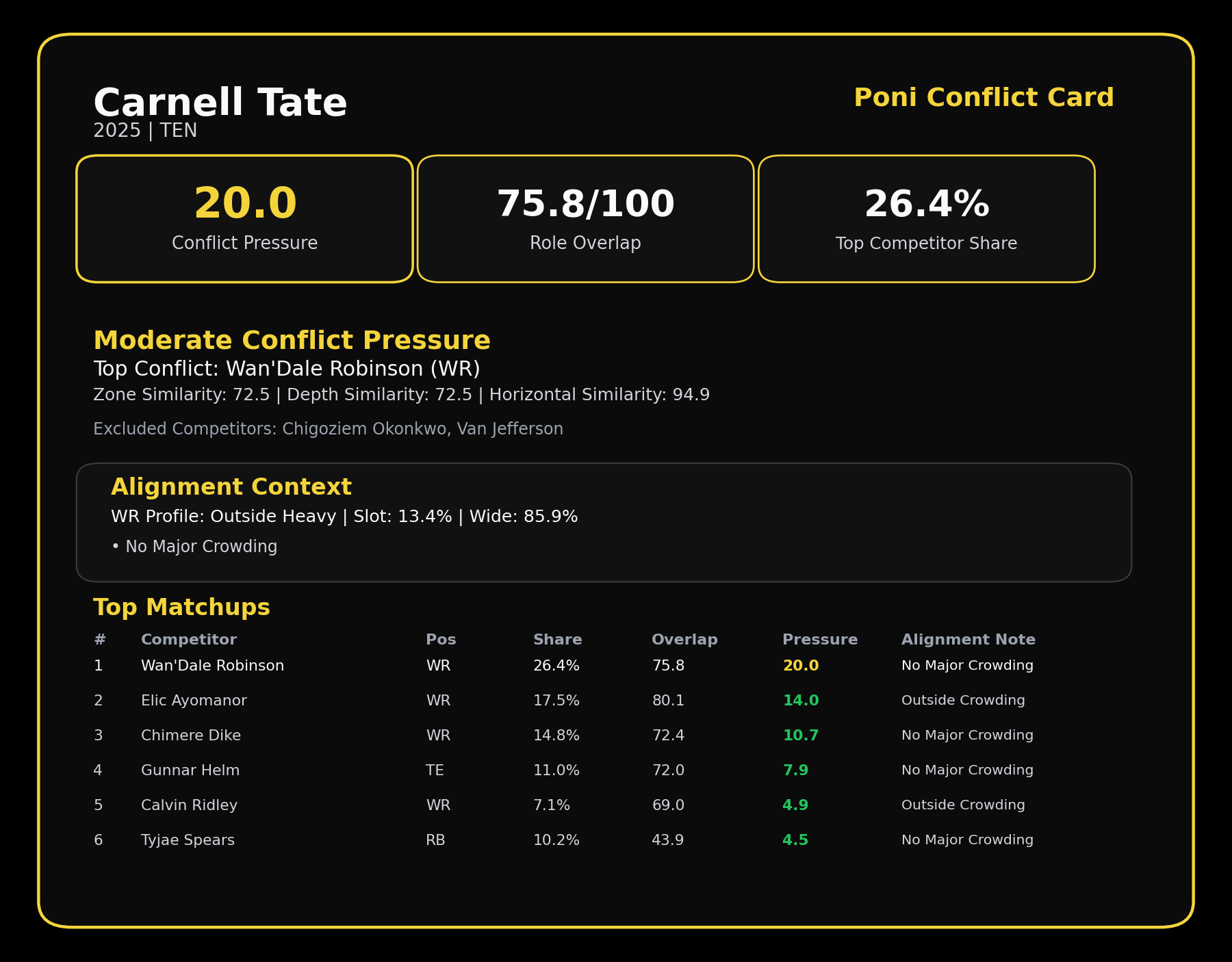
Carnell Tate Conflict Card
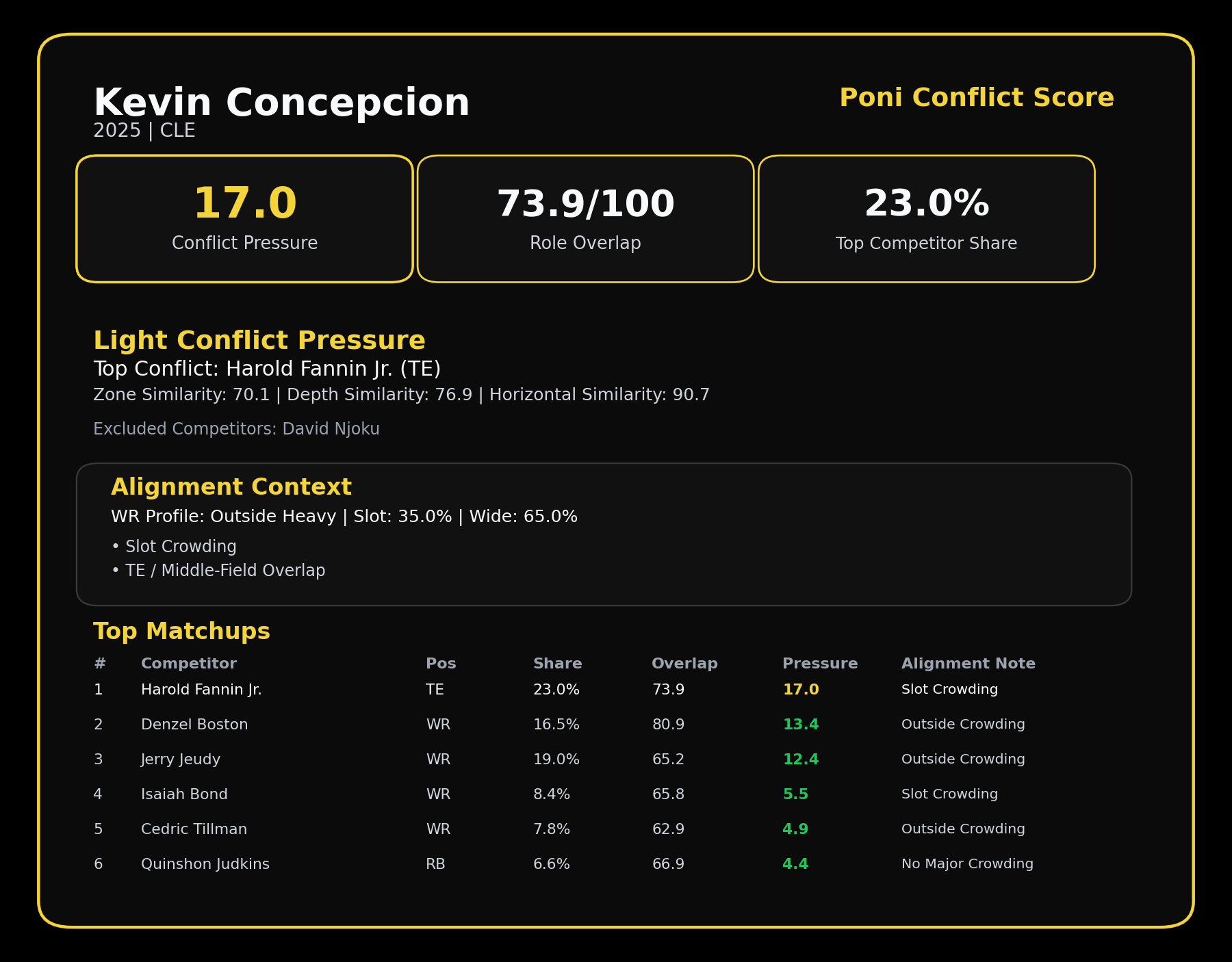
Wan’Dale Robinson is serious target competition for Tate. He just signed a big money deal, reunited with his last offensive coach Brian Daboll, and is going into year 5 (prime window of most wide receivers careers). The good news is that there is significantly less role overlap in usage. Especially when we talk about the usage depth. This sets up a nice opportunity for the duo to work together. Ideally, this will help both to be successful. The bigger threat in role and usage is Elic Ayomanor.
The competition is seriously solid but there's a route where both Robinson and Tate can find success. It’ll be up to Cam Ward and the offense to take that step this year. If not, we might end up with another year with my #1 rule from 2025 comes into play; “Don’t ever start any Titans players!”.
Jordyn Tyson
New Orleans, Saints: Pick 8
Jordyn Tyson to Tyler Shough:
Poni Fit Score: 83.7/100
Fit Label: Good fit
Conflict Pressure Score: 21.4 - Strong Conflict
Horizontal similarity: 87.6%
Depth similarity: 81.0%
Horizontal rank sample: 33/39
Depth rank sample: 13/39
BLOS: Low manufactured touches, 14.1%
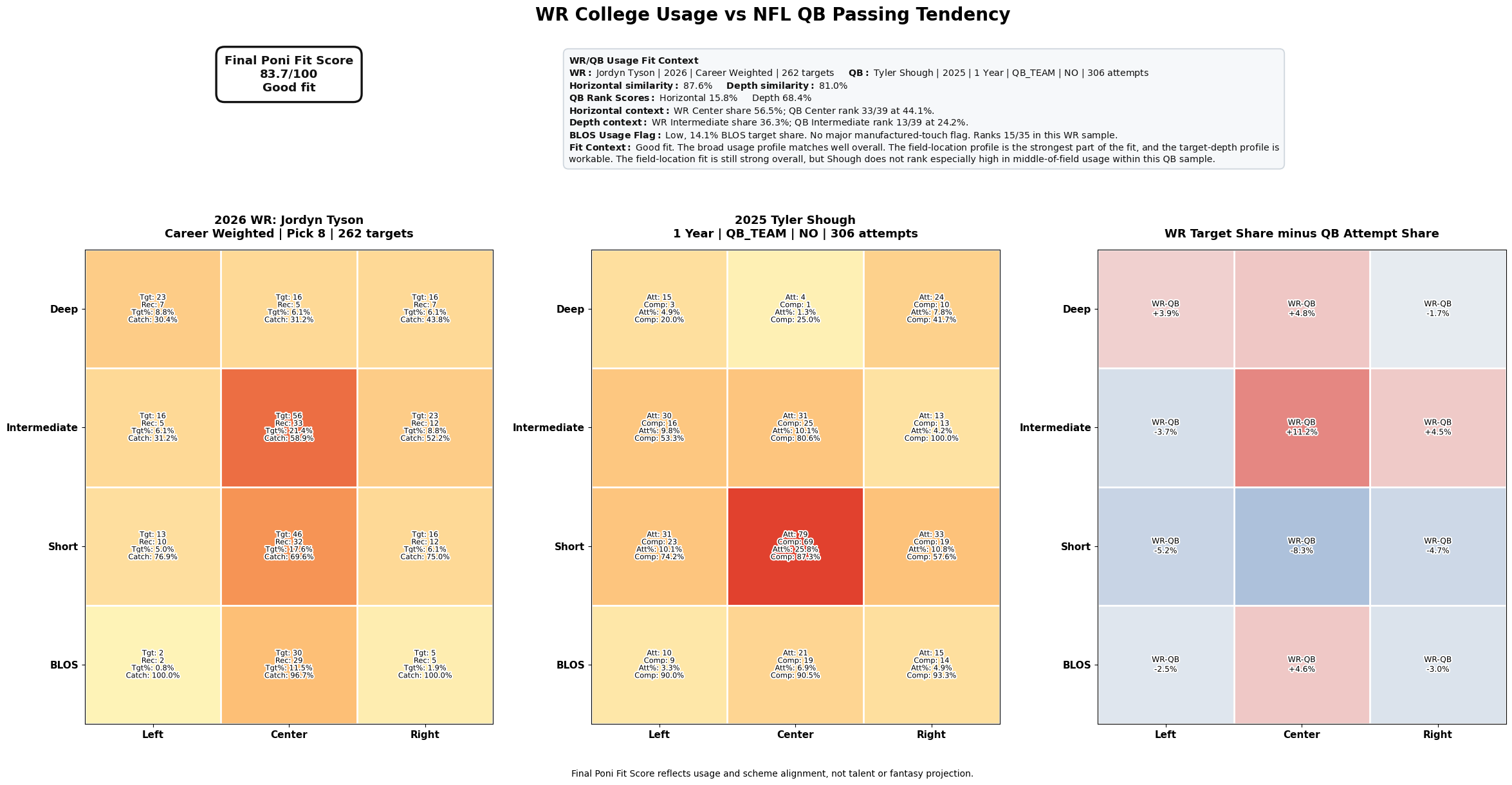
Jordyn Tyson checks in as a good fit with Tyler Shough. The score is closer to a strong fit than neutral, but it is not perfect. Tyson’s college profile was built around the middle of the field and the intermediate area, and that is exactly what makes this landing spot good. Shough ranked 13th out of 39 quarterbacks in intermediate attempt share, which gives Tyson a real path to keep winning in the area where his profile is strongest.
The one concern is that Shough was not especially middle-of-the-field heavy overall. Tyson had 56.5% of his targets come in the center of the field, while Shough ranked 33rd out of 39 in center-field usage. So while the depth fit looks strong, the field-location fit is not quite as clean as the final score might suggest.
Tyson had only a 14.1% BLOS target share, so he had a lower manufactured-touch profile. Even better, 57.3% of his targets came in the intermediate and deep areas, which is exactly what we as fantasy managers want to see from a receiver being drafted this highly.
Jordyn Tyson & Tyler Shough 12-Zone Map
Tyson’s fit is positive because Shough gives him enough intermediate-area access to keep his college role alive. The ceiling of this fit probably depends on whether New Orleans lets Tyson keep working the middle of the field, especially with Chris Olave already commanding WR1 targets in this offense. But lets see what the Conflict Card says…
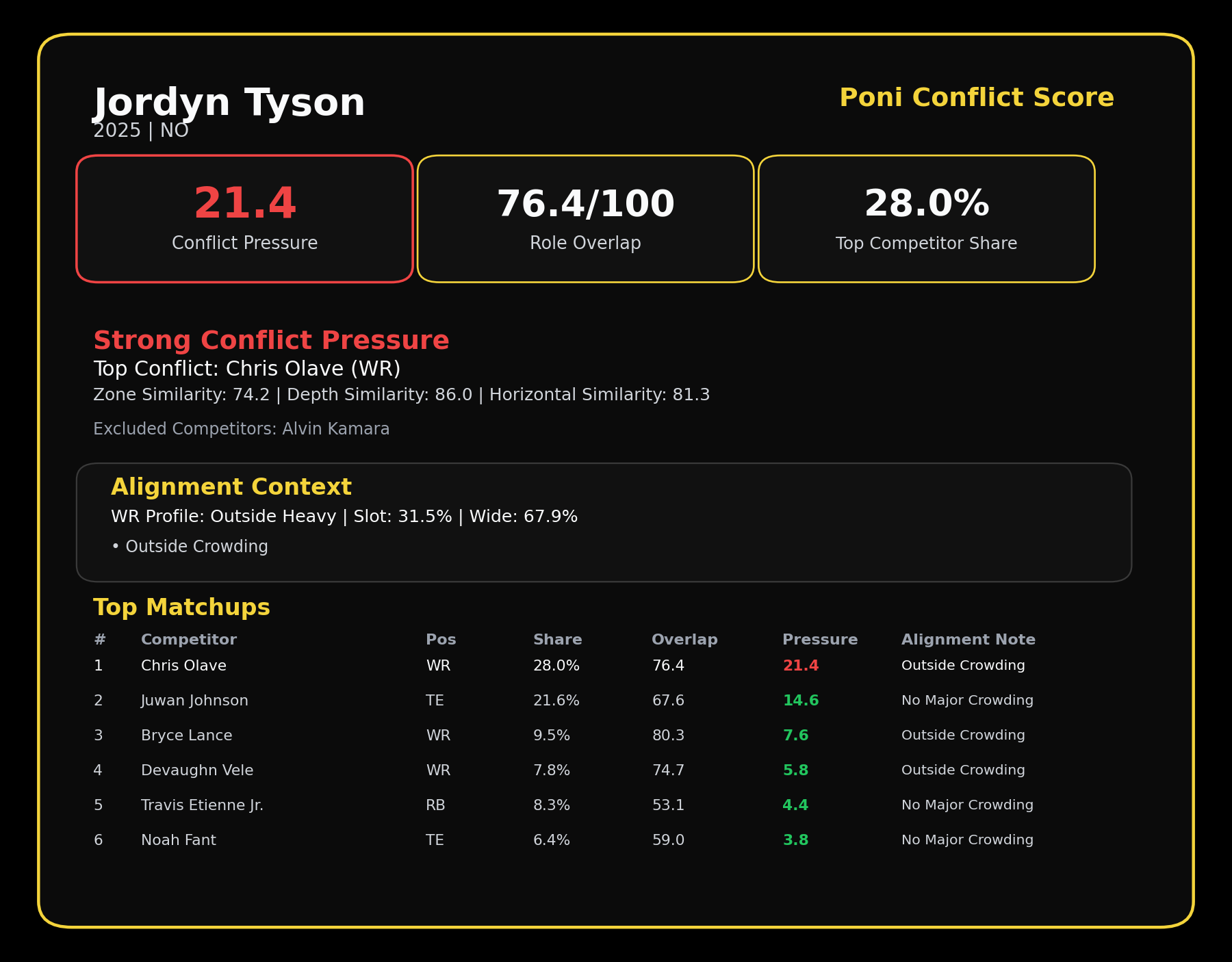
Jordyn Tyson is going into a difficult situation. Olave is a true wide receiver one target hog. I also have never understood the Olave hate. The kid broke 1000 yards as a rookie, and then proceeded to have ¾ seasons with over 1000 yards. I get the concussion concerns, but in that case, you shouldn’t ever draft Christian McCaffrey or 2024 Devon Achane , or 2025 Puka. You get my point. Dude’s a stud and if you cant see that, I’m sorry that you’re blinded by the narrative.
Jordyn Tyson Conflict Card
Outside the target competition, Tyson and Olave usage profiles are very similar in both depth and horizontal similarity. While the final Role Overlap score isn’t outlandish, these two players will be fighting for not only targets, but similar types of targets. This was one of the strongest conflicts I have found in the 2026 class.
With all that said, the Saints are my sleeper team going into 2026 (*Giants too). I’ve been talking about it so much with Alex, that it’s become a running joke…”Tyler Shough NFL MVP”. I fully believe, Tyler Shough and a Kellen Moore offense is capable of maintaining two fantasy relevant wide receivers. But do not get it twisted. Olave is the alpha.
Makai Lemon
Philadelphia, Eagles: Pick 20
Makai Lemon to Jalen Hurts (3 year sample):
Poni Fit Score: 76.0/100
Fit Label: Neutral/mixed fit
Conflict Pressure Score: 19.5 Moderate Conflict
Horizontal similarity: 71.0%
Depth similarity: 84.0%
Horizontal rank sample: 43/45
Depth rank sample: 9/45
BLOS: Normal manufactured touches, 22.4%
Makai Lemon is a neutral/mixed fit with Jalen Hurts. Since Hurts has multiple years of passing data, I used the last three years instead of only looking at one season. This is not a bad fit per se, but it is one where the context matters. The model likes the depth profile, especially the short-area fit, but the field-location profile is where the concern shows up.
Lemon was very middle-of-the-field heavy in college, with 67.6% of his targets coming in the center of the field. That is the biggest issue with this landing spot. Hurts ranked 43rd out of 45 quarterbacks in center-field usage, so if Lemon is going to keep the same type of role he had in college, the Eagles may need to use him differently than their recent passing profile suggests.
The good news is the depth fit is much better. Lemon’s top depth area was short, and Hurts ranked 9th out of 45 in short-area attempt share (5th in 2025). That gives Lemon a realistic path to touches, especially if Philadelphia uses him as a YAC piece instead of asking him to become something totally different. This is going to come down to Sean Mannion’s offensive scheme and the offensive identity Philly wants to have in 2026. And yes, Eli Stowers being added to the mix makes this even more challenging.
Lemon had a 22.4% BLOS target share, which is higher than both Tate and Tyson. That does not make him a bad prospect or a screen-only player, but it does show that his usage profile and archetype are different. He needs some designed touches and space opportunities to fully maximize what he does well.
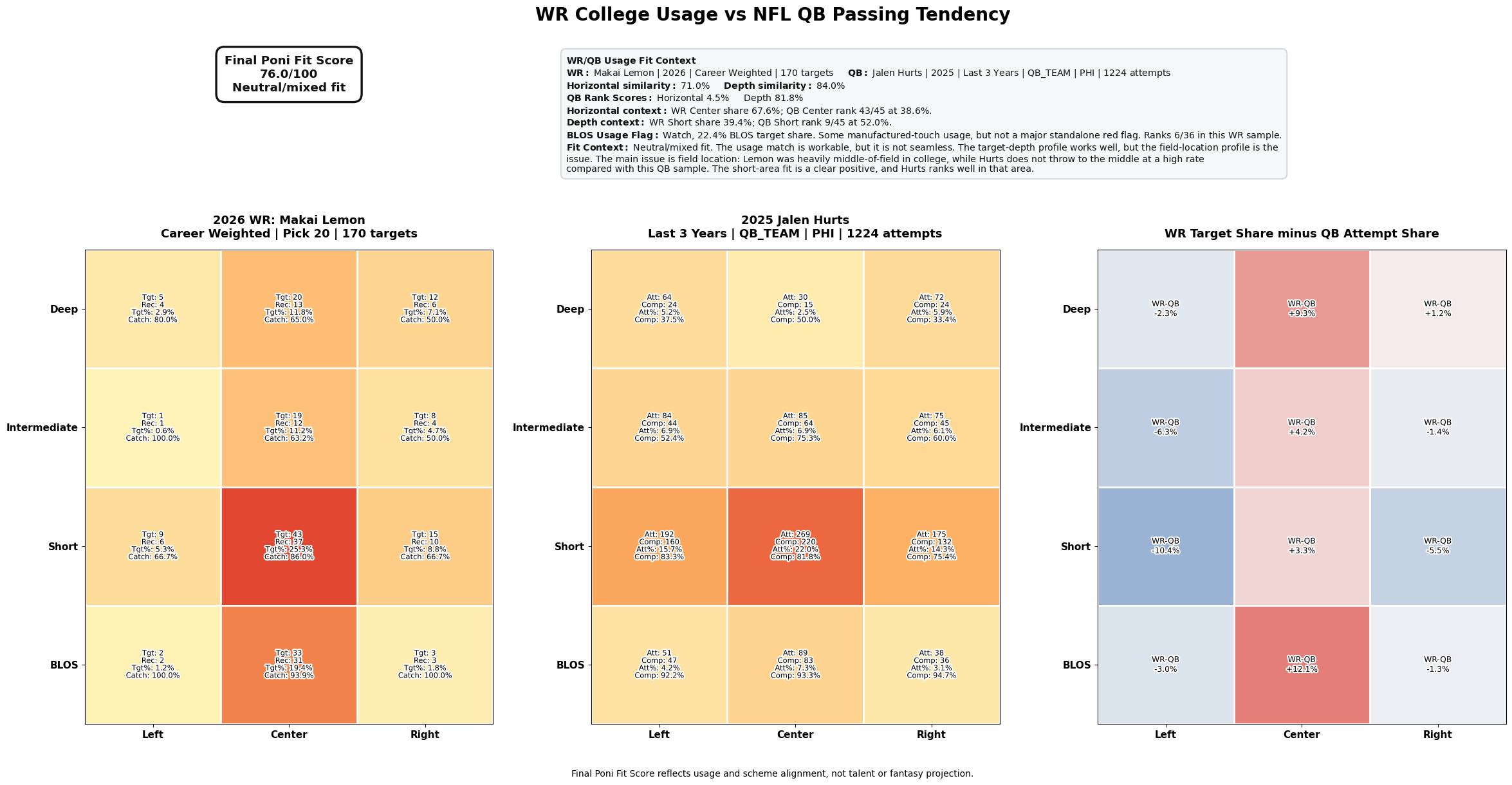
Makai Lemon & Jalen Hurts 12-Zone Map
This fit is workable, but not seamless. The short-area fit with Hurts is a clear positive, but the middle-of-the-field mismatch is real. For fantasy, I would view Lemon as a role-dependent fit in Philadelphia. If the Eagles give him designed touches and let him work underneath, this can work. If they ask him to win in a different role than the one he played in college, the fit gets a lot shakier.
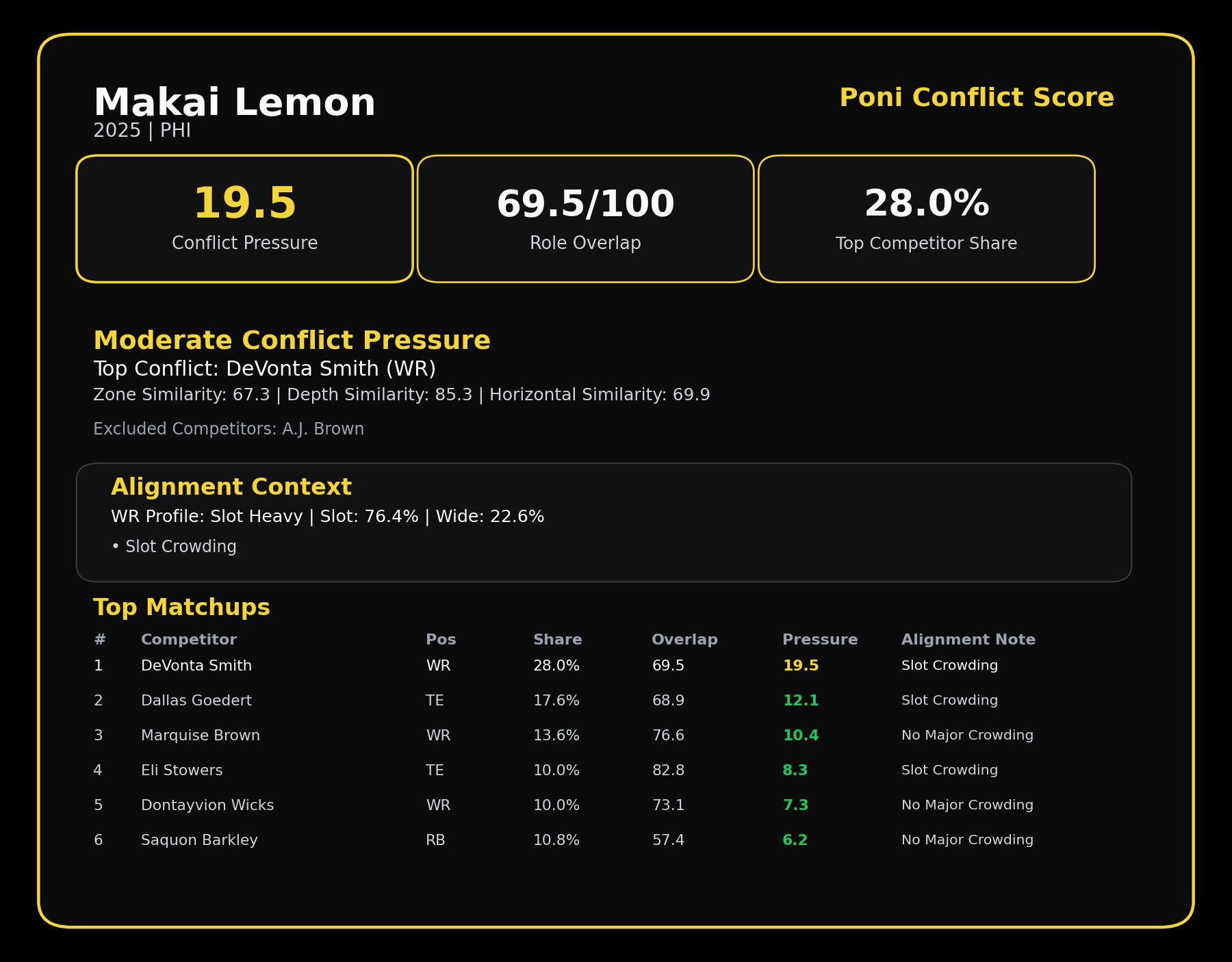
Makai Lemon Conflict Card
DaVonta Smith has never commanded more than a 27% target share in his entire career. A.J. Brown has only ever commanded 30% once in his career, but historically floated around 28%. The 28% team target share for DaVonta seems fair to me when considering the impact of AJ Brown leaving.
The Conflict Card says the pressure is only moderate when looking at DaVonta Smith; but it is very close to our 20 point threshold. It also gives us some additional context to consider. While the score is only moderate, Smith’s depth profile strongly aligns with Lemons. There will be competition in the short part of the field, where Lemon has found success the most. There is also slot crowding by DeVonta (58% in 2025), Goedert (49%), and Stowers (66%). This is telling me the Eagles have to decide how they want to use some of these guys. Who is going to play a different role? Whoever it is, might have a learning curve which could impact fantasy success in the first season.
This is a situation to monitor. How consistently will Lemon be on the field and in what sets. While the room isn’t dominated by elite studs (outside DeVonta), it is crowded in the sense that there are 6 different playmakers that can all eat into the rookies target share and 3 other playmakers that have similar roles.
Lemon is a good wide receivers who is going to crowded room. We have seen this before. As time goes on, things usually start to open up for the player if they truly have the ability to be elite. If you are drafting Lemon in dynasty, barring injury, your eye should be set on elite production potential 2027+, with a route of WR3/WR2 production in 2026 if he sees the #2 target share on the team.
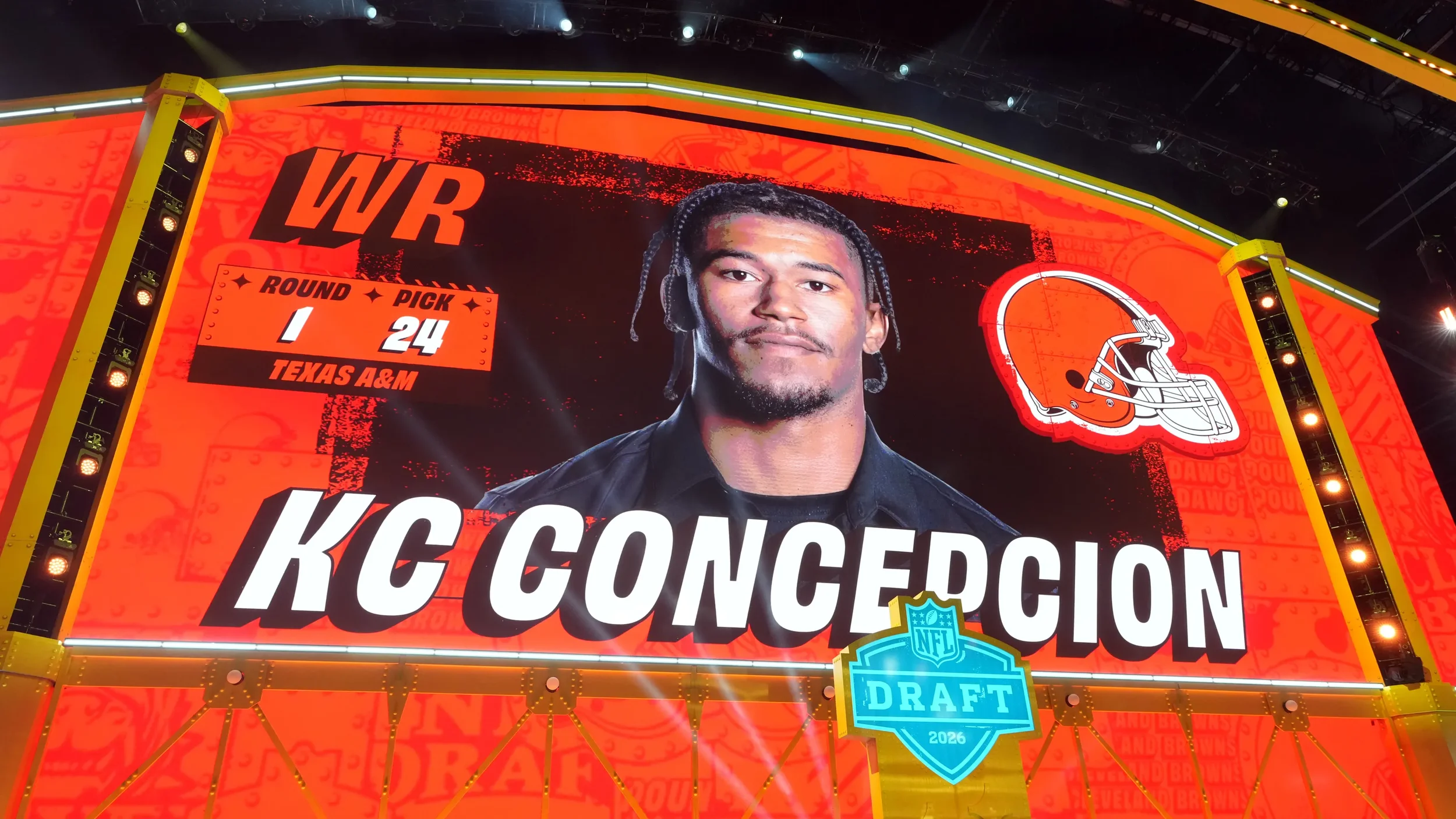
KC Concepcion
Jr.
Cleveland, Browns: Pick 24
KC Concepcion to Shedeur Sanders:
Poni Fit Score: 80.2/100
Fit Label: Good fit
Conflict Pressure Score: 17 - Light Conflict
Horizontal similarity: 79.1%
Depth similarity: 95.2%
Horizontal rank sample: 14/39
Depth rank sample: 23/39
BLOS: Normal manufactured touches, 21.1%
KC Concepcion is a good fit with Shedeur Sanders, but this is one where the team context makes the landing spot much more fun to figure out. My model likes the actual usage fit with Shedeur, but I do not know if Shedeur or Deshaun Watson is going to be the quarterback. Is Dillon Gabriel still on vacation? Then throw in the new head coach Todd Monken and offensive coordinator Travis Switzer, both from the Baltimore Ravens regime. This makes this a tougher situation than the score alone suggests.
From a pure Shedeur fit standpoint, there is a lot to like. Concepcion’s college profile was built around the short area and the middle of the field. He had 41.9% of his targets come in the short area, while Shedeur was at 46.7%. That is why the depth similarity came in so strong at 95.2%. Based on usage this gives Concepcion a realistic path to early touches if Cleveland uses him in the right role.
The field-location fit is solid too, but not perfect. Concepcion was extremely center-field heavy in college, with 71.5% of his targets coming in the middle of the field. Shedeur ranked 14th out of 39 quarterbacks in center-field usage, so there is enough overlap here for the fit to make sense.
Concepcion had a 21.1% BLOS target share, which isn’t abnormal. The bigger issue is target competition. Cleveland still has Jerry Jeudy, drafted Denzel Boston (different usage profiles - check it out below), and Harold Fannin Jr.. Fannin already showed he can command targets as a rookie. This is a good fit on paper with Shedeur, but the landing spot is complicated.
Some additional context: Concepcion lined up 65% out wide his final year, so many believe that in the Monken scheme he could be used as the true Z & used as the X wide receiver with big sets. Exactly like Zay Flowers which would make his fantasy value significantly higher. Especially, with how the league has been leaning with multiple tight end sets and Monken’s offense.
But, I am not so sure. Even though Concepcion lined up out wide, the majority of his usage came from underneath work. His intermediate/deep share was only 37%, actually lower than Lemon’s at 38%. I think he could fill the Z role exceptionally well (big upside), which I believe is why Monken drafted him. But, based on his usage profile, him being on the field in 13 personnel might take him some time to adjust. If this doesn’t happen, it could impact his fantasy upside. If it does happen, he is essentially Zay Flowers but on the Browns. Be sure to check out Denzel Boston usage map, because I compare the two in his breakdown. Also, take a look at the Zay Flowers profile below, and how its much different than KCs.
Fun Fact: KC Concepcion #1 college usage map comp was…Josh Downs. This is obviously contextual, but still very interesting.
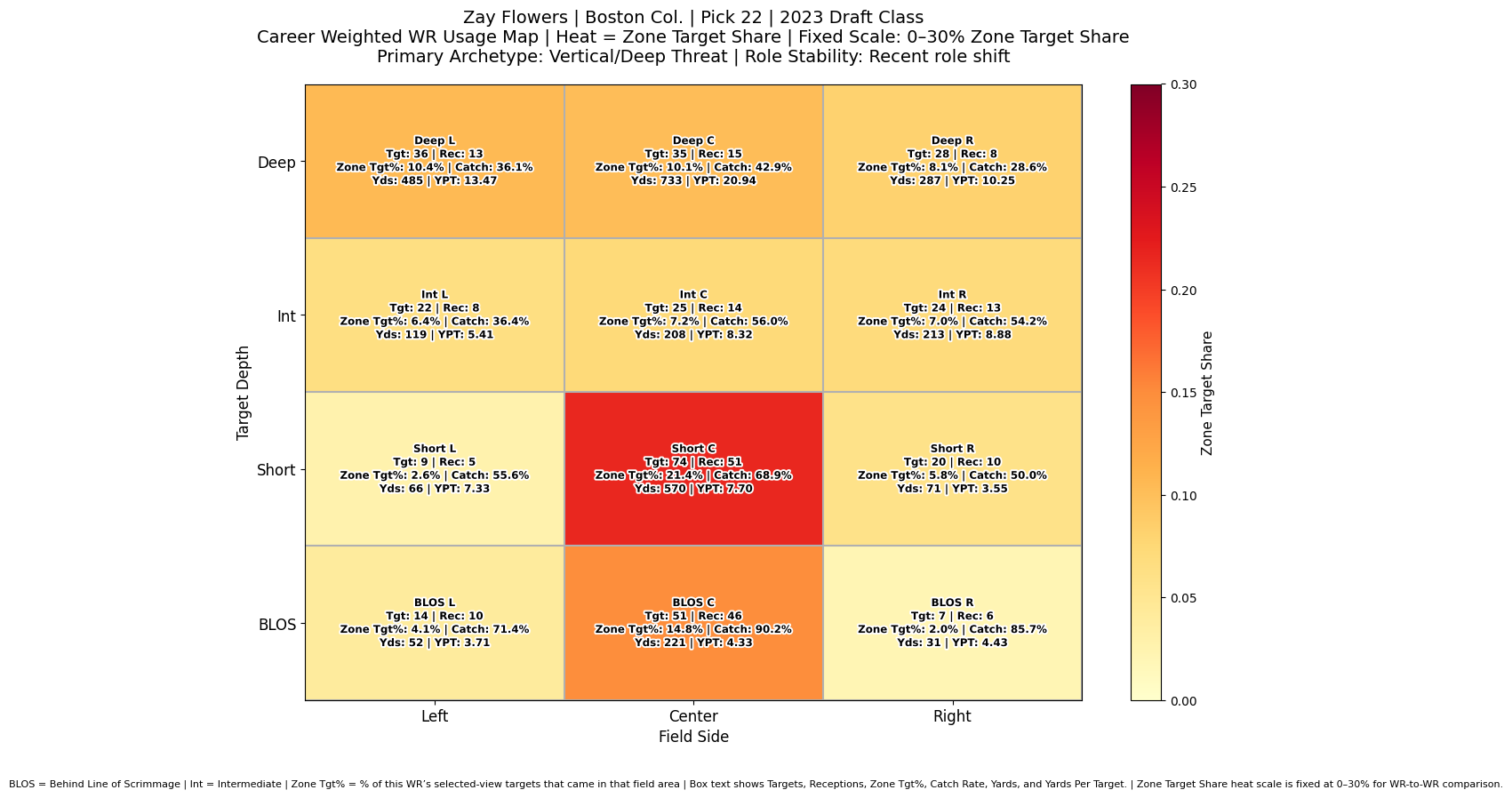
I compared that to Zay Flowers college profile, who was much more of an intermediate/deep threat in comparison at 49%. Foreshadowing for Boston…
For fantasy, the QB situation and franchise culture is bad, but the potential is certainly there for the rookie. Based on his usage (deep/intermediate), it’s not as strong as a fit as I originally suspected.
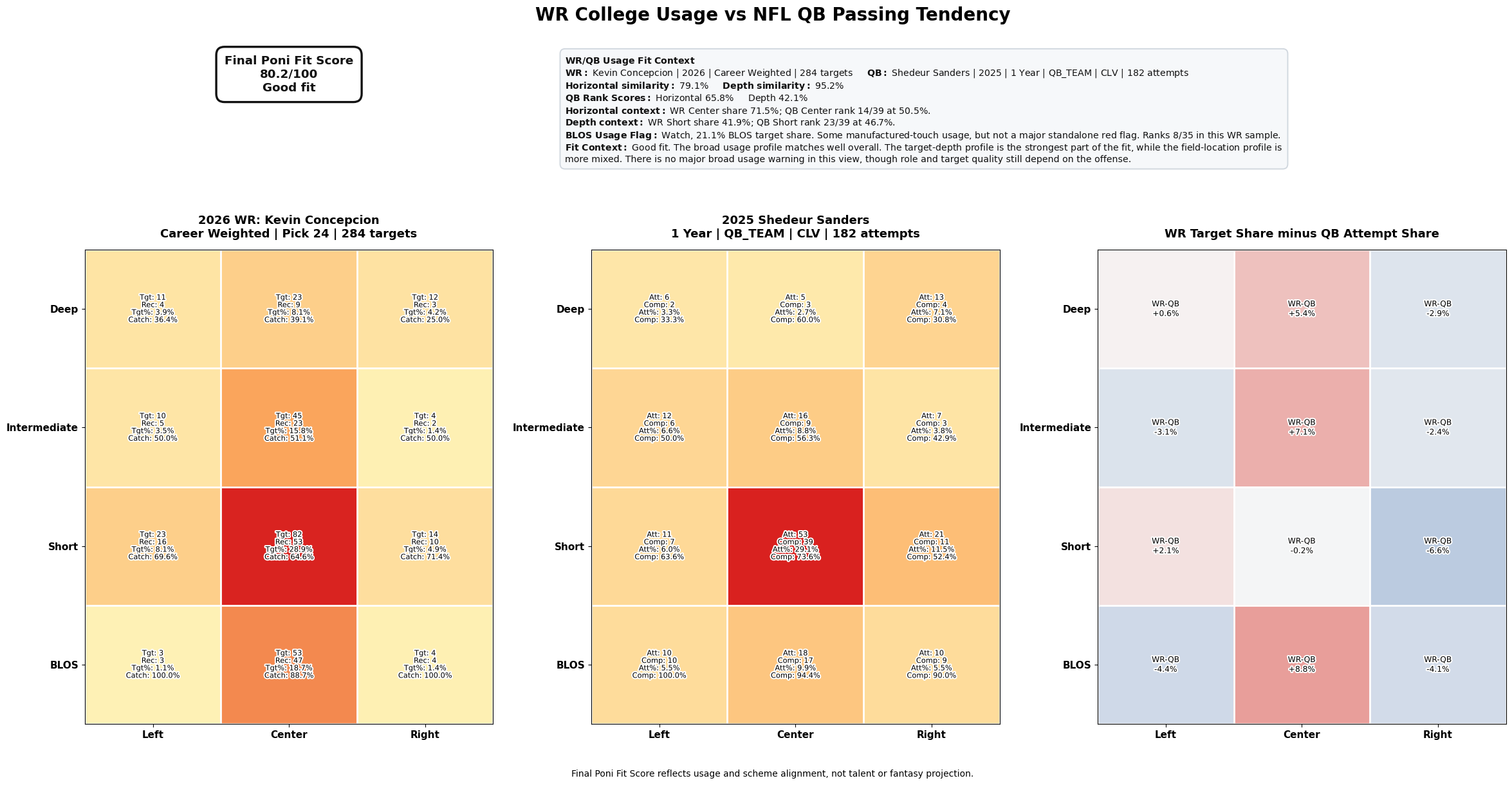
KC Concepcion & Shedeur Sanders 12-Zone Map
Now, let’s get into his Conflict Card to see what it is telling us.
Omar Cooper Jr. Conflict Card
Of wide receivers we have charted up until this point, KC has the strongest path to an alpha WR1 role. While there is competition around him, there isn’t a true alpha yet. Harold Fannin Jr. broke out as a rookie and looks electric. There is no putting that genie back into the bottle. I was high on Fannin back in April 2025. So, I get it.
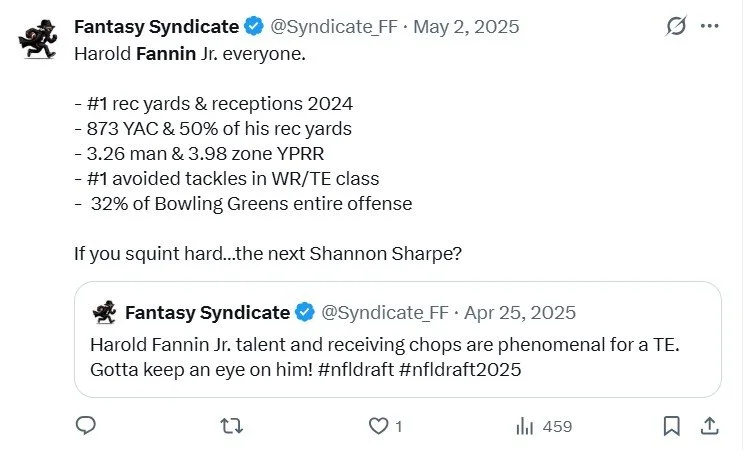
Fantasy Syndicate Tweet 2025
But, it comes down to the usage we believe Fannin will see. I think Fannin is an elite talent, but I am not ready to put him into Travis Kelce, George Kittle, Trey McBride or any other tight end that has dominated their teams offense as the true alpha WR1. Not just yet. Which tells me that in a Todd Monken scheme, KC is the player to own of the two. Don’t get me wrong, Fannin will be a fantasy asset, but Concepcion appears to be the better usage fit…which is what this entire article is about.
KC Concepcion = Zay Flowers
Denzel Boston = Rashod Bateman
Jerry Jeudy = D-Hop
Harold Fannin Jr. = Mark Andrews
Quenshon Judkins = Derrick Henry
Dylan Sampson = Justice Hill/ Keaton Mitchell
You could obviously nit pick this all over in player comps, but you get the point. This is one of the instances I like the scheme and fit, more than the player or situation.
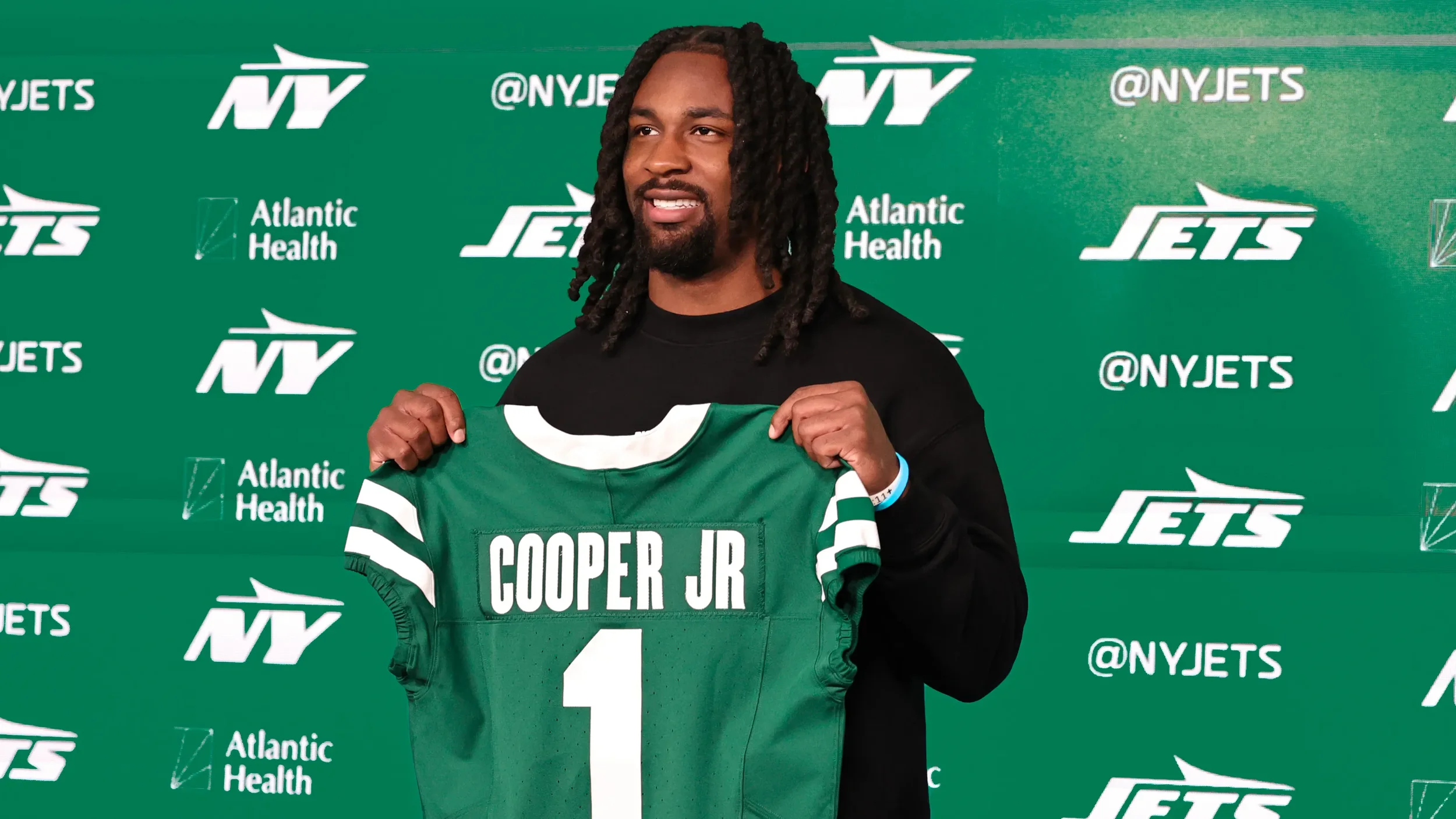
Omar Cooper Jr.
New York, Jets: Pick 30
Omar Cooper Jr. to Geno Smith (3 year sample):
Poni Fit Score: 72.2/100
Fit Label: Neutral/mixed fit
Conflict Pressure Score: 19.4 - Moderate Conflict
Horizontal similarity: 79.7%
Depth similarity: 76.6%
Horizontal rank sample: 50/57
Depth rank sample: 49/57
BLOS: Low manufactured touches, 13.5%
Omar Cooper Jr. is in a neutral/mixed fit with Geno Smith. Since Geno has multiple years of passing data, I used his last three years across all teams instead of only looking at one season. This is not a bad fit, but it is not a clean one either. The model sees enough overlap for it to work, but there are clear issues.
Cooper’s college profile leaned toward the middle of the field, with 59.4% of his targets coming in the center. That is a red flag. Geno ranked 50th out of 57 quarterbacks in center-field usage, so Cooper’s most common college target area does not perfectly match where Geno has historically thrown the ball.
The depth profile is also mixed. Cooper’s top depth area was intermediate, with 32.3% of his targets coming there. For fantasy that’s normally a good thing, because it shows he was not just living on cheap touches. His intermediate and deep target share was 54.8%, which gives him one of the cleaner downfield profiles in this group. The issue is that Geno ranked 49th out of 57 quarterbacks in intermediate attempt share, so the exact area where Cooper was strongest in college is not an area Geno has leaned into heavily. Cooper had only a 13.5% BLOS target share, so there is no major manufactured-touch worry in college.
This is where new offensive coordinator Frank Reich context becomes a little tricky. On one hand, Reich’s offenses have historically leaned into short and intermediate throws, especially digs and drags over the middle of the field. That part could help Cooper because his college profile was built around center-field and intermediate usage.
But it is not all positive. Cooper also had a strong intermediate/deep profile, with 54.8% of his targets coming in those areas. Reich has not historically been a big vertical-shot coach, and his offenses have been below average on deep targets and go/post routes. So if the Jets use Cooper as more of a methodical middle-of-the-field piece, the fit makes sense. If we are hoping he gets unlocked as a true downfield weapon, Reich’s history makes that a little harder to buy (ignoring competition). That is why I view this as more of a mixed fit. The concepts could help Cooper, but the overall offensive philosophy may also cap the part of his profile that makes him most interesting for fantasy.
The bigger picture is still what makes this landing spot hard to fully buy into. Reich may help the route-concept fit in year one, but this still feels like a bridge-year for the entire organization. There is also real target competition with Garrett Wilson, Adonai Mitchell, first-round tight end Kenyon Sadiq, and Mason Taylor. That is a lot of mouths to feed for an offense that still has quarterback and long-term identity questions. I believe Coopers ceiling is a WR2 for the indefinite future, with Garrett Wilson signed to a long term deal.
For me, Cooper’s player profile is exciting, but the landing spot is gross. The Geno fit is not great, but Reich’s middle-of-the-field and intermediate route tendencies make the pairing slightly more appealing than the raw score alone in the short term.
For fantasy, I would view Cooper as a role-adjustment fit with real competition around him. If the Jets use him on digs, drags, and intermediate work, there is a path. If not, this could be one of those situations where the player is more interesting than the landing spot.
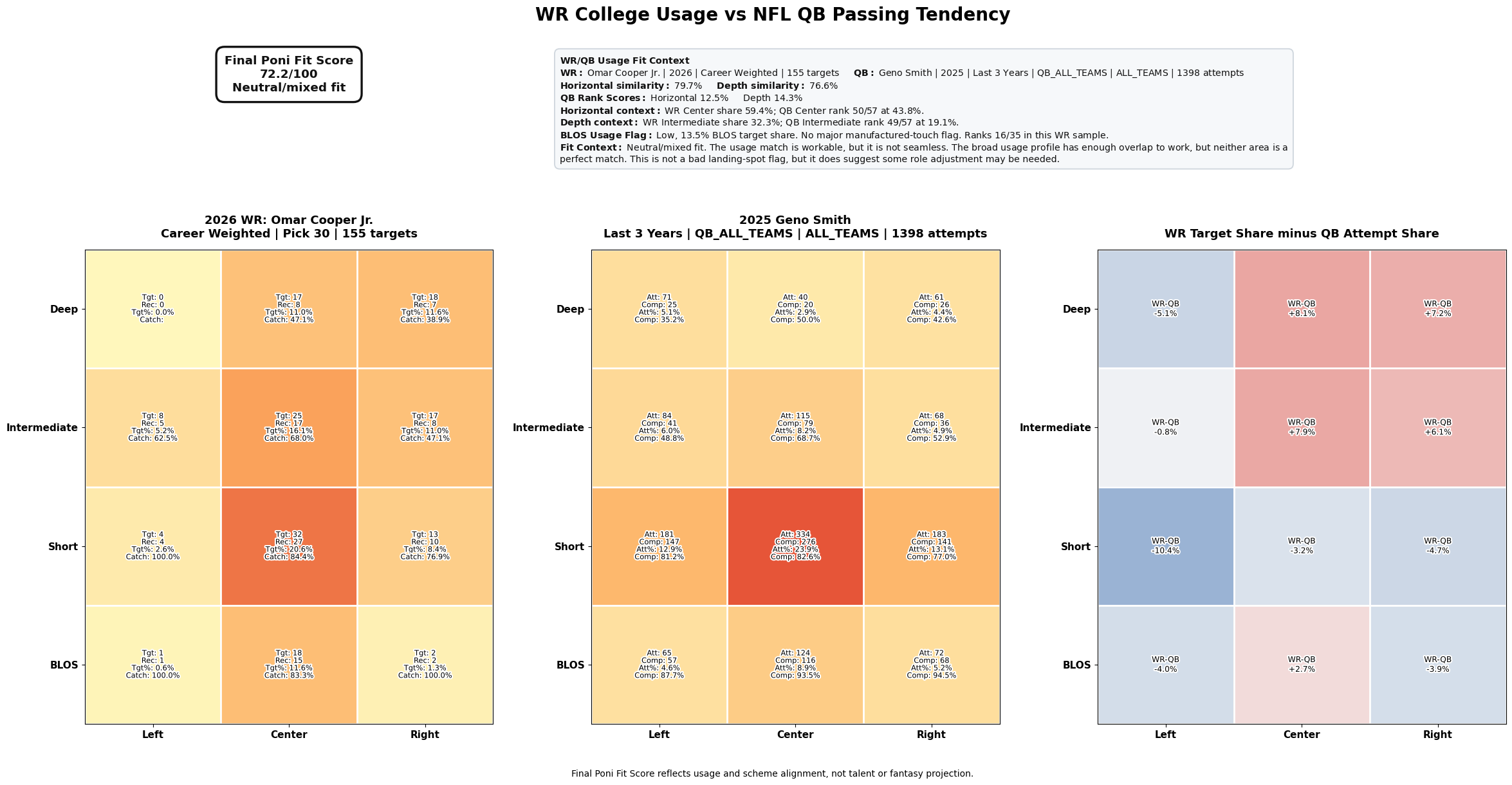
Omar Cooper Jr. & Geno Smith 12-Zone Map
Now lets look at the Conflict Card to see how much of an impact Garrett Wilson will have on Omar Coopers early success.
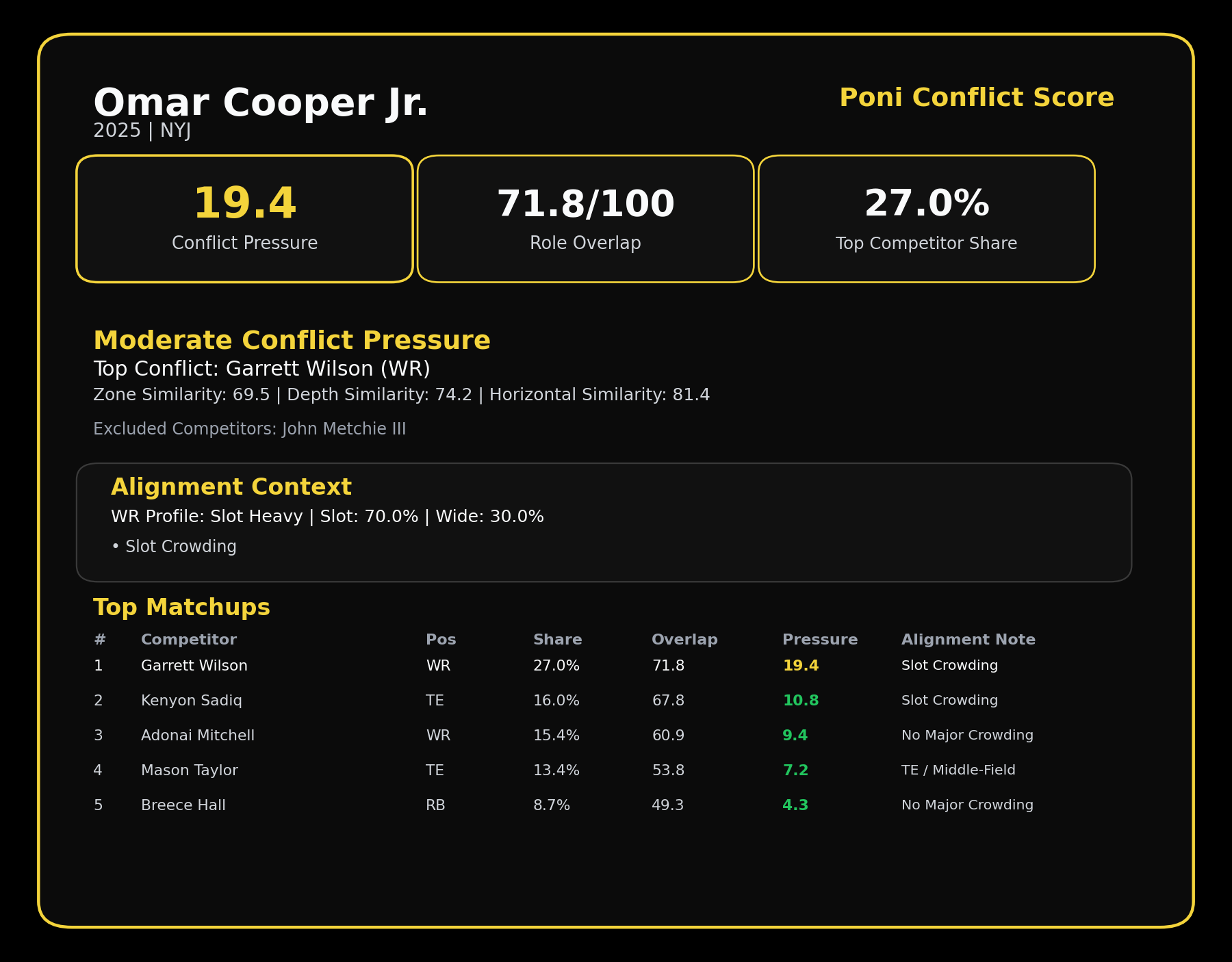
Omar Cooper Jr. Conflict Card
While there are multiple pass catchers in New York, the good news is that the role overlap with Wilson isn’t as severe as we would have expected. The depth and zone usage was very different. While it does indicate there is slot crowding, Wilson played out wide 60% of the time in 2025. Cooper played 83% out of the slot in 2025, leading me to believe this will be the role he plays.
This brings us back to the same discussion we had with Makai Lemon. How much will Cooper actually be on the field and in what sets? Will Sadiq eat into those opportunities (55% slot role 2025).
Personally, I am much higher on Cooper than most due to his profile. While I do not believe he can out alpha Wilson, I do see a path where he finds fantasy success over the next three years. As long as the Jets culture doesn’t leave him to die (very likely).
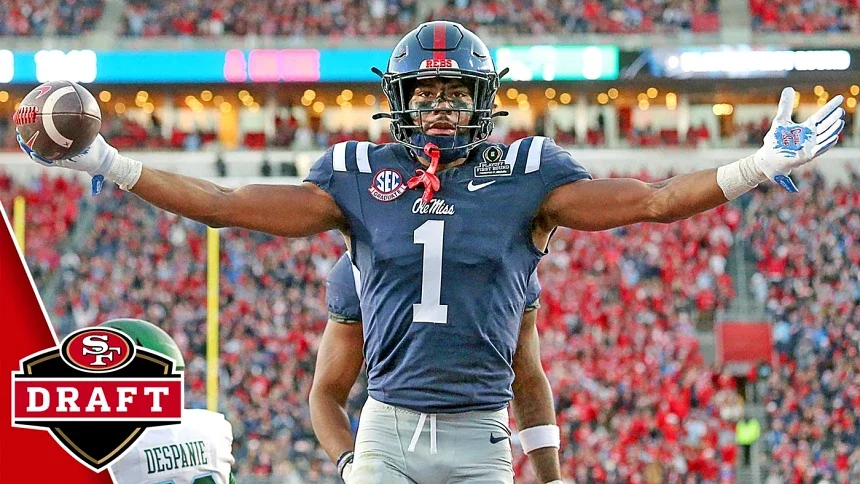
De'Zhaun Stribling
San Francisco, 49ers: Pick 33
De'Zhaun Stribling to Brock Purdy (Career Sample):
Poni Fit Score: 85.7/100
Fit Label: Strong fit
Conflict Pressure Score: 14.3 - Low Conflict
Horizontal similarity: 89.9%
Depth similarity: 88.3%
Horizontal rank sample: 2/48
Depth rank sample: 23/48
BLOS: Low manufactured touches, 9.3%
While this pick was controversial for almost except everyone who had “consensus in the building” (if you know you know), this is actually one of the best fits in the class. Stribling’s college usage profile lines up extremely well with what Purdy and the 49ers already do. The biggest reason is the middle-of-the-field overlap. Stribling was heavily used in the center area of the field, and Purdy ranked near the very top of the QB sample in that same area.
The depth fit is strong too. Stribling’s top depth area was short, and Purdy’s profile is right around league average there. That does not mean Stribling is walking into a guaranteed fantasy role, but it does mean the usage transition should not require a major change to who he already is as a player. His profile is built more around working beyond the line of scrimmage, especially in the short and intermediate areas. He had very little BLOS manufactured usage in college.
I’d also argue that of all the wide receivers I have discussed up until this point, Stribling has the cleanest path to real usage. George Kittle is entering his age-33 season coming off an Achilles tear in January. Mike Evans is turning 33 years old and hasn't gone a full season without getting injured. Year 3 Ricky Pearsall who has shown flashes but can’t stay on the field. The dude can get shot in the chest and be back in 4 weeks, but bumps his knee and is out for months. If Stribling finds his way to WR1 usage in a Shanahan system, watch out. It usually doesn't matter who you are. If you are a WR1, TE1, or RB1 in that system, and you have a pulse, you put up fantasy points.
This is a strong usage fit. The role match with Purdy and San Francisco makes a ton of sense, haters be damned.
De'Zhaun Stribling #1 college usage comp was…Tetairoa McMillan. Again, this is obviously contextual, but a fun comparison.
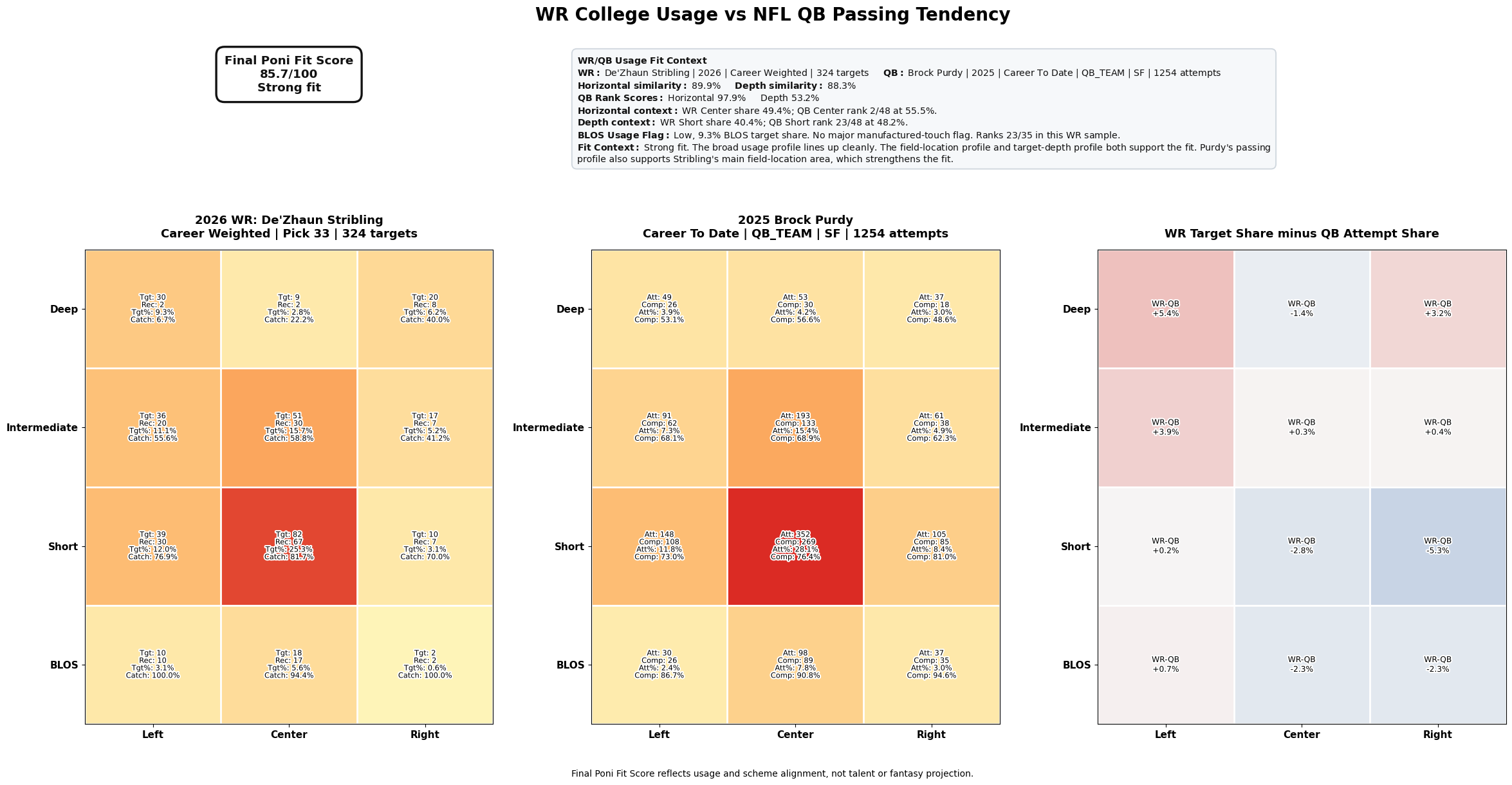
De'Zhaun Stribling & Brock Purdy 12-Zone Map
Now I discussed some contextual situations above about his receiving room competition, but let’s see what the Conflict Card says.
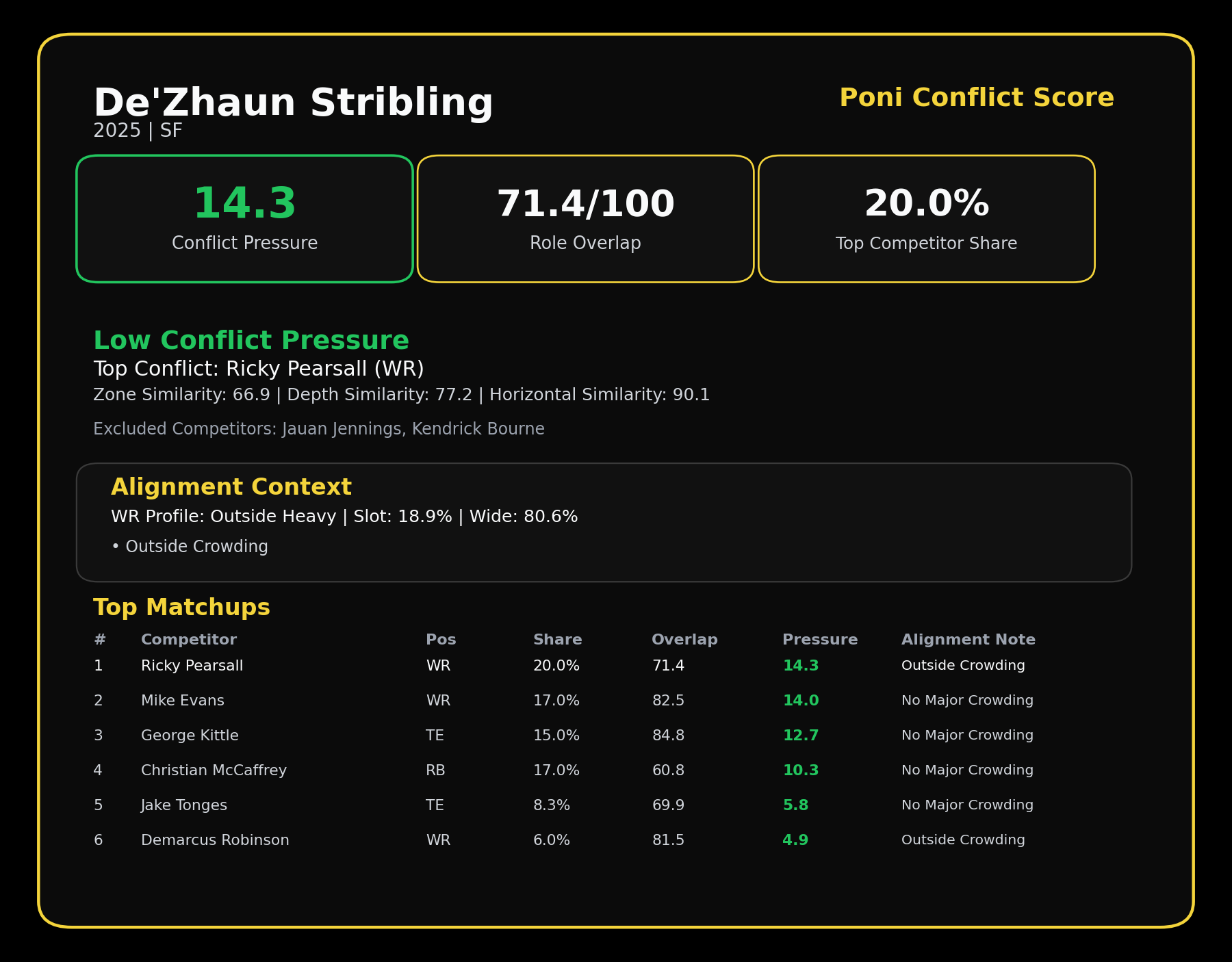
De’Zhaun Stribling Conflict Card
The Conflict Card tells us that Stribling has a real path to becoming the alpha in this offense. Remember, this card isn’t telling us if he will, it’s telling us if there is a path or conflict in that path. For target share purposes I decided to have Ricky be the WR1. I did this because I wanted to consider the long term usage/impact Stribling might face.
In reality, going into 2026, Mike Evans and George Kittle threaten his opportunities because of their role overlap in usage. When I manipulate the target share for all three, Evans and Kittle conflict score raises significantly more when compared to Ricky’s. Which is good news for the long term outlook in usage and conflict.
I think the bigger concern is the Shanahan offense. This is strange to say because he produces every year in fantasy. But in reality he spreads the ball around a lot due to scheme and injuries. The offense being so productive offsets this spread, but its good context to know. Over the past 4 years, this is what the target share breakdown has looked like in San Francisco.
2025: 2 players over 15% target share / none over 23%
2024: 3 players over 15% target share/ none over 22%
2023: 4 players over 15% target share/ none over 22%
2022: 4 players over 15% target share/ none over 22%
2021: 3 players over 15% target share/ none over 24%
If someone can find that path to a true WR1 pass catcher, the upside is insane. We see it yearly and weekly when injuries pop up on the Niners. Shanahan has to focus one or two players and they put up WR1, TE1, or RB1 fantasy numbers.
Overall, Stribling has a good fit with Purdy and the offense. He has a lot of older pass catchers around him. There is no alpha wide receiver that has emerged even if Ricky has shown flashes. And we know his upside is insane with Shanahan. This is an instance where I like the situation and fit, more than the player.
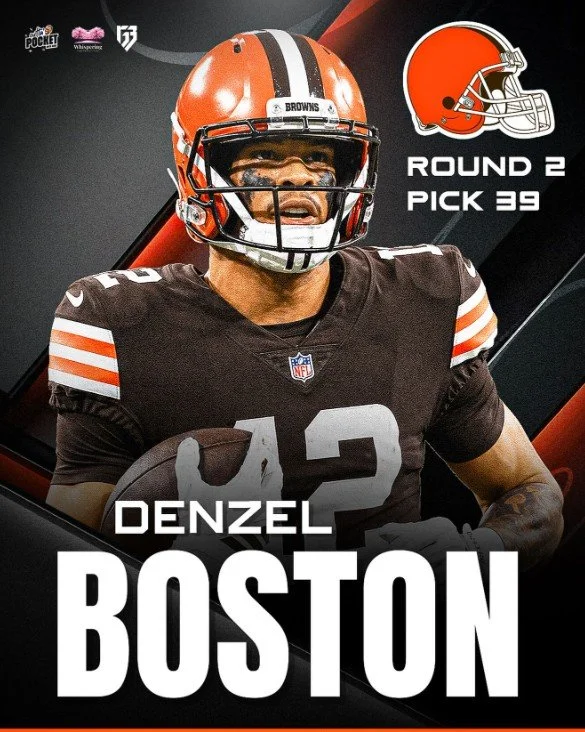
Denzel Boston
Cleveland, Browns: Pick 39
Denzel Boston to Shedeur Sanders:
Poni Fit Score: 82.8/100
Fit Label: Good fit
Conflict Pressure Score: 17 - Light Conflict
Horizontal similarity: 90.5%
Depth similarity: 79.5%
Horizontal rank sample: 13/48
Depth rank sample: 26/48
BLOS: Very low manufactured touches, 6.9%
Boston is another good fit with Shedeur Sanders. After already drafting Kevin Concepcion, the Browns doubled down by adding Boston, and the good news is, the two profiles are not the same.
Boston’s cleanest fit comes from the middle of the field. He had 55.6% of his targets come in the center area, while Shedeur was at 50.5% and ranked 13th out of 48 quarterbacks in center-field usage. That gave Boston a strong 90.5% horizontal similarity score, which tells us his college usage lined up well with where Shedeur has been willing to pass the ball.
The depth fit is solid, but not as strong as the field-location fit. Boston’s top depth area was short, with 40.2% of his targets coming there. Shedeur was at 46.7%, ranking 26th out of 48 quarterbacks. That is still a workable match, but it is not the same near-perfect depth fit I saw with Concepcion.
The bigger difference is the type of receiver profile. Concepcion’s usage was more of an underneath/middle-field movement piece. Boston looks closer to a cleaner, more traditional receiver profile. He had only a 6.9% BLOS target share, a 93.1% non-BLOS target share, and a 52.9% intermediate/deep share. This points to a player who was asked to work more of the actual route tree instead of living on underneath touches, potentially making it easier to project into a real NFL route tree. Based on the usage data, Boston’s profile looks more X-friendly than what I saw with Concepcion. Concepcion usage makes it appear that he would fit much better as the z/movement piece, short area, middle of the field, manufactured space, and quick-game touches. Boston’s profile looks cleaner as a more traditional outside receiver. This aligns with Boston playing 81% out wide in college in 2025. It’s possible he becomes the sacrificial X receiver, which could lead to KC being even more successful.
Boston is a good fit with Shedeur, and his profile is easier to understand than Concepcion’s. That does not automatically mean he has the better fantasy ceiling, but it does make his role feel a little less dependent on Cleveland creating the perfect manufactured-touch package for him. Regardless, in the Todd Monken offense, I’d bet on KC over Boston any day of the week.
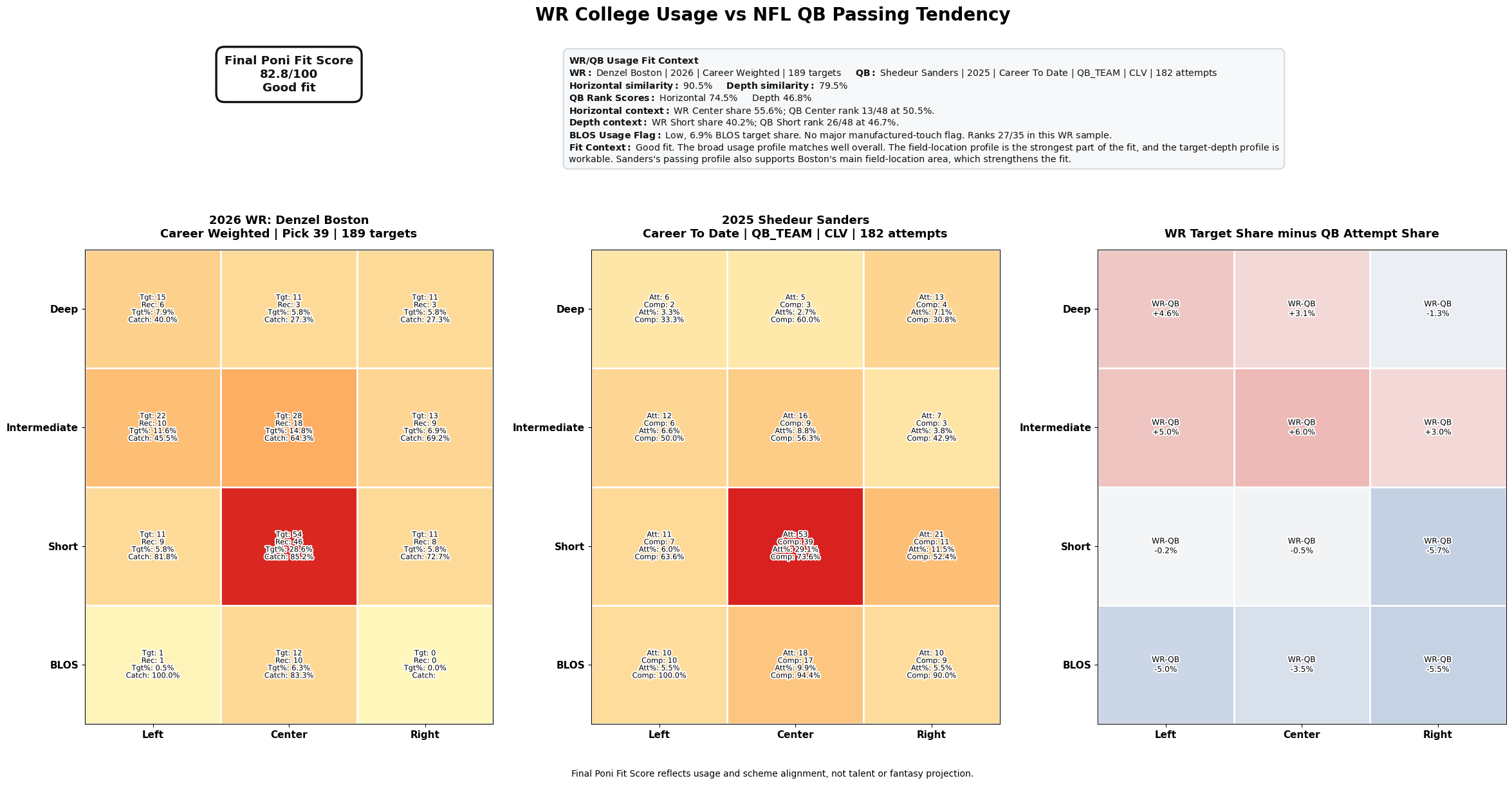
Denzel Boston & Shedeur Sanders 12-Zone Map
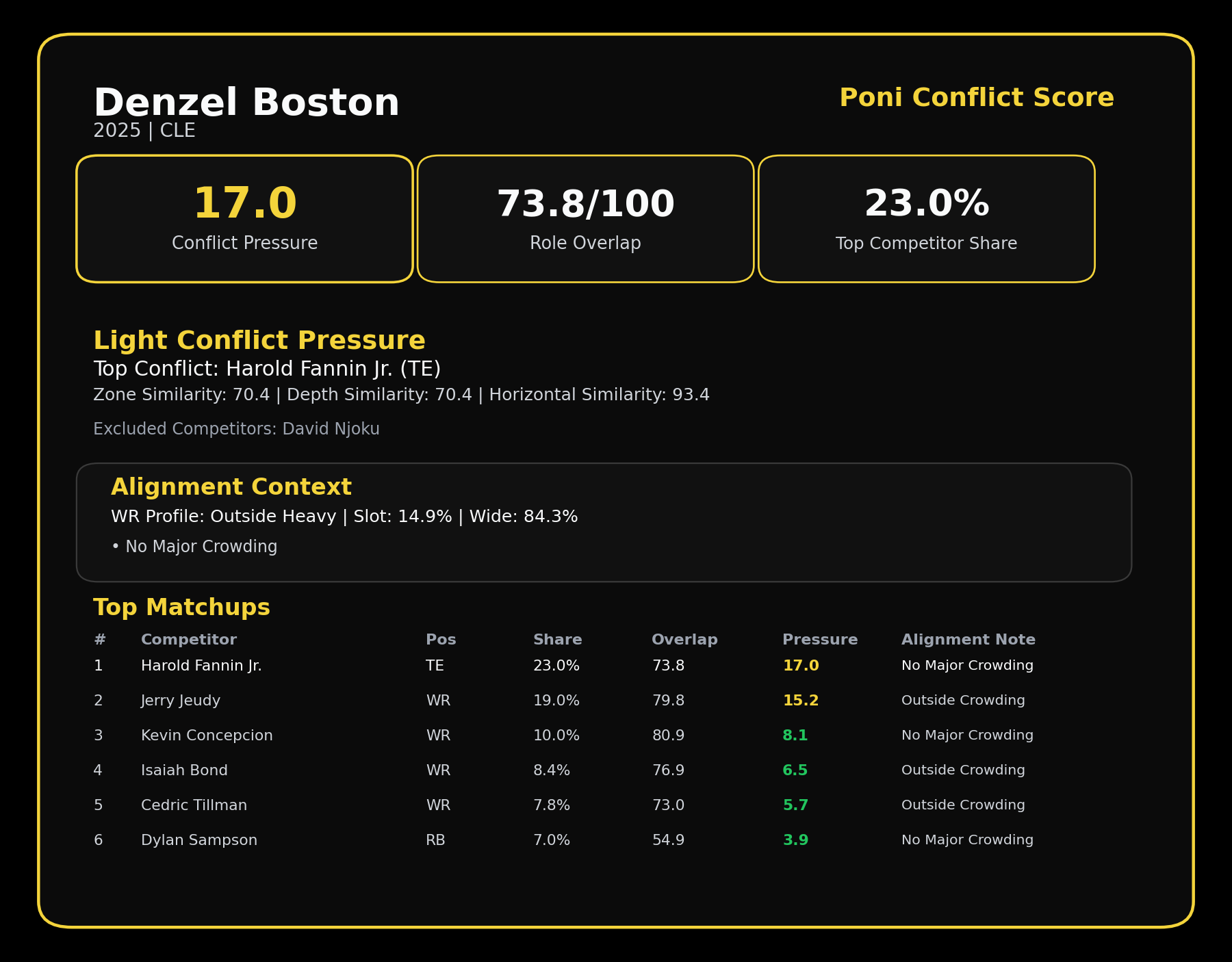
Denzel Boston Conflict Card
What is valuable context is that Boston shows much more overlap with Jerry Jeudy than KC did.
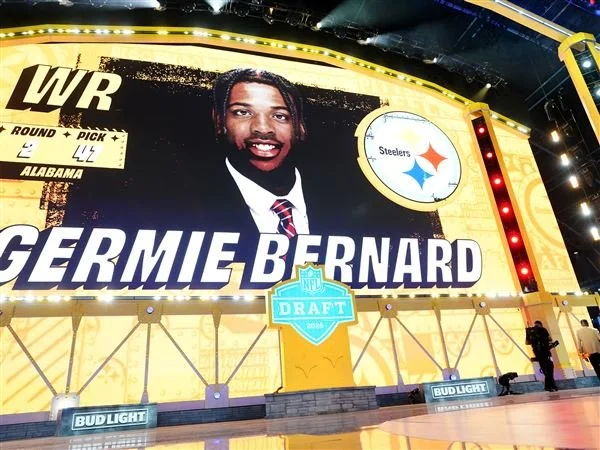
Germie Bernard
Pittsburgh, Steelers: Pick 47
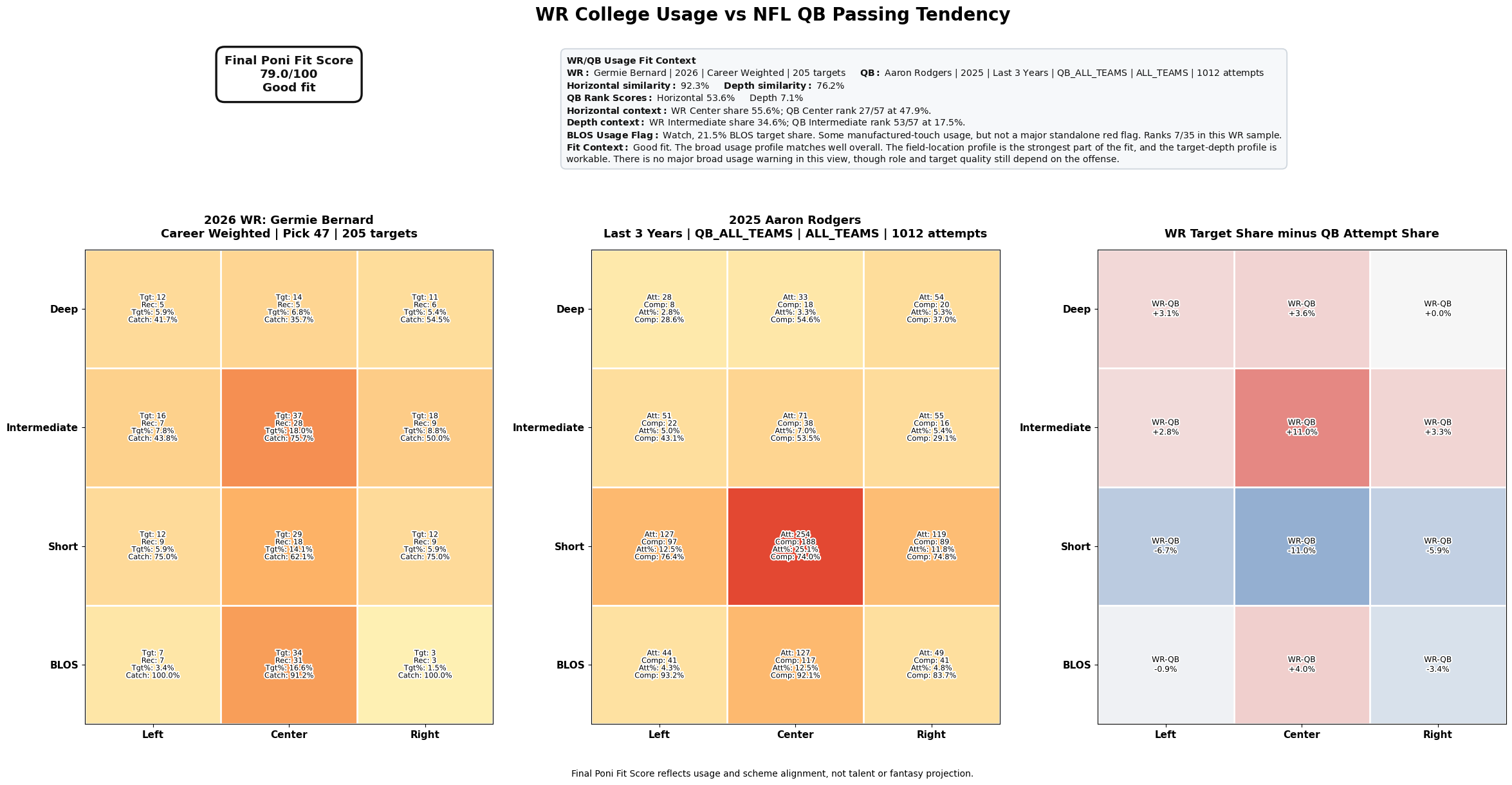
Germie Bernard to Aaron Rodgers (3 year sample):
Poni Fit Score: 79.0/100
Fit Label: Good fit
Conflict Pressure Score: 17.6 - Moderate Conflict
Horizontal similarity: 92.3%
Depth similarity: 76.2%
Horizontal rank sample: 27/57
Depth rank sample: 53/57
BLOS: Normal manufactured touches, 21.5%
Germie Bernard is a good fit with Aaron Rodgers, but this is one where the role matters a lot. The usage map likes the field-location fit. Bernard had 55.6% of his targets come in the center of the field, and the horizontal similarity with Rodgers came in at 92.3%. This lines up well.
The concern is the depth profile. Bernard’s top depth area was intermediate, with 34.6% of his targets coming there. He also had a 52.7% intermediate/deep target share, which tells us he was not just a short-area slot player in college. The issue is that Rodgers ranked 53rd out of 57 quarterbacks in intermediate attempt share, so the area where Bernard was strongest does not cleanly match Rodgers’ recent passing profile.
This is where the Pittsburgh context gets shaky. With DK Metcalf and Michael Pittman already there, Bernard is expected to play more from the slot. That makes sense from a depth chart standpoint, but I do not want to assume the role automatically fits just because “slot” is next to his name. The usage map says Bernard was an intermediate/middle-of-the-field receiver, not just an underneath slot option. While he had 21.5% BLOS target share, it wasn’t anything outlandish for manufactured touches.
Bernard’s usage fit is good, but there could be a learning curve based on the role they ask him to play. The slot label matters less than whether Pittsburgh uses him in a way that matches the profile he actually was strongest in college.
Germie Bernard & Aaron Rodgers 12-Zone Map
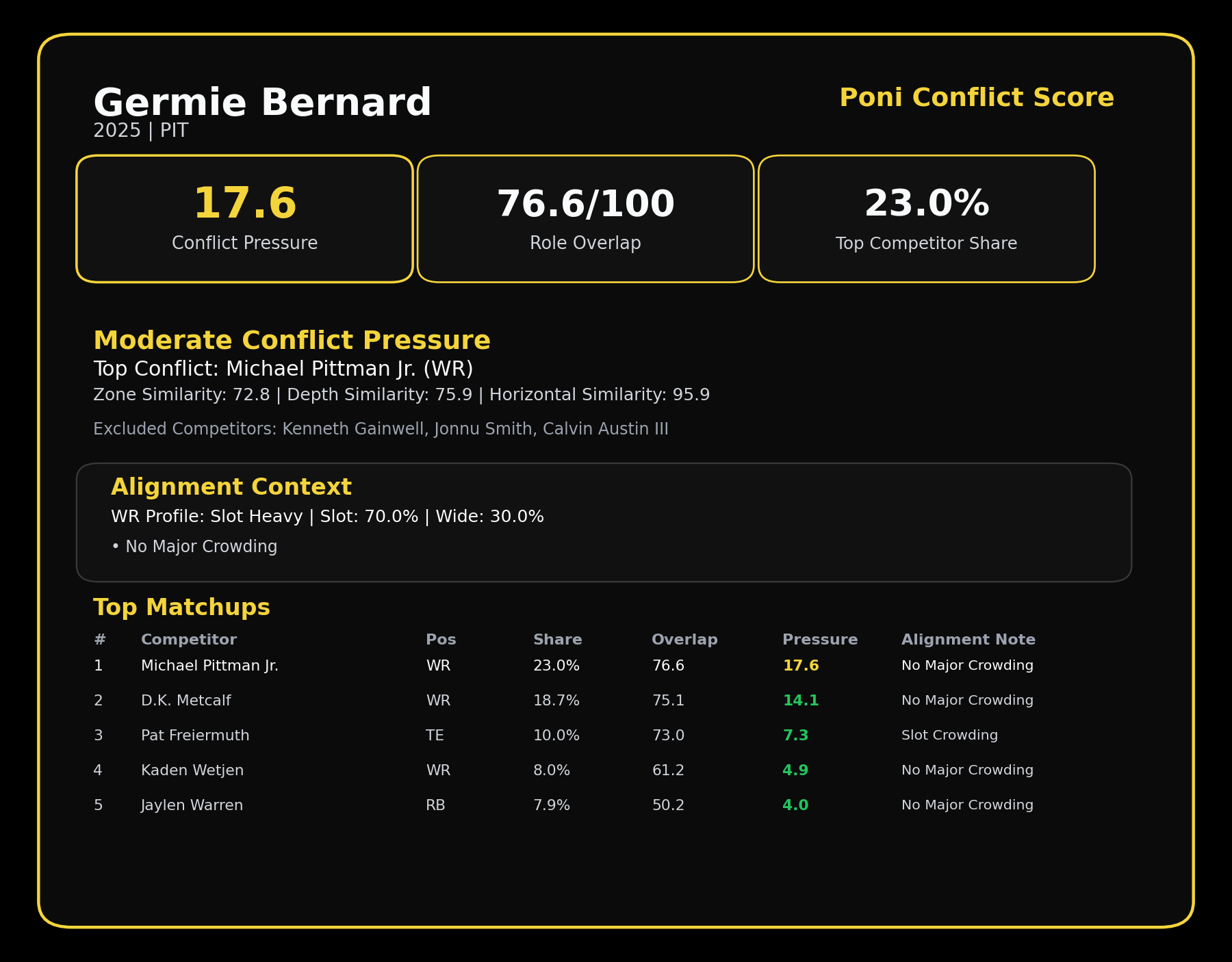
With DK Metcalf and Michael Pittman being the 1/2, let’s see what the Conflict Card says.
Germie Bernard Conflict Card
The good news about the conflict card is that there is very little overlap in alignment. Michael Pittman (70%) and DK Metcalf (80%) are normally asked to line up outside. The only issue I face with this, is that we are assuming Bernard plays out of the slot. When we look at his usage map, it leans much more as an out wide receiver. There might be a learning curve for Bernard with only 23% of his usage in college coming from the short depth.
This might be an unpopular opinion, but I could see Bernard taking some out wide looks from DK. The fall off for DK seems to be inevitable. The question is when in my opinion. I could also see Pittman playing more in the slot than people expect.
The moderate conflict score comes from Pittman specifically due to the role overlap, and my belief that he will be the WR1 on that team. Even with a low target share of 23%, Pittman is a real conflict for Bernard.
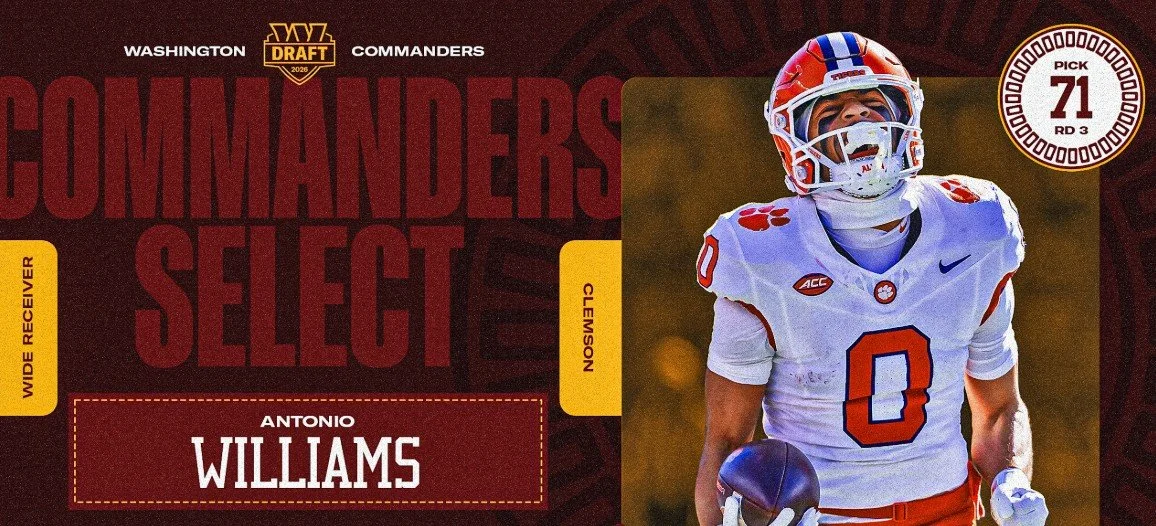
Antonio Williams
Washington, Commanders: Pick 71
Antonio Williams to Jayden Daniels (2 year sample):
Poni Fit Score: 82.0/100
Fit Label: Good fit
Conflict Pressure Score: 14.4 - Low Conflict
Horizontal similarity: 84.2%
Depth similarity: 93.4%
Horizontal rank sample: 5/44
Depth rank sample: 29/44
BLOS: Watch, 21.8%
Antonio Williams is one of the cleaner usage fits so far, and the reason is pretty simple: what he was asked to do in college actually lines up with what Jayden Daniels has shown he will throw!
Williams was basically a true slot player in his final college season, playing 93% of his snaps from the slot. That matches the usage map too. He was heavily middle-of-the-field driven, with 69.4% of his targets coming in the center area. Daniels ranked 5th out of 44 quarterbacks in center-field usage, so this is not one of those fits where I have to squint and talk myself into it. The middle-of-the-field fit is real.
The depth profile also works. Williams’ top depth area was short, and the depth similarity came in at 93.4%. That is a strong number. Now, Daniels was only 29th out of 44 in short-area attempt share, so it is not perfect, but the overall shape still lines up well. Williams lived in the short/middle areas, and Daniels’ passing profile gives him enough access there for the fit to make sense.
Williams had a typical 21.8% BLOS target share, but his non-BLOS target share was still 78.2%. So yes, there is some manufactured-touch context here, but nothing to write home about.
The Washington context is pretty straightforward too. Luke McCaffrey and Treylon Burks are there, but the real target competition starts with soon to be 31-year old Scary Terry. For Williams, the question is less about whether he can become the top option and more about whether Washington gives him a defined slot role that matches what he actually did in college. As a slot wide receiver, there are always concerns on if he will see enough usage to be fantasy relevant. He could get “Josh Downsed”. I’m coining that phrase.
Williams was a slot/middle-field receiver in college, and Daniels has shown he will attack the middle of the field. This is a good fit.
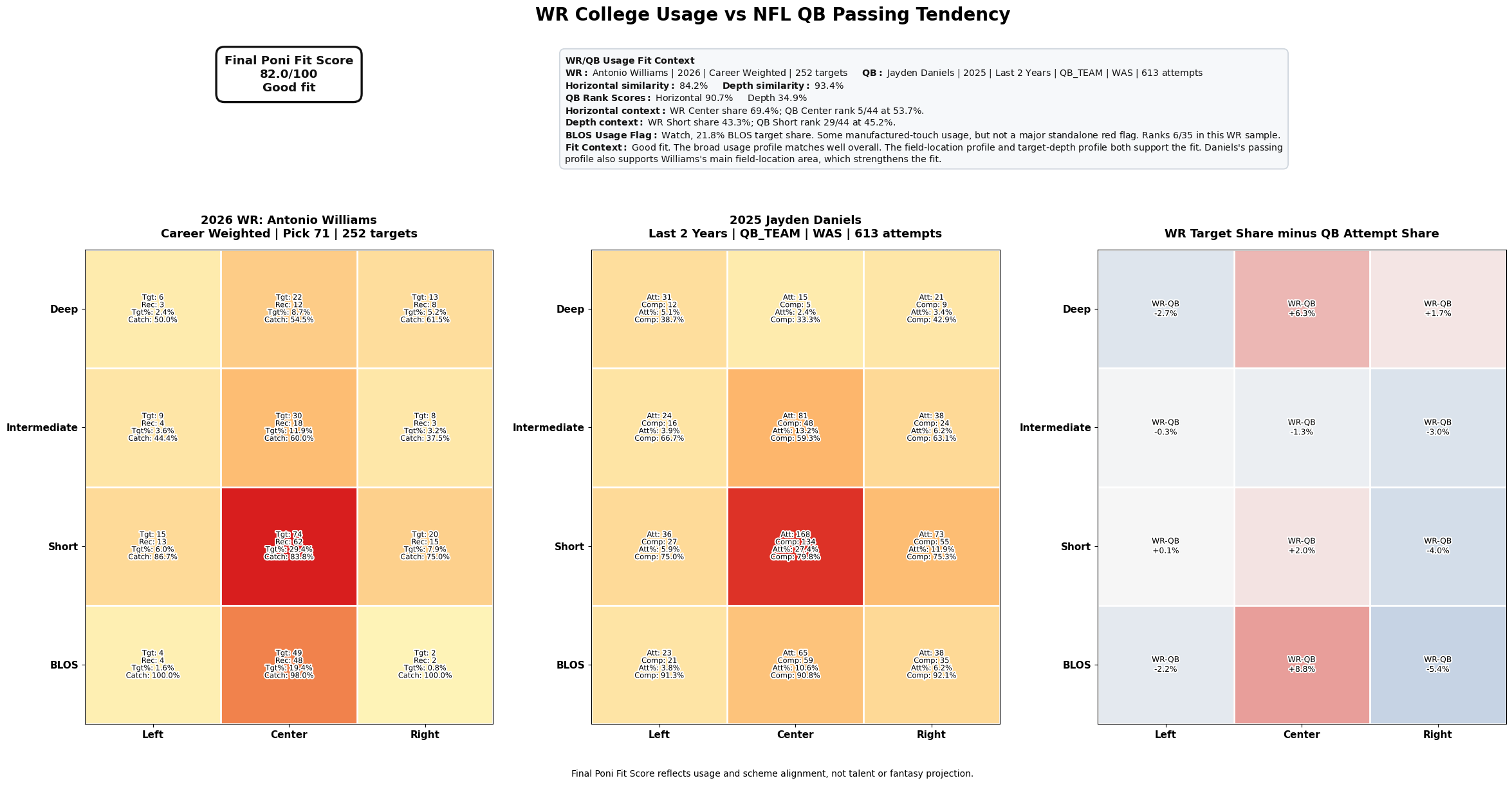
Antonio Williams & Jayden Daniels 12-Zone Map
Let’s see how 31-year old Scary Terry will conflict with Antonio Williams success.
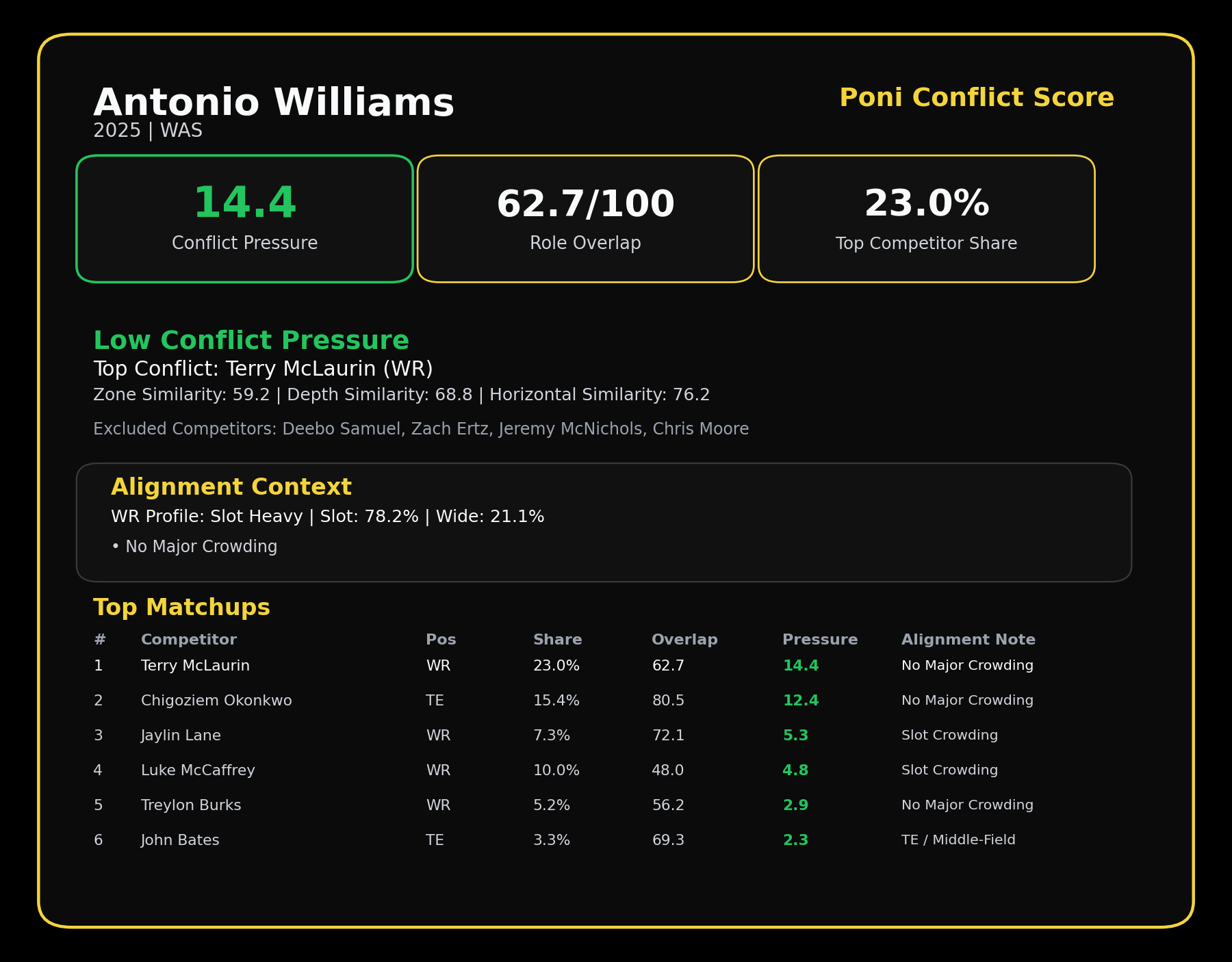
Antonio Williams Conflict Card
As I look at this conflict card, Chig looks like an amazing TE sleeper!
But this is about Antonio Williams, and this is an amazing situation for Williams as well. Terry McLaurin has never had over 23% target share in his career. In addition to that, his role overlap is almost non-existent. Williams usage map actually conflicts with Chig’s the most. There is no real competition around him, so he has a strong usage opportunity to become the lead pass catcher. It’ll come down to actual on field usage and routes run.
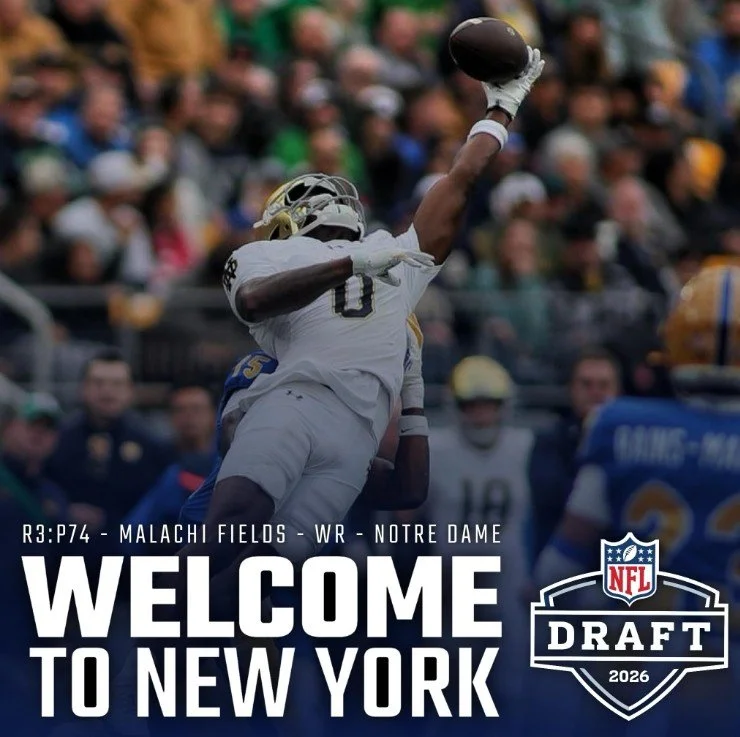
Malachi Fields
New York, Giants: Pick 74
Malachi Fields to Jaxson Dart:
Poni Fit Score: 78.9/100
Fit Label: Good fit (barely)
Conflict Pressure Score: 20.7 - Strong Conflict
Horizontal similarity: 90.8%
Depth similarity: 77.0%
Horizontal rank sample: 25/39
Depth rank sample: 34/39
BLOS: Very low manufactured touches, 3.2%
My buddy Kyle is a Giants fan, so he probably skipped to the Fields profile first. I just need to remind him; I beat you every year in fantasy. Loser. ;) Alright, lets get into it.
Malachi Fields is a good example of why I like looking at the usage map before jumping straight into landing spot takes. On paper, the Giants have a crowded room with Malik Nabers, Darius Slayton, Darnell Mooney, and Isaiah Likely (Jaxson Dart 2026 NFL MVP loading).
Fields played 89% out wide in his final college season, and his usage map backs up the idea that he was not just a gadget or underneath receiver. His BLOS target share was only 3.2%, which is one of the lowest in this group. He also had a 59.7% intermediate/deep target share, also highest in the group until now, so this was a real downfield/out-wide profile. To me, this screams Darius Slayton might be in trouble for his job, not just because he can't catch the ball in the endzone, but because Fields' usage profiles as his replacement. This might be the future WR2 for the Giants if he can perform well enough next to Nabers. His other analytics make it unlikely, and I am not high on him, but the usage data says it's possible.
The model likes the field-location fit with Jaxson Dart. Fields had a more balanced field profile than some of the center-heavy WRs in this class, and the horizontal similarity came in strong at 90.8%. That part is clean. He does not need the offense to force-feed one specific part of the field for the fit to make sense.
The depth profile is where it gets a little less exciting. Fields’ top depth area was technically still short, but his overall profile had plenty of intermediate and deep usage. Dart ranked 34th out of 39 in short-area attempt share, so the top-depth match is not some slam dunk. Still, the broader target-depth fit is workable, and the lack of BLOS usage makes this profile easier to understand.
Fields’ usage fit is good, but it is far from perfect. The question is whether the Giants use him like the outside receiver he was in college, or if he gets buried in a room with Nabers, Mooney, and Slayton. He might be a development project, with the eventual goal of taking that outside WR2 job if he doesn’t get many opportunities in his first year. The path exists based on his usage profile even if it doesn’t happen this year.
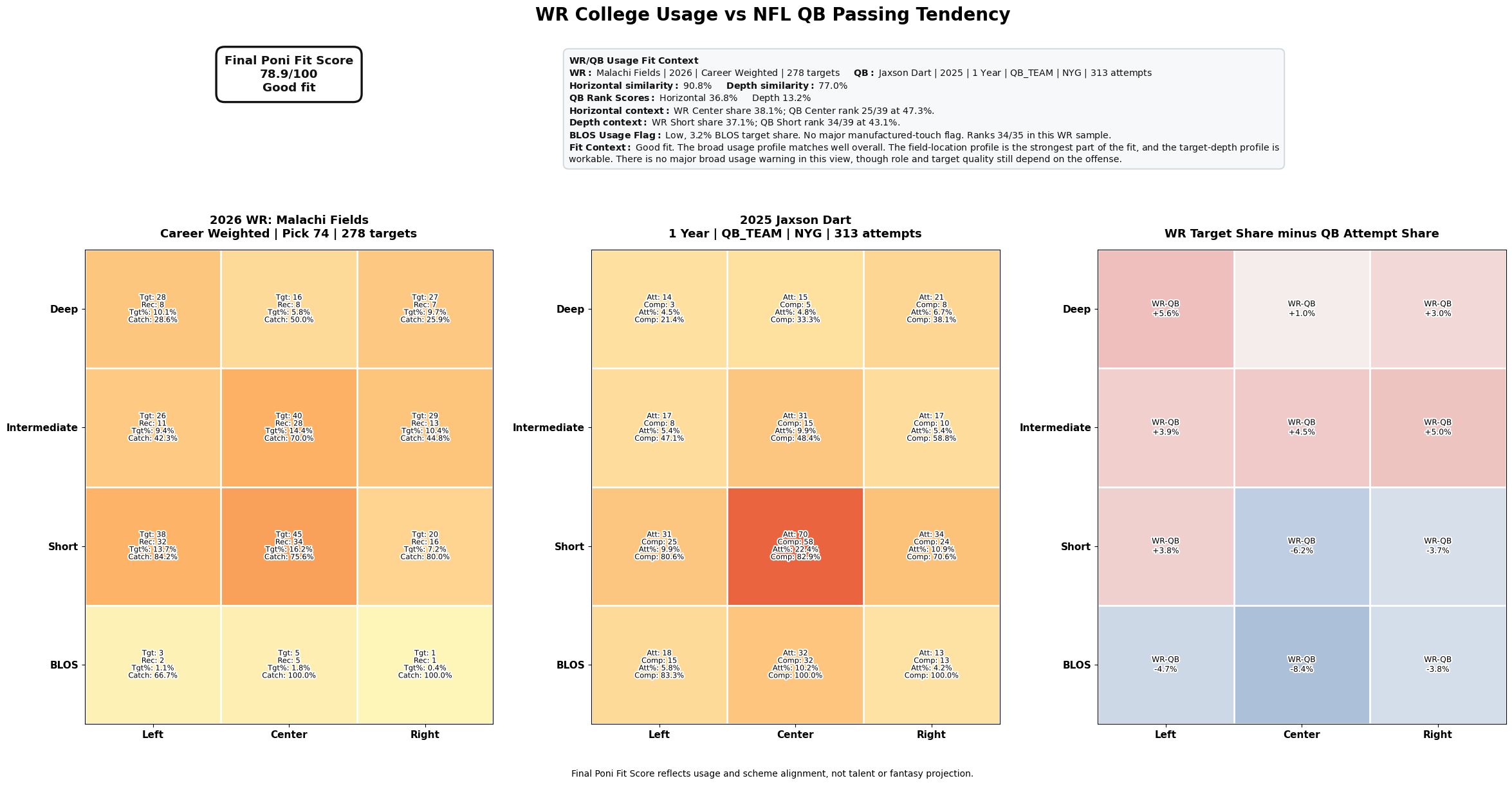
Malachi Fields & Jaxson Dart 12-Zone Map
No surprise here but Malachi Fields has strong competition and a high conflict pressure score.
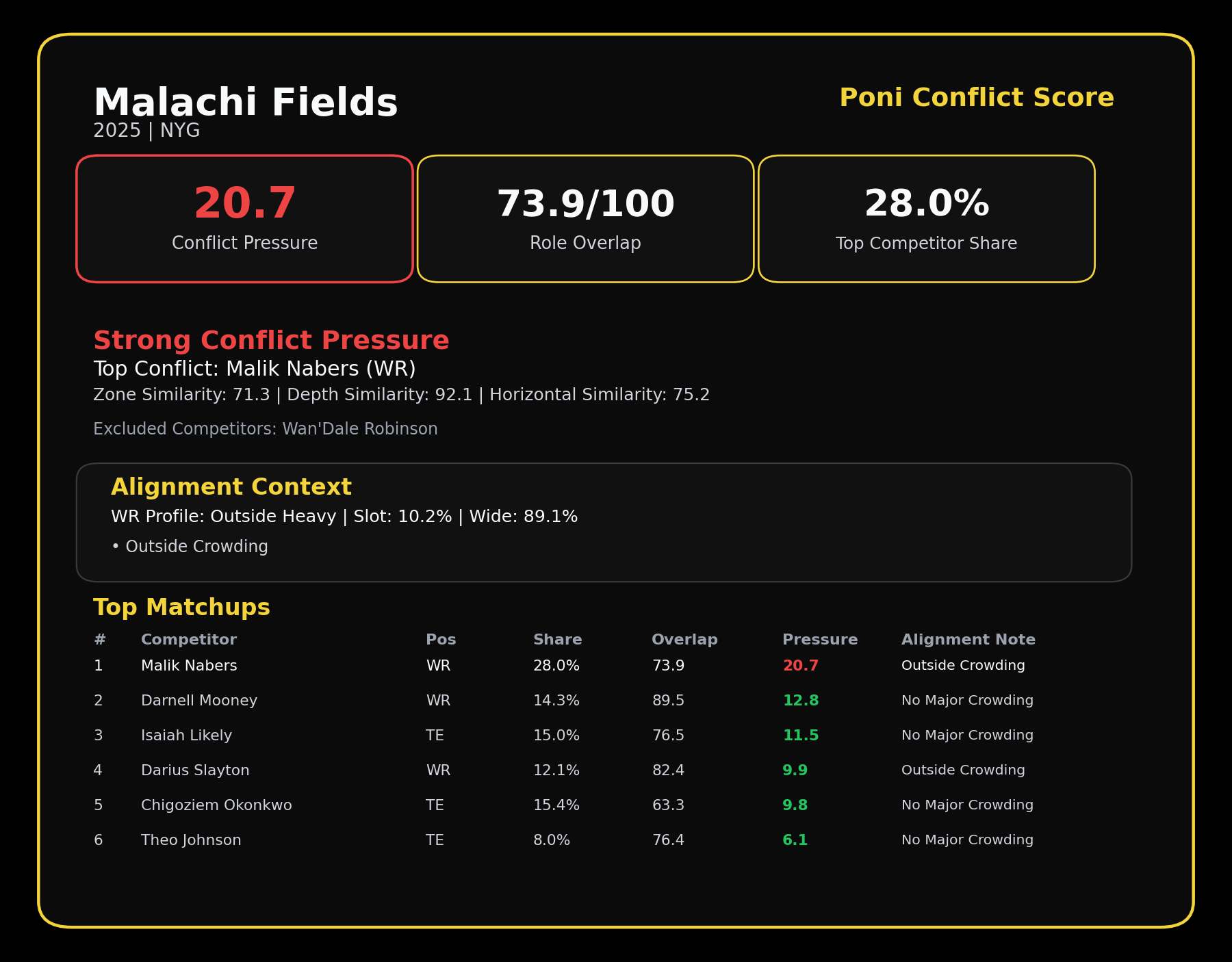
Malachi Fields Conflict Card
Obviously, Malik Nabers is a real threat to the alpha role. But, let’s look at the wide receiver 2 potential. This is really what we are considering. There is a strong overlap with Darnell Mooney and Darious Slayton. I was surprised to see Mooney’s overlap so high, but this is exactly why we let the data drive our findings. The route to wide receiver one feels impossible, and the path to wide receiver two doesn’t seem much better. Especially in year one.
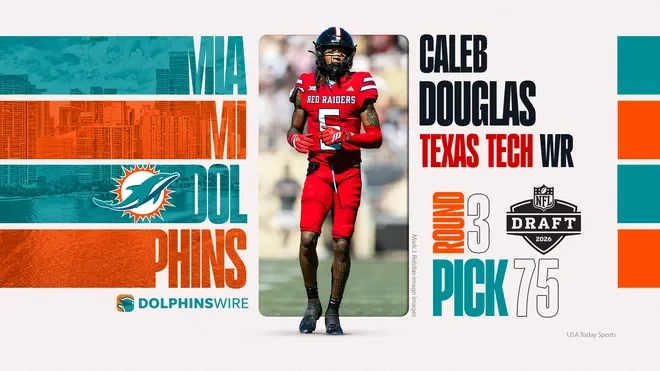
Caleb Douglas
Miami, Dolphins: Pick 75
Caleb Douglas to Malik Willis:
*Poni Fit Score: 70.7/100
Fit Label: Mixed fit/ Neutral (barely)
Conflict Pressure Score: 8.6 - Low Conflict
Horizontal similarity: 75.9%
Depth similarity: 80.9%
Horizontal rank sample: 57/57
Depth rank sample: 52/57
BLOS: Low manufactured touches, 10.0%
Caleb Douglas is one of those fits where the depth chart looks friendlier than the usage map. Malik Washington, Jalen Tolbert, Tutu Atwell, Greg Dulcich, and fellow rookie Chris Bell are not exactly a “good luck earning targets, kid” group. So from an opportunity standpoint, this is not a bad room to walk into.
The tricky part is the quarterback sample. I used Malik Willis’ usage chart, but I need to be honest about the data. He only had 87 pass attempts over the past two years. This is honestly nothing, and is not the same as looking at a full-time starter with hundreds of pass attempts. A few passes can swing the percentages, so I would treat the Willis fit score much more carefully than some of the other QB fits.
And honestly, the fact that a guy who could not beat out Ryan Tannehill, Josh Dobbs, or Will Levis a few years ago is now sitting here as the projected starter is wild. It shows the NFLs desperation for quarterbacks.
With that said, using the data I do have, the fit is uneven. Douglas played 83% out wide in his final college season, and his profile was not built on cheap touches. Only 10.0% of his targets came behind the line of scrimmage, while 54.7% came in the intermediate and deep areas. That is a cleaner outside/downfield profile than the score alone might suggest.
The issue is that Willis’ passing profile does not really match the areas Douglas leaned into. Douglas had 46.8% of his targets come in the center of the field, but Willis ranked 57th out of 57 quarterbacks in center-field usage. That is not great. But again, with only 87 attempts, I would not treat that rank like it is carved in stone. It is a warning sign, not a final verdict.
The depth side is not much cleaner. Douglas’ top depth area was short, and Willis ranked 52nd out of 57 in short-area attempt share. The broader depth similarity was still 80.9%, so there is some overlap here, especially in spots like short center, short right, and intermediate right. But this is not a plug-and-play usage fit.
Douglas has a cleaner player profile than the team fit score. The low BLOS number and 54.7% intermediate/deep share are positives. The target competition is not terrifying either. But because the QB sample is so small, I would be careful overreacting to the exact score. This is a workable fit with a shaky data sample, not a clean usage match.
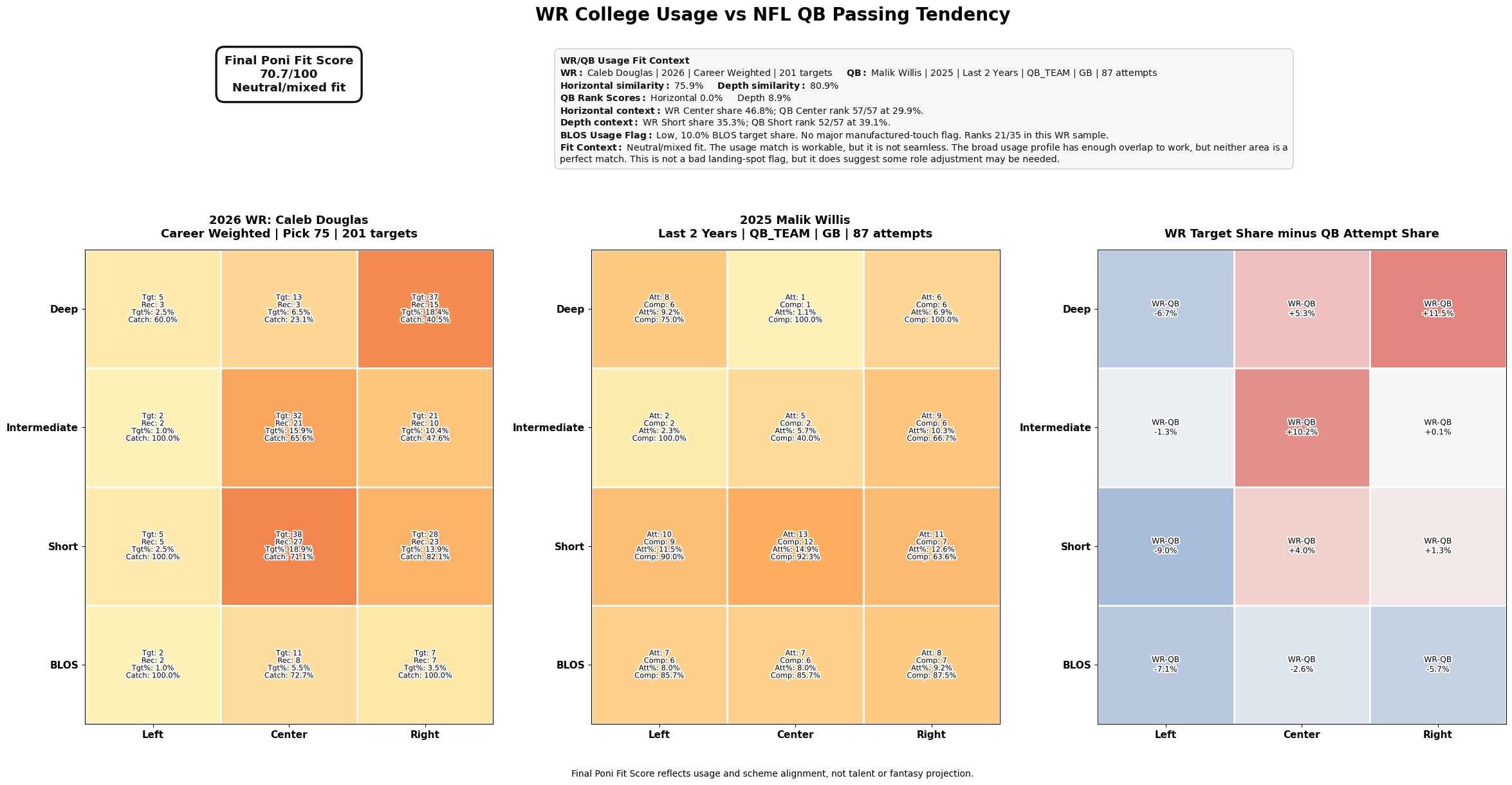
Caleb Douglas & Malik Willis 12-Zone Map
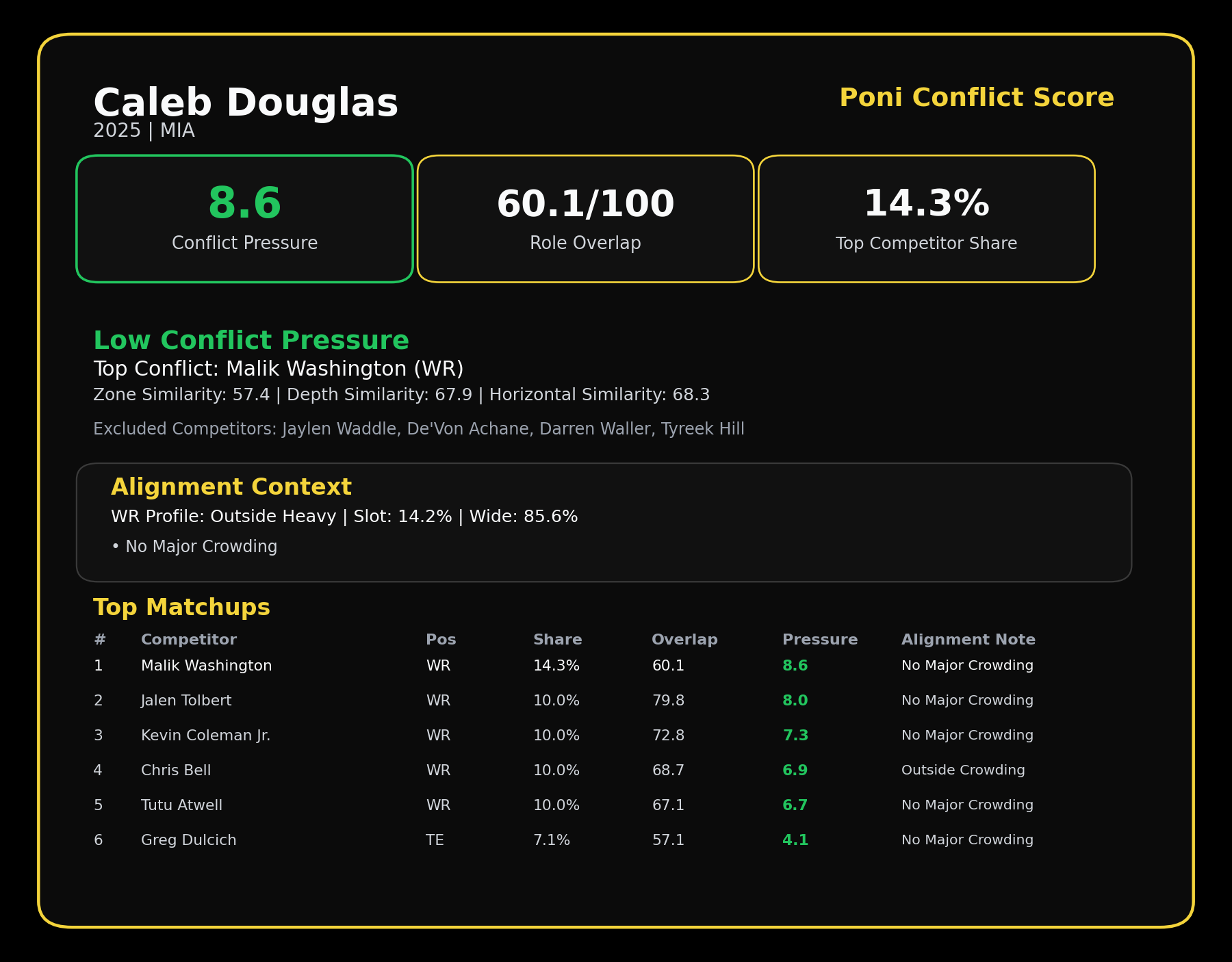
Caleb Douglas Conflict Card
I removed Achane from this sample, just to look at all the players who he really will be competing with. There is no surprise that the conflict pressure score is very low. The room is wide open.
The context we can learn from the card is the role these players play on an offense. Miami is projected to lose a lot in 2026, which means they will be passing a lot. Picking the right wide receiver or tight end in this room, could lead to a big fantasy hit.
Chris Bell
Miami, Dolphins: Pick 94
Chris Bell to Malik Willis:
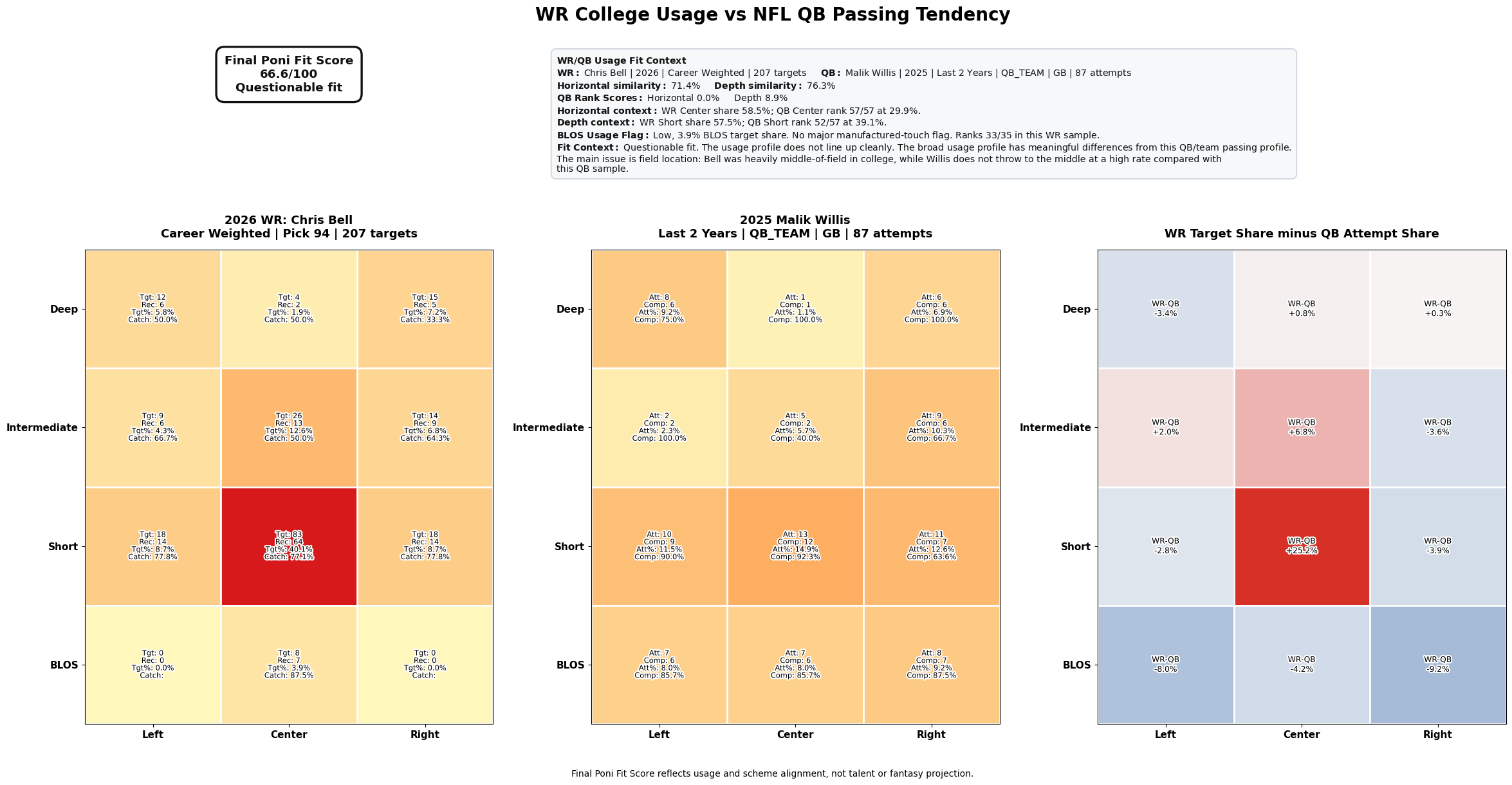
*Poni Fit Score: 66.6/100
Fit Label: Questionable fit
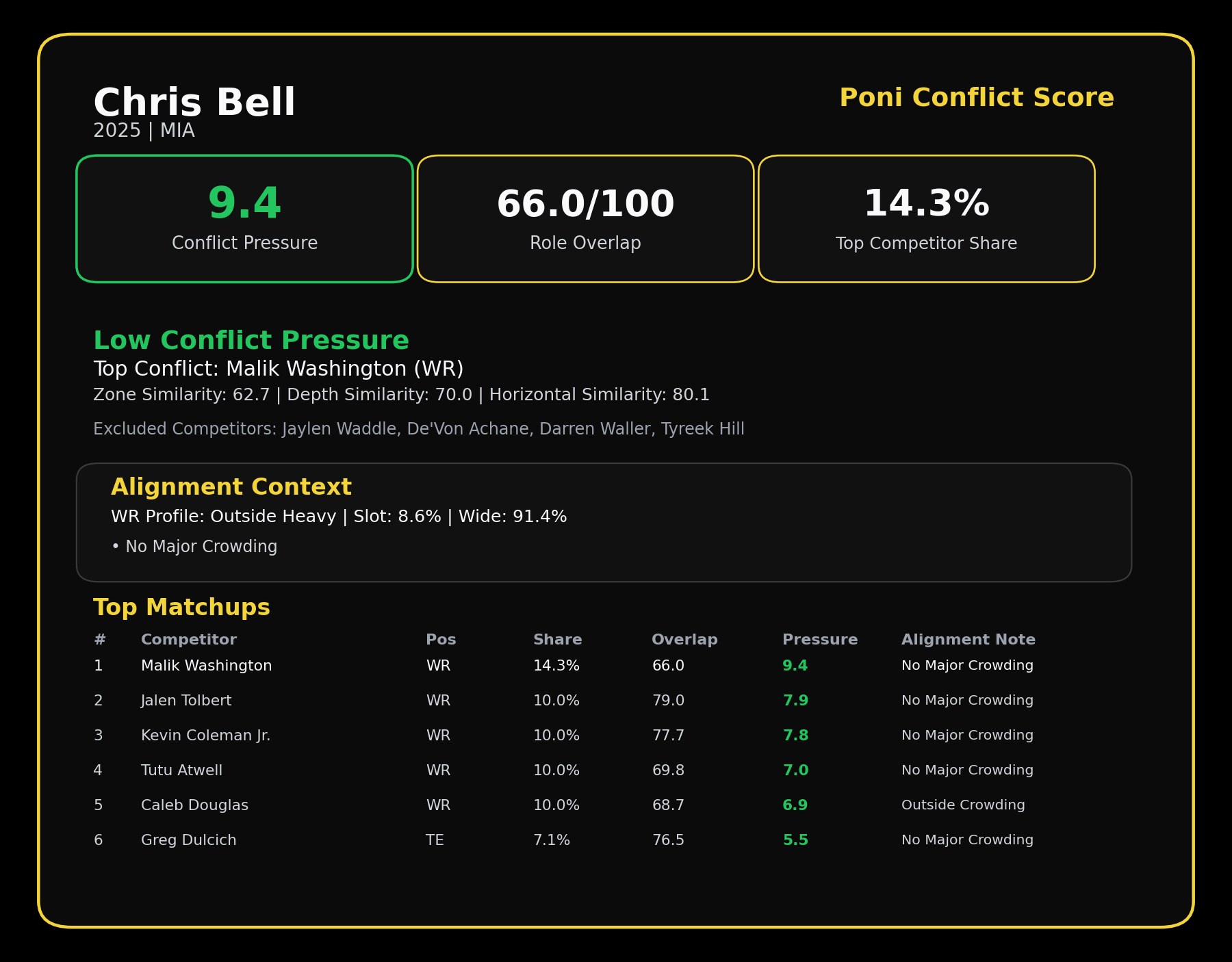
Conflict Pressure Score: 9.4 - Low Conflict
Horizontal similarity: 71.4%
Depth similarity: 76.3%
Horizontal rank sample: 57/57
Depth rank sample: 52/57
BLOS: Low manufactured touches, 3.9%
Caleb Douglas and Chris Bell are actually a good example of why usage maps matter. On the surface, they are both rookie receivers entering a room without much target competition. But they were not used the same way in college.
We know Douglas was more of the cleaner outside/downfield profile. Bell is different. He played 65% out wide and 35% in the slot, so he was not a pure slot player, but his target map was much more short/middle driven. His top depth area was short at 57.5%, and 58.5% of his targets came in the center of the field. That is a very different target profile than Douglas. Bell was not being fed manufactured touches either, with only a 3.9% BLOS target share, but his work came much closer to the line of scrimmage.
That is where the two can complement each other. Douglas gives you more of the intermediate/deep outside profile. Bell gives you more of the short/intermediate middle-of-the-field profile. There is some overlap because both were low-BLOS receivers and both can play out wide, but the way they were targeted was not the same. The issue is not whether they can coexist. The issue is whether Willis and the offense can actually support the wide receiver's role.
I do not want to overreact to the exact score for either of these players.
Chris Bell & Malik Willis 12-Zone Map
Chris Bell Conflict Card
Zachariah Branch
Atlanta, Falcons: Pick 79
Zachariah Branch to Michael Penix Jr.
Zachariah Branch to Tua Tagovailoa
Zachariah Branch is probably the best example so far of why the quarterback matters in this model. Same player. Same college usage profile. Completely different fit depending on who is throwing him the ball.
Branch’s profile is pretty specific. He was not a traditional outside receiver winning downfield. He played 80% out of the slot his final college season. His career-weighted usage was built around the middle of the field and manufactured touches. He had 70.7% of his targets come in the center of the field, and a massive 44.5% of his targets came behind the line of scrimmage. Yuck.
With Michael Penix Jr., the fit gets ugly fast. Penix ranked 44th out of 44 quarterbacks in center-field usage and 33rd out of 44 in BLOS attempt share. That is a rough match for a player whose college usage lived in those exact areas. Penix is not naturally a match with what Branch was asked to do in college.
With Tua Tagovailoa, it is a completely different conversation. Tua ranked 6th out of 45 in center-field usage and 4th out of 45 in BLOS attempt share. That lines up much better with Branch’s actual profile. The score jumps all the way to 82.4, which puts him in the good fit range. This is where the model actually sees a role that makes sense. Sure you could argue this was due to a Mike McDaniel system, but it’s still an important takeaway.
But here is the catch, and it is a big one. Branch’s BLOS number is extreme no matter who the quarterback is. A 44.5% BLOS target share is not just “some designed touches.” That is a massive part of his profile. So even when the fit looks good with Tua, it clearly looks like he is a screen merchant. A player can match an offense because both sides like screens and quick touches, but that does not automatically remove the translation to the NFL question.
Branch is a much better usage fit with Tua than Penix. That part is not close. But Branch is still a very specific type of player. If the offense has a real plan for him as a motion/YAC/space weapon, the Tua version makes sense. If not, this can get gadgety in a hurry.
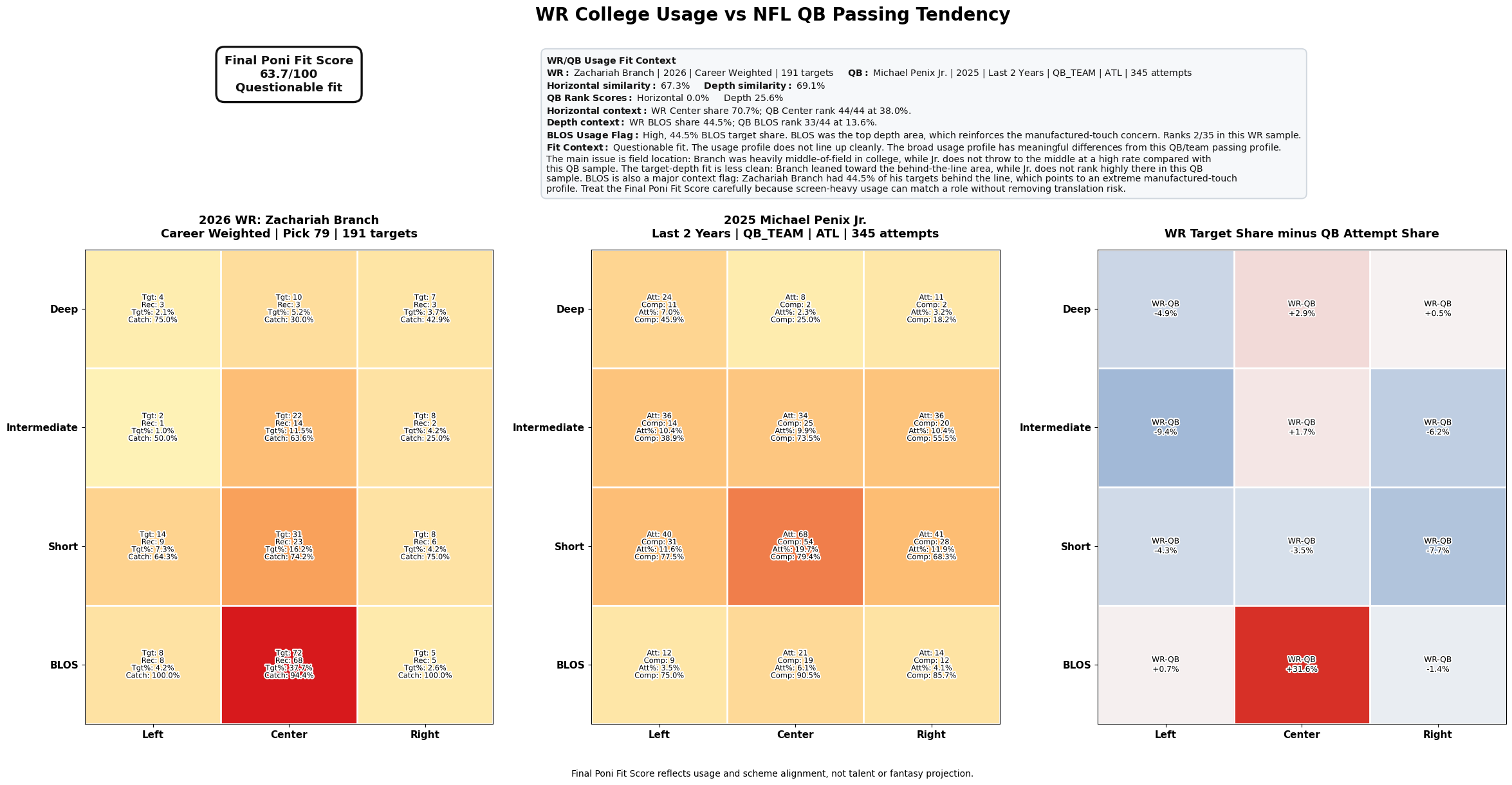
Zachariah Branch & Michael Penix Jr. 12-Zone Map
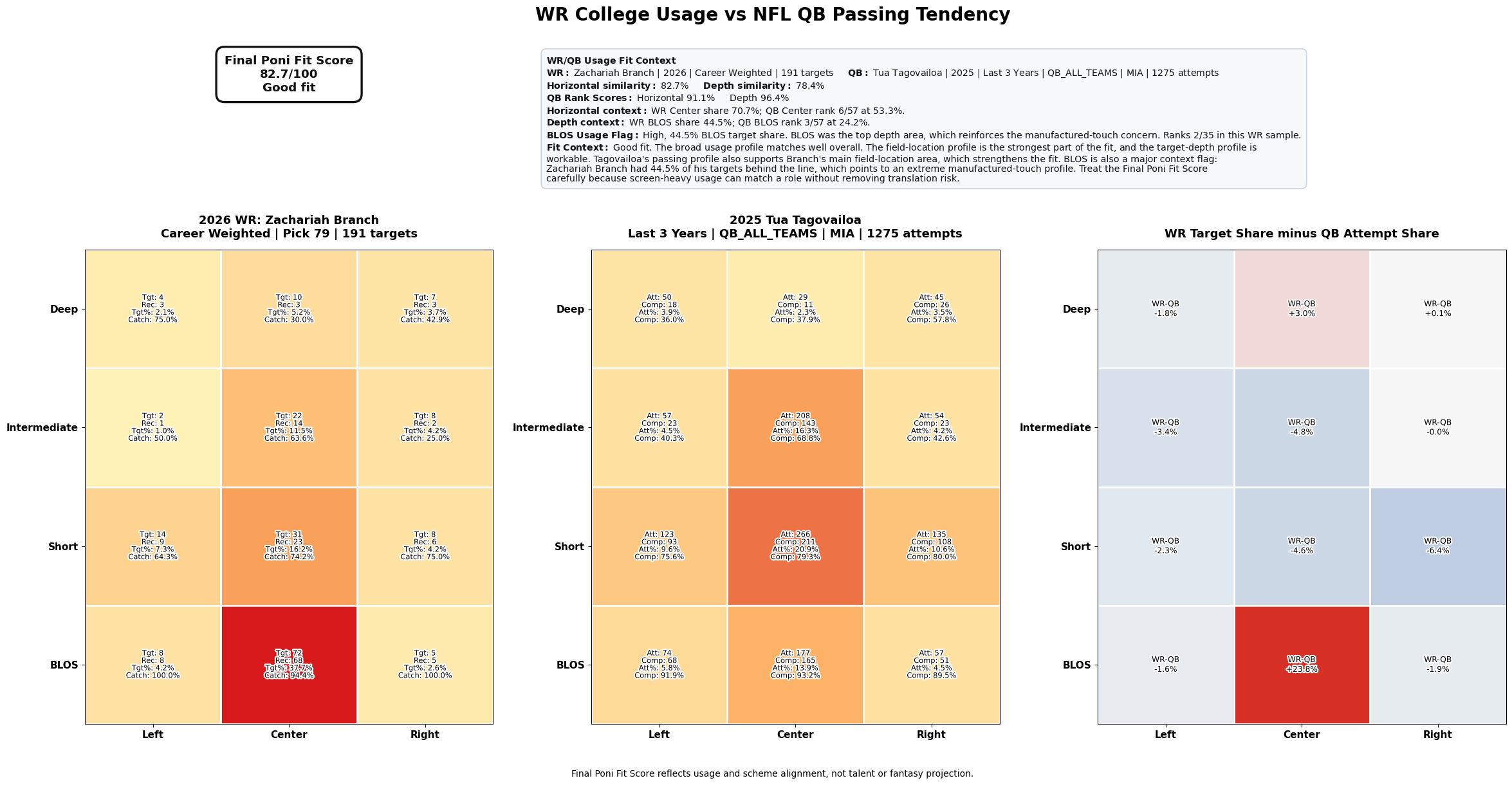
Zachariah Branch & Tua Tagovailoa 12-Zone Map
Let’s see what the conflict card tells us about his situation.
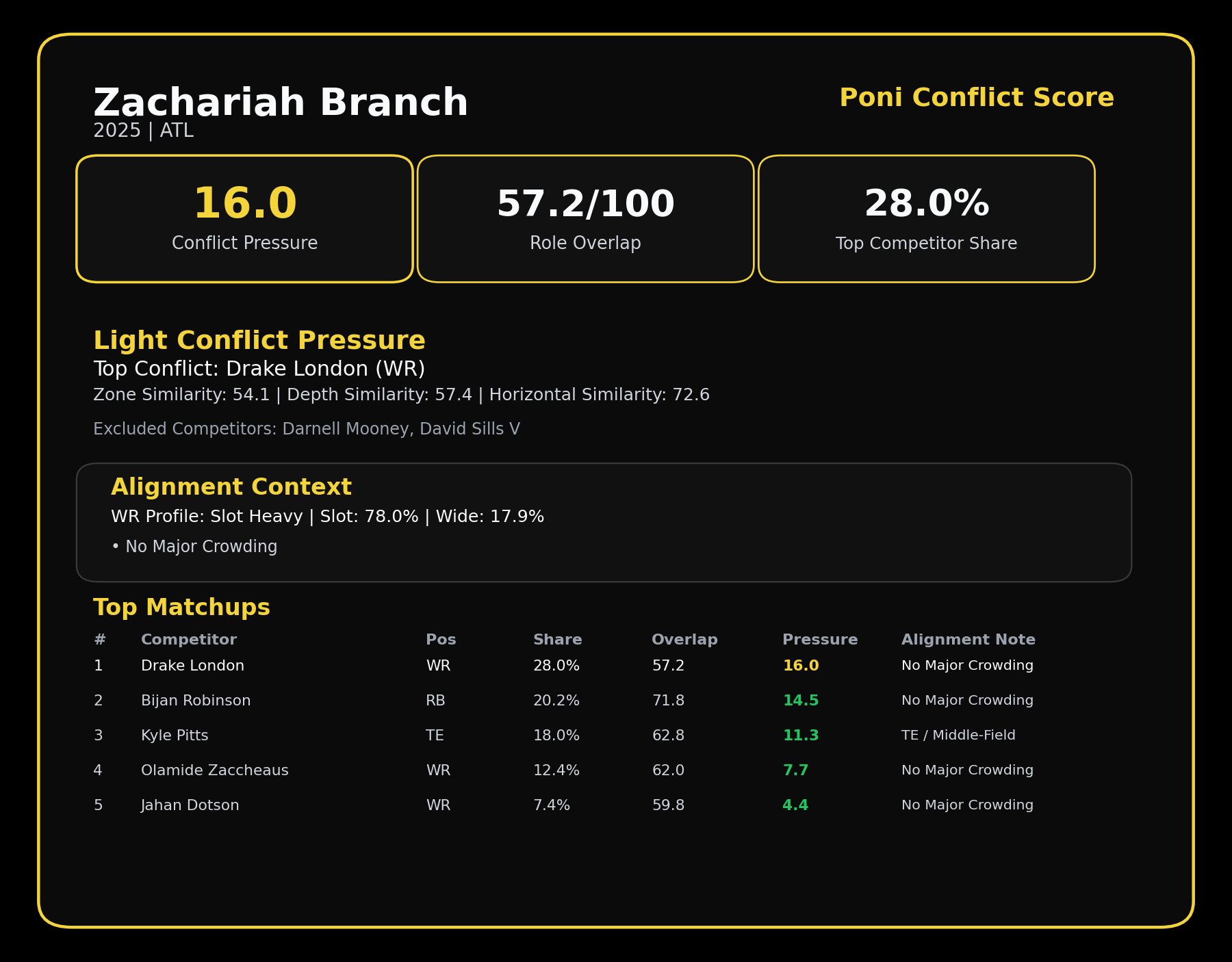
Zachariah Branch Conflict Card
I was a little shocked by the conflict scoring being so low. But it’s because of the insanely low overlap in roles. While on the surface Drake and Branch will be competing for targets, they are completely different players and would be used very differently in the offense. Branch and Bijan seem to be competing for similar usage, which would make sense with Branch's high BLOS/short yardage passing usage.
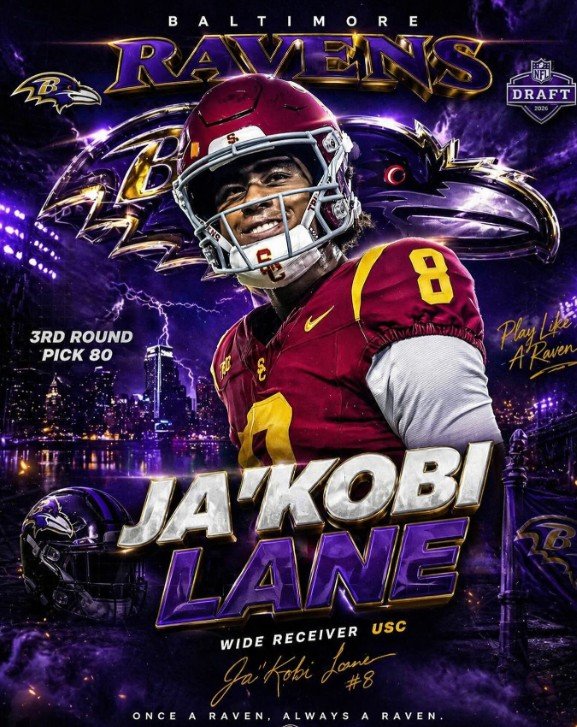
Ja'Kobi Lane
Baltimore, Ravens: Pick 80
Ja’Kobi Lane to Lamar Jackson:
Poni Fit Score: 82.7/100
Fit Label: Good fit
Conflict Pressure Score: 23.2 - Severe Conflict
Horizontal similarity: 93.2%
Depth similarity: 86.2%
Horizontal rank sample: 23/45
Depth rank sample: 41/45
BLOS: Low manufactured touches, 4.3%
Ja’Kobi Lane is a good fit with Lamar Jackson, and this one is pretty easy to understand once you look at the usage map. Lane had very little manufactured touches in college (4.3% BLOS).
The part that stands out is how naturally his field-location profile matches Lamar. Lane had 54.3% of his targets come in the center of the field, and the horizontal similarity came in at 93.2%. That is very strong. Lamar was not elite in center-field rank, sitting 23rd out of 45, but the overall shape of the usage still lines up well.
The depth profile also works. Lane’s top depth area was short, but that undersells the profile a little bit. He had 55.1% of his targets come in the intermediate and deep areas, so this is not just a short-area possession profile. There is actual route depth here. The one note is that Lamar ranked 41st out of 45 in short-area attempt share, so the top-depth rank is not perfect. Still, the overall depth similarity was 86.2%, which keeps this in a good range.
The Baltimore target competition is tough, but it is also pretty clear. Zay Flowers, Rashod Bateman, and Mark Andrews are the names that matter. That does not crush the fit, but it does mean Lane probably needs a defined role instead of just being thrown into the general Ravens pass-catching blob and hoping it sorts itself out. Lamar may not be a perfect match in Lane’s top depth area, but the overall usage map says there is a real fit here. In the next breakdown, I am going to compare him and Elijah Sarratt’s usage/ profile.
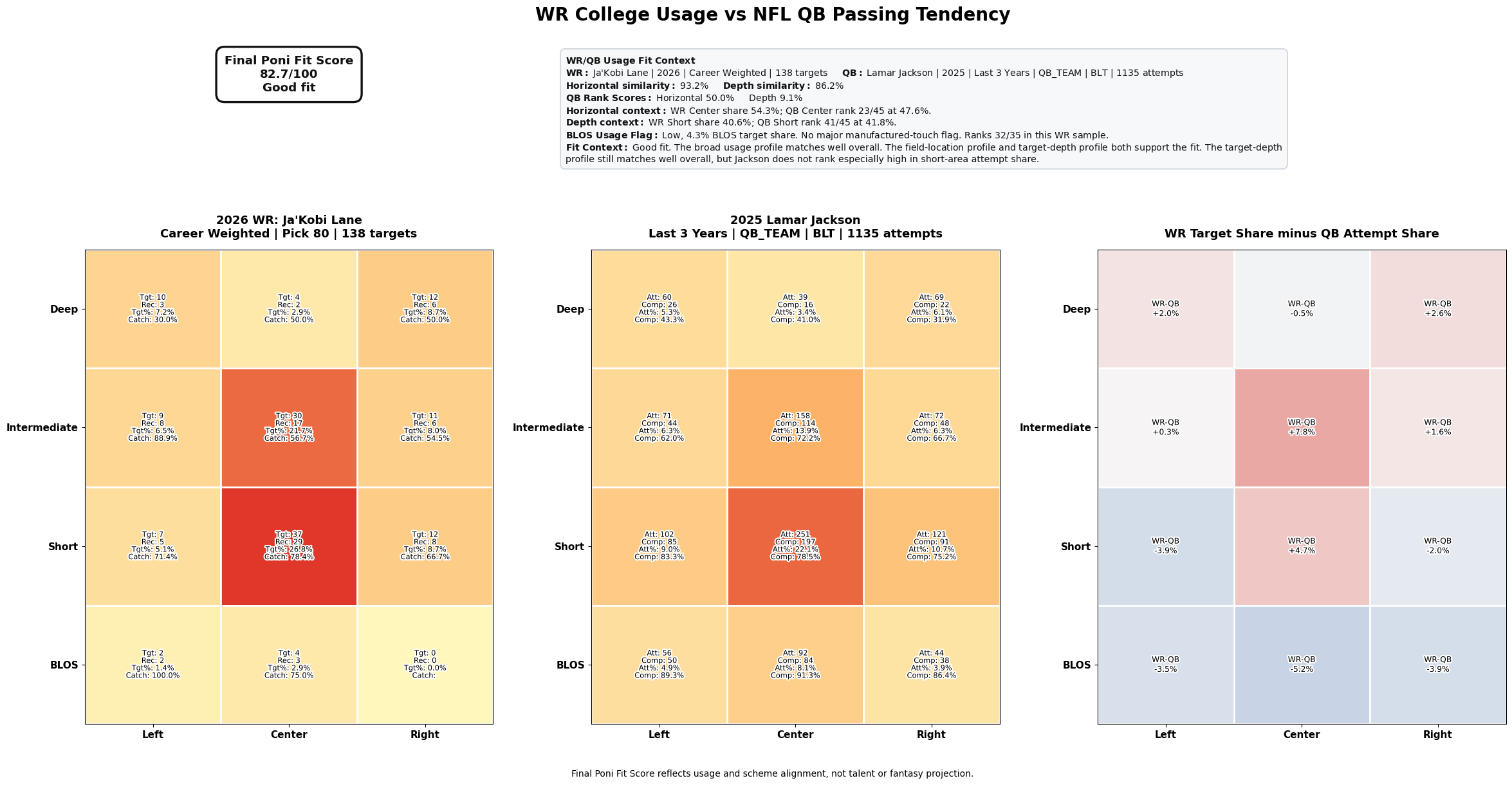
Ja’Kobi Lane & Lamar Jackson 12-Zone Usage Map
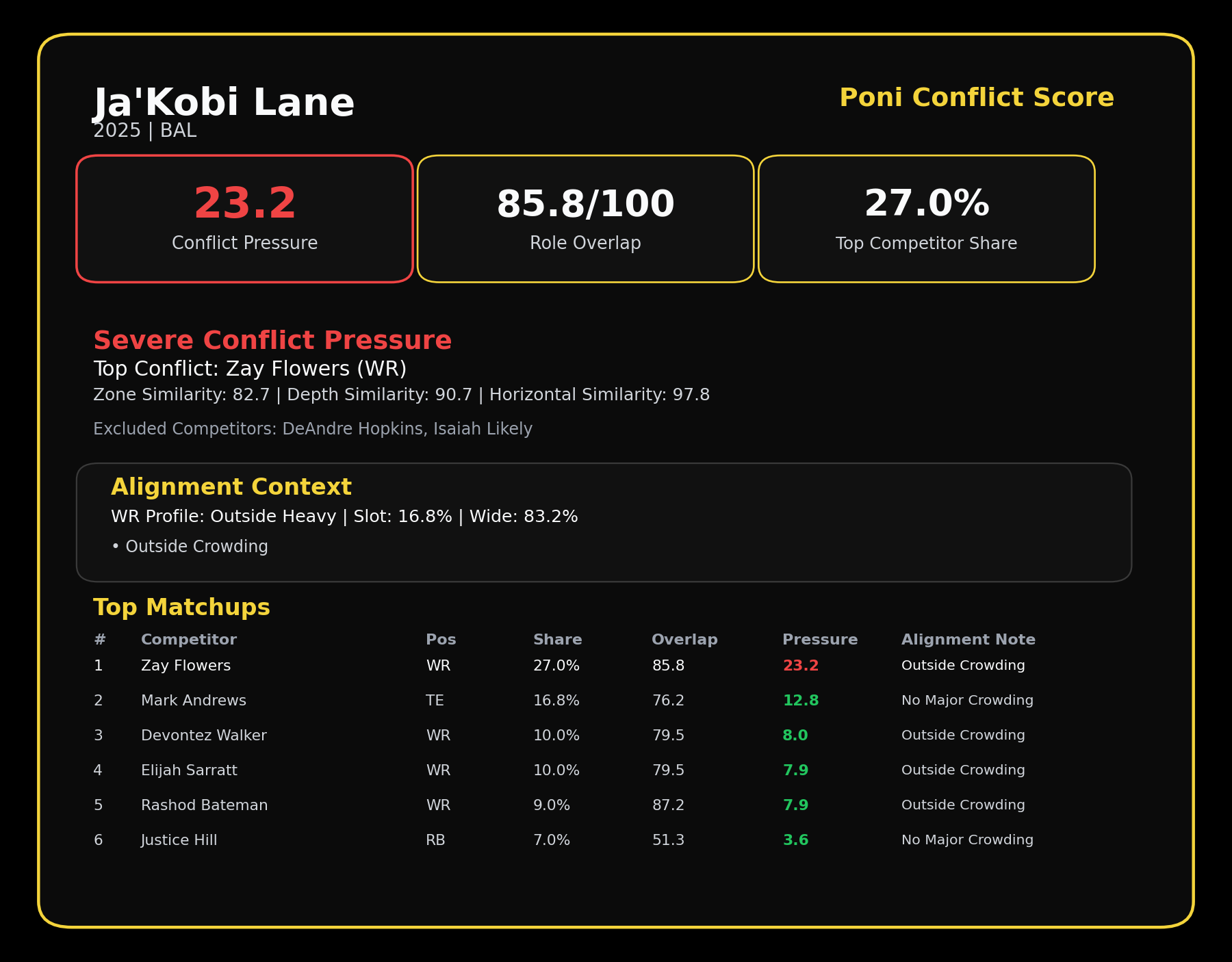
Ja’Kobi Lane Conflict Card
There is obviously a strong conflict with Zay Flowers, but if you believe in Ja’Kobi Lane, the overlap in roles with both Zay, Bateman, and the rest of the team is a green flag.
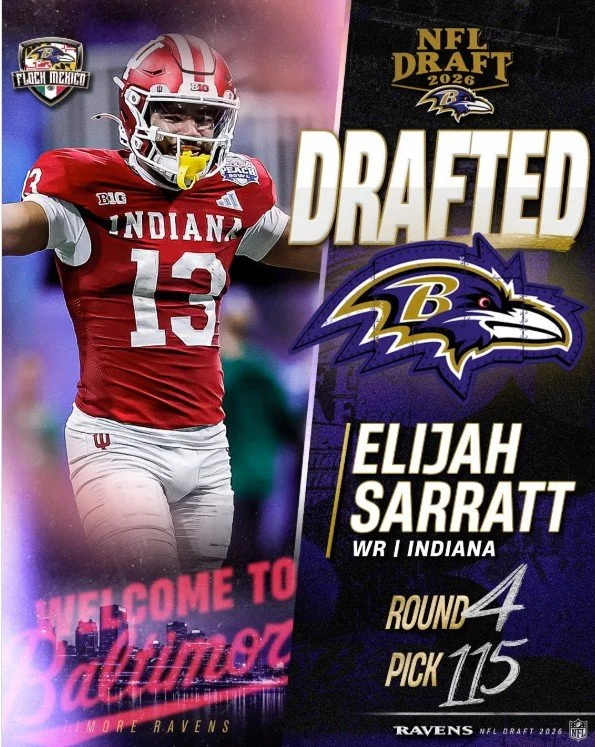
Elijah Sarratt
Baltimore, Ravens: Pick 115
Elijah Sarratt to Lamar Jackson:
Poni Fit Score: 84.0/100
Fit Label: Good fit
Conflict Pressure Score: 21 - Strong Conflict
Horizontal similarity: 82.6%
Depth similarity: 85.2%
Horizontal rank sample: 23/45
Depth rank sample: 6/45
BLOS: Low manufactured touches, 5.6%
If you made it this far congratulations. You have stumbled upon one of my deep sleepers, Elijah Sarratt! While this article's focus has been my usage map, I am going to deviate a bit for Elijah and write this more up as a player profile.
I fully expect Sarratt to overtake Devontez Walker spot on the depth chart at some point this season. I wouldn’t be surprised if it happened before the start of the season. I then expect Sarratt to overtake Rashod Bateman. These are bold claims, I know, but I really like the profile. Let me explain why I love Sarratt and belive he is being slept on; while having a path to production.
First, my wide receiver model has Sarratt as the highest ranked non-first round pick. This class is overall weak, but it’s very optimistic for a 4th round pick to rank that high.
While breakout age typically gets overshadowed by draft capital, I took some time to see how it correlated with late round wide receiver picks. Using my personal breakout definition, thresholds, age, and a ton of testing, I was able to find a correlation in identifying potential sleepers. While the sample size is small, I thought it was a winning find.
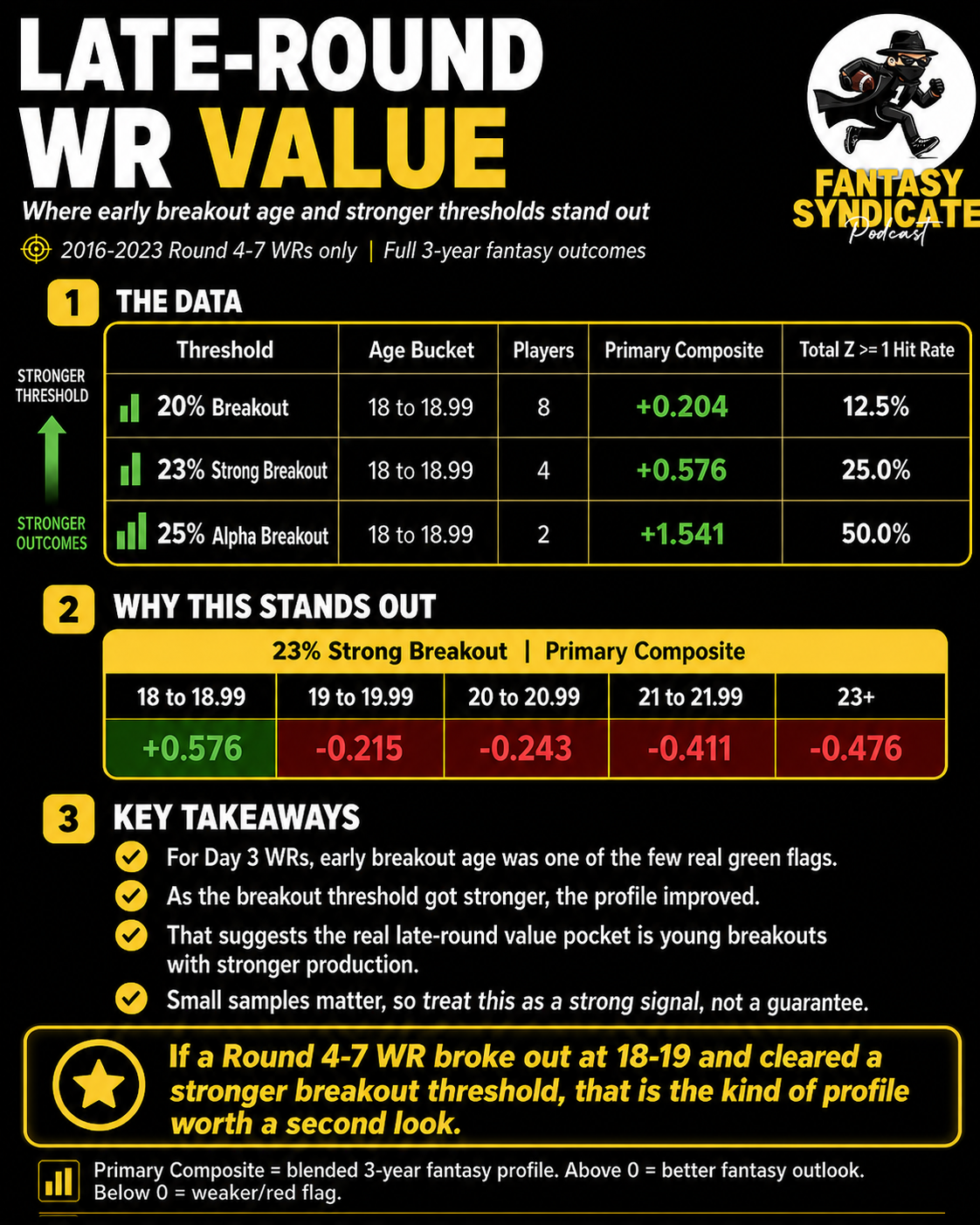
Here is Elijah Sarratt's track record:
Freshman: Saint Francis University, 42 receptions, 700 yards, 13 touchdowns.
Yes, I understand this is a D3 but I’m absolutely counting it.
Sophomore: James Madison University, 82 receptions, 1191 yards, 8 touchdowns
Yes, it's an FBS…I DO NOT CARE.
Junior: Indiana University, 53 receptions, 957 yards, 8 touchdowns
WR1, ahead of 1st round draft pick Omar Cooper Jr.
Senior: Indiana University, 65 receptions, 830 yards, 15 touchdowns
Total stats didn't tell the full story. WR2 finish, but really he was the WR1, again, ahead of 1st round pick Omar Cooper Jr.
This is the full story. Sarratt got injured before halftime in week 8 vs UCLA. He then proceeded to miss the next 3 games (4 games total). Up until this point, he had 45 receptions, 606 yards, 10 touchdowns. Cooper aka 1st round draft pick Omar Cooper Jr. stat line was 39 receptions, 583 yards, and 7 touchdowns. Now these two play extremely different roles. They actually complimented each other extremely well, so it’s difficult to compare the two, and I understand baseline stats aren't everything.
The trend that you noticed from Sarratt is that he dominates wherever he goes. Do you want a wide receiver who has a history of being one of the best players on his team, regardless if its D3, FSB, or the Big Ten? I do.
He arguably out alphaed 1st round pick Omar Cooper Jr. for multiple years, met the breakout age sleeper threshold, is clearly a dog, has a nose for the endzone, and fits exceptionally well alongside Zay Flowers and Lamar Jackson. This guy absolutely has enough green flags to make him my sleeper. I would love for him to become the Ravens future wide receiver 2, and I see this as a very realistic path. Maybe even future WR1. I am all in!
Now let’s jump back into the usage map fit, and make some comparisons to Lane. Sarratt and Lane were both players who were mostly outside receivers in their last college season (Lane 80%, Sarratt 86%). So from an alignment standpoint, they both have outside wide receiver profiles. But the usage map tells us Sarratt is stronger in a key area.
Sarratt’s top depth area was intermediate, with 39.6% of his targets coming there and 56.1% of his usage came in the intermediate/deep areas. Lamar ranked 6th out of 45 quarterbacks in intermediate attempt share. There is real usage overlap here. I truly wonder if the reason for the Ravens to go back to back with wide receiver picks in the 3rd and then 4th round, was because of Sarratt's fit and their shock at him falling.
Anyways, Lane was asked to be an intermediate/deep receiver, his main depth usage was short. He also was never the best wide receiver on his team in college (1st round pick Makai Lemon). Sarratt looks like the better match to one of Lamar’s stronger passing areas.
While I absolutely loathe betting on any wide receiver outside the 2nd round and even first 100 picks, Elijah Sarratt is basically free and people continue to sleep on his talent, profile, scheme fit, and path to usage. Draft this man!
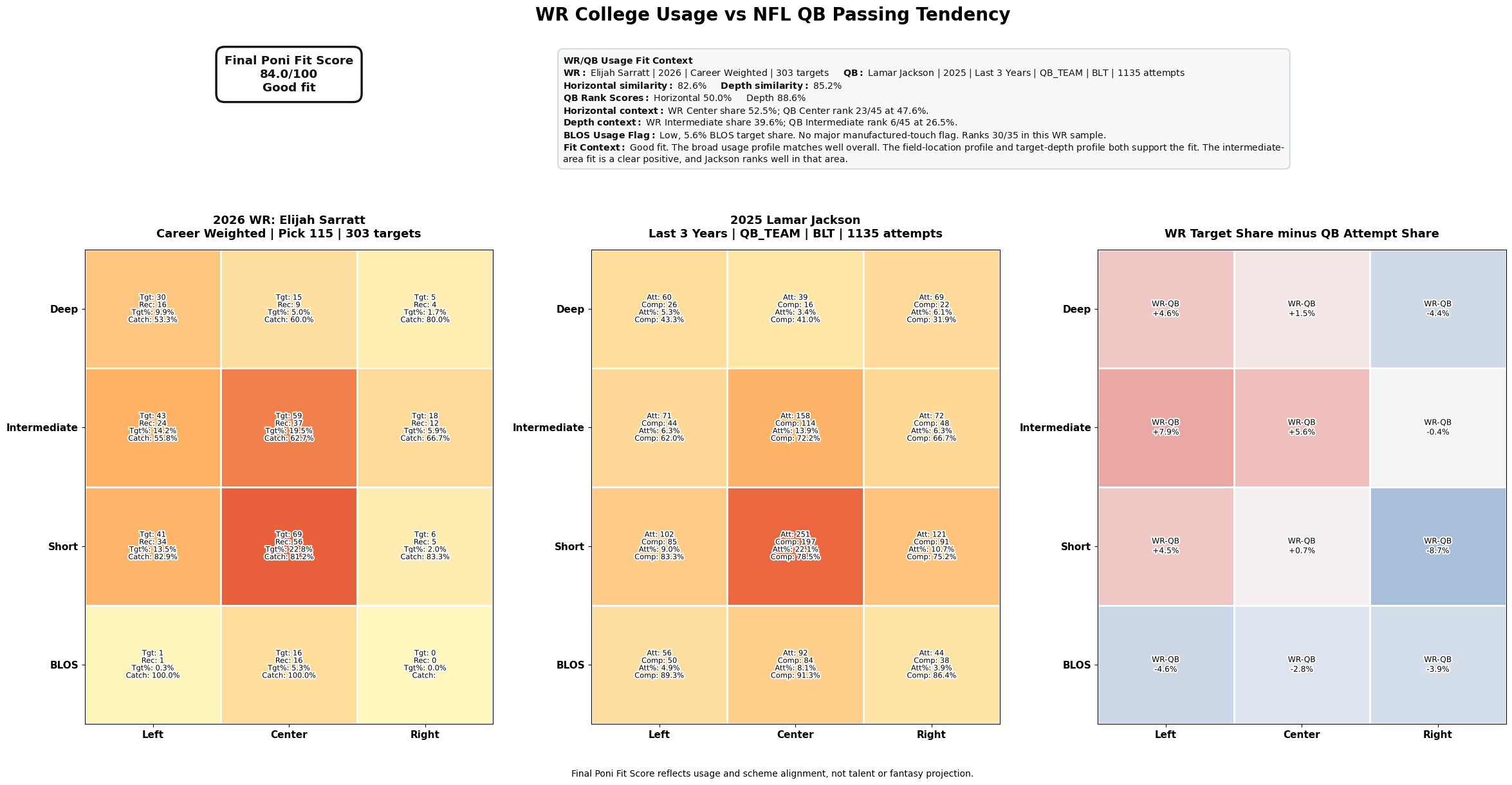
Elijah Sarratt & Lamar Jackson 12-Zone Usage Map
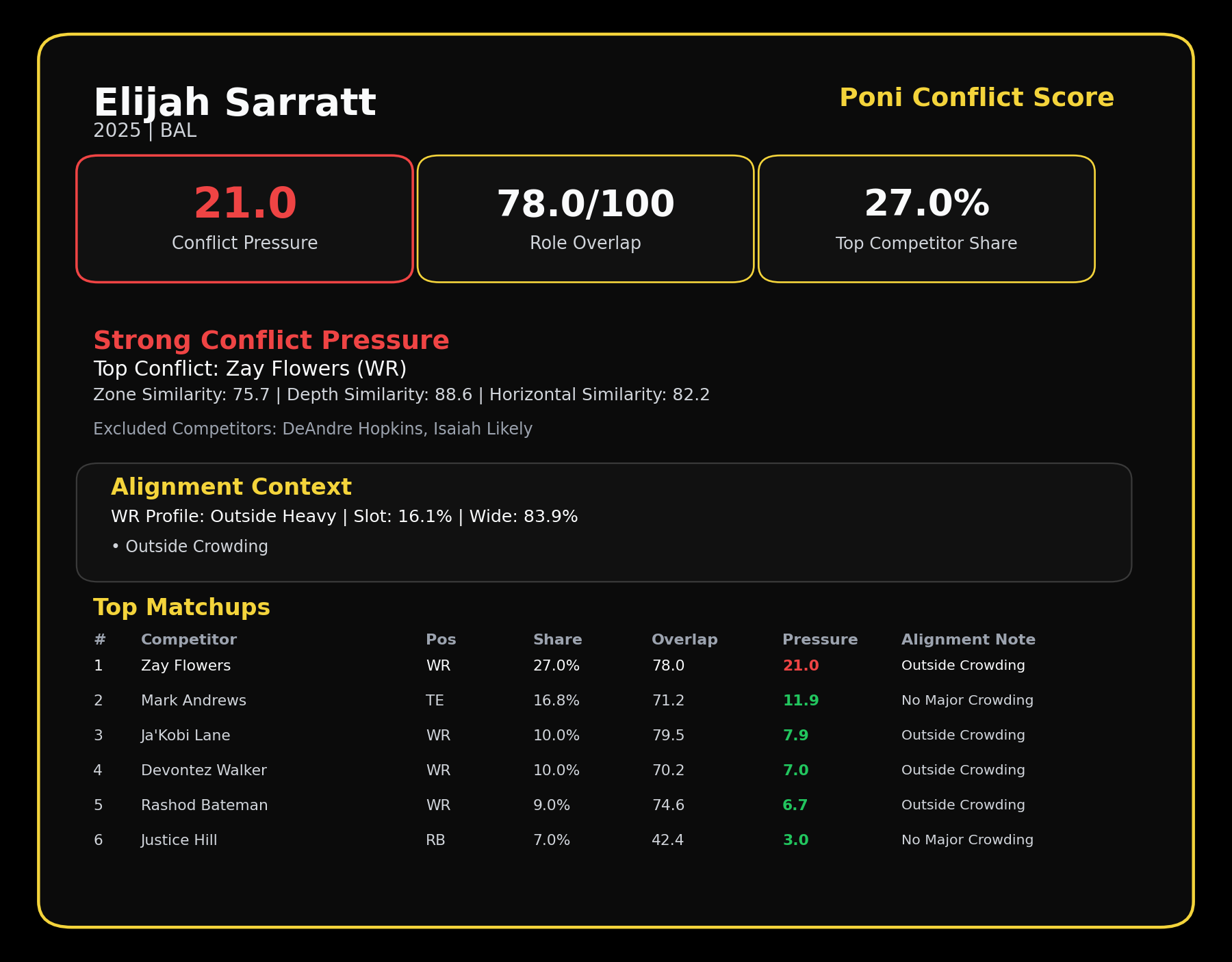
Elijah Sarratt Conflict Card
Thanks for hanging out. If you want to show support go ahead and give us a follow on Youtube, Spotify, Twitter, or Reddit.
The way you win a fantasy championship and get an advantage isn’t by using platforms like FantasyPros. It’s by listening to the little guys that no-one else is. That’s your advantage.
Now go steal a championship!