Who Benefits the Most in a Ben Johnson Offense: Rome Odunze, Luther Burden, or Colston Loveland? I Found an Answer for 2026
We have a lot of unknown wide receiver rooms in fantasy football this year. One of our listeners was asking about several of these crowded rooms, but the main one he wanted to talk about was the Bears.
I decided it would be a great mini-series to see if we can actually get to the bottom of who the player to own is in these offenses (Bears, Jacksonville, Broncos, Chargers, Green Bay, Washington, Steelers, etc).
I’ll be writing about a couple of these rooms over the coming weeks. My goal is to identify which player has the best chance to take over the most valuable role in the offense, using data to drive my decision-making.
If there is a WR room you’re interested in, ask us on Twitter, YouTube, or one of our socials.
First up is Ben Johnson & DA BEARS!
The #1 burning question heading into 2026 for a wide receiver room has been: Who becomes the primary pass catcher in this offense, and who scores the most fantasy points between Rome Odunze, Colston Loveland, and Luther Burden?
Well, I think I legitimately found an answer in the data. At the very least, I think the numbers support a fairly clear argument that there is a clear one, two, and three among these pass catchers heading into 2026.
All of the data used in this article comes from the Fantasy Points Data Suite. They are the GOAT fantasy analytics platform.
Spoiler Alert TL;DR
I went through Ben Johnson's Detroit offenses from 2022–2024 and compared the roles of Amon-Ra St. Brown, Jameson Williams, and Sam LaPorta to how Luther Burden, Rome Odunze, and Colston Loveland were used in Chicago in 2025.
Here’s what I found:
Luther Burden has the strongest overall case to take over the ARSB WR role, by a lot. His aDOT, TPRR, and route tree all point in that direction, and his usage became much more ARSB-esque as the 2025 season progressed. His horizontal-route rate jumped from 18% in Weeks 1–6 to roughly 46% from Weeks 7–18. Horizontal-route breaks are the most productive route group in Ben Johnson’s offense.
The only question was volume. Even late in the year, Burden was only around 56% route participation, so the ceiling depends heavily on him taking that step. Which I fully expect to happen with the departure of DJ Moore and Olamide Zaccheaus who vacated 817 routes. Seems perfect when all he was missing was usage.
Rome Odunze is the clearest Jameson Williams comparison. Rome's vertical usage, wide/slot alignment, shallow usage, and aDOT all closely resemble the Jamo role. This was the cleanest overall role comparison I found in my research.
Colston Loveland is more than just a LaPorta comparison. Overall, he still looks the most like LaPorta, but his route tree started pushing much further into ARSB territory as the season went on. From Weeks 7–18, Loveland's route-tree distance from ARSB was actually 0.245, closer than Burden's 0.301. Some of that is natural overlap between the LaPorta and ARSB route trees, but Loveland still went beyond LaPorta's historical baseline. I even checked LaPorta’s usage when Jamo was injured or limited (<20% route share), and he never cleared that high level of horizontal usage in the offense.
Loveland is the biggest threat to Burden's ceiling not Rome. If Loveland continues to take a large chunk of the horizontal and shallow work while also maintaining the LaPorta role, Burden may never get the concentrated ARSB workload we all want to see.
With that being said, the data points toward Ben Johnson putting Burden into the ARSB WR role. Burden will run more routes than Loveland and he has the most benefit to gain from this offense and that role. Sky’s the limit.
If I had to rank these three for 2026 production, it would go:
Luther Burden
Colston Loveland
Rome Odunze
My 2026 take: Burden is the ceiling play if his route share takes the significant jump we expect. He could very well finish as a WR1. Loveland looks like the safer floor with a legitimate ceiling if he does eat into Burdens route group or any injury strikes. Rome appears the most likely to sit third in the pecking order because his role is the most vertical and least connected to the high-volume areas of the offense.
My Process
The first thing I wanted to do was establish a baseline for how Ben Johnson ran the offense in Detroit from 2022-2024 and determine which receiving role was the most valuable.
I focused specifically on Amon-Ra St. Brown, Jameson Williams, and Sam LaPorta. I wanted to understand how each player was being used in the offense, how their roles differed, and ultimately how valuable each of those roles was for fantasy football. I started with fantasy production.
Using half-PPR scoring, I calculated how much of the Lions WR/TE (ARSB, Jamo, and Laporta) receiving fantasy production came from each of the three primary pass catchers and looked at how each player finished on a points-per-game basis.
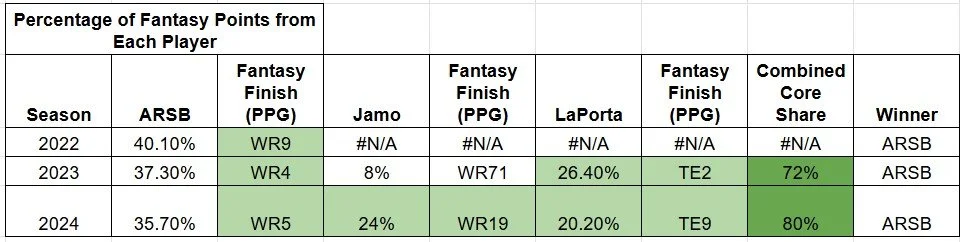
No surprise here. ARSB held the most valuable role in all three seasons. We also see that when the targets are concentrated, Ben Johnson's offense was capable of supporting multiple fantasy-relevant pass catchers at the same time (another duh).
Even more importantly, 79.8% of the qualifying WR/TE receiving fantasy production in 2024 came from ARSB, Jameson Williams, and Sam LaPorta. The passing offense was extremely concentrated between those three. Now we go into 2026, where DJ Moore and Olamide Zaccheaus have vacated 817 routes, 114 targets, and 995 yards.
ARSB consistently owned the largest piece of the offense, while the other two roles had to divide a smaller portion of the receiving production. We need to know what exactly was ARSB doing differently, and can we identify which Bears player could be placed into this role.
I broke the usage down even further to understand which route types were the most valuable in the offense.
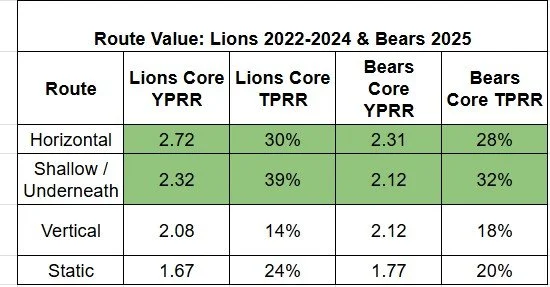
It was pretty clear that horizontal and shallow routes were the most valuable areas of the route group, not just because of the production they created, but because of how often they were targeted.
Naturally, I wanted to look at how these players were actually being used in the offense. While I broke this down by year and even by week to identify trends, the table below gives a general overview of each player’s role.
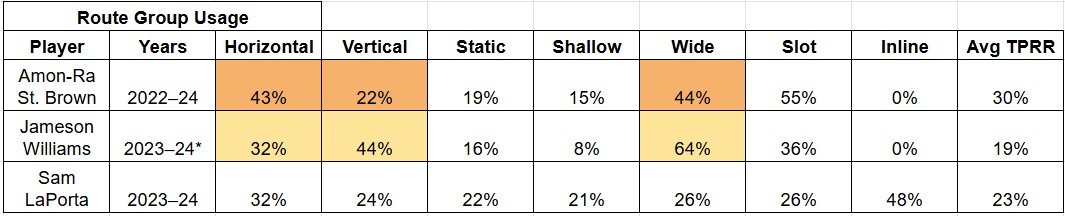
Generally speaking, ARSB was used much more on horizontal routes, ran the second-most shallow routes, and was used vertically far less than Jameson Williams. LaPorta was sprinkled around a little bit of everywhere, but led the group in shallow-route usage.
It also shows that while ARSB primarily played out of the slot, he was still consistently moved outside, with nearly 44% of his routes coming from a wide alignment.
Since we established that ARSB had the most valuable role in the offense, I wanted to see what the alignment looked like year over year and determine if there were any changes.
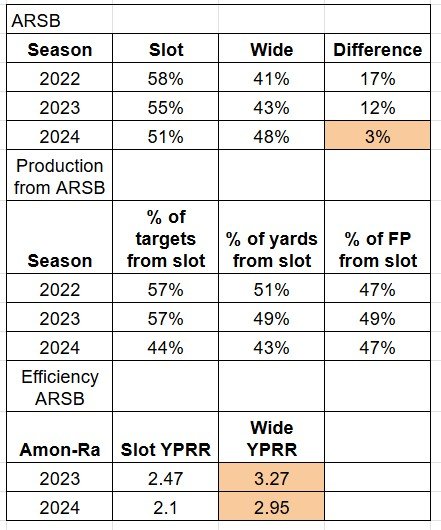
Year over year, ARSB was increasingly moved outside. His slot rate dropped from 58% in 2022 to almost an even 51/48 slot-to-wide split by 2024. He was also more efficient out wide than in the slot. But, when we look at his route group usage.
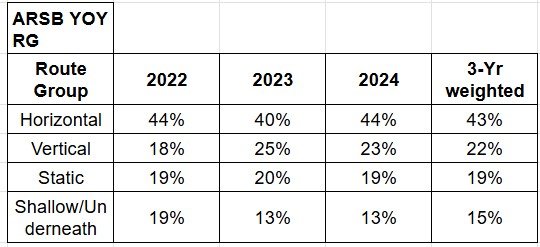
Year over year, his route tree was damn near identical. The biggest change came after LaPorta arrived in 2023, when ARSB started to lose some of the shallow/underneath work. But the big takeaway is he led the group in horizontal route usage while maintaining a higher shallow usage than Jamo.
To keep this article somewhat reasonable length, I’m not going to be able to show every step of the process. But know that I went much deeper than just route tree, fantasy scoring, and alignment. I also looked at overall TPRR, horizontal and shallow TPRR, aDOT, catch rate, YAC per reception, overall separation score, separation by coverage type, designed targets, and how each player’s role changed from the early, middle, and late portions of the season. I did the same thing for both the Lions and Bears players. I will share most of this process.
Bears 2025 Data
After I established a baseline for the Lions players and how Johnson used them, I followed the same process for Rome Odunze, Luther Burden, and Colston Loveland. I started looking for similarities, beginning with alignment.
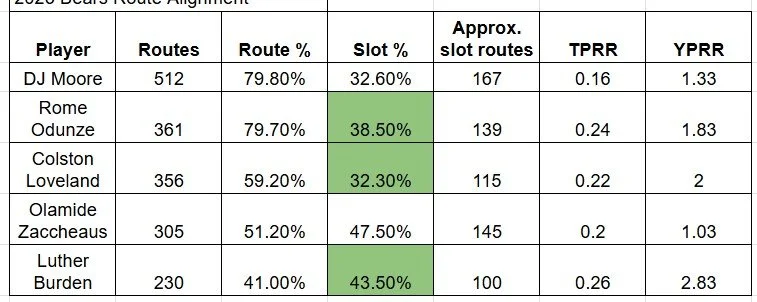
Of the three players we care about, Luther Burden had the highest slot rate. But overall, the alignment was still fairly spread out. This is probably where most people stop looking at the full-season numbers, but this didn't tell the entire story.
Since Burden and Loveland were both rookies, I wanted to see if their roles changed as the season went along and whether their ramp-up showed us something the yearly numbers didn’t.
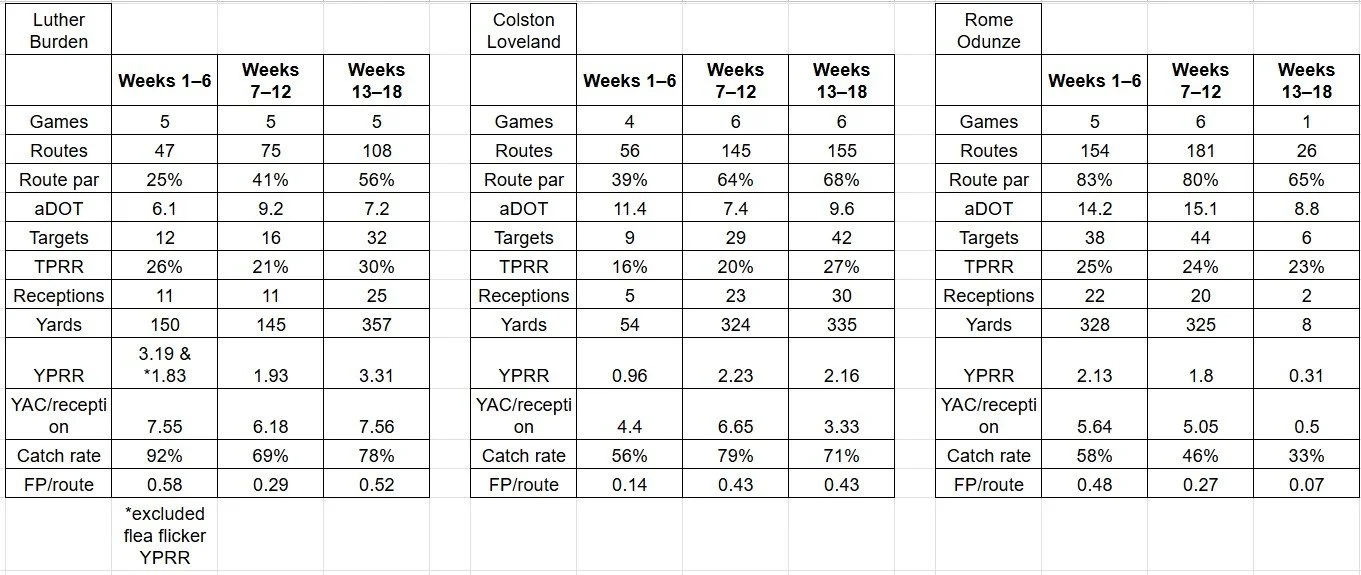
The biggest takeaway, outside of Burden and Loveland growing into much larger roles as the season went on, was what happened with Rome in Weeks 1–6. This was when Odunze really broke out. Burden and Loveland were both on the field, but neither had become a major part of the offense yet. His main competition was DJ Moore and Olamide Zaccheaus.
In my opinion, year-two Burden and Loveland are going to provide much stronger target competition than what Rome was dealing with from those two players early last season. That doesn't mean it was the only reason for his early breakout, but I definitely think it had something to do with it. Yes, I know Rome got injured but that doesnt change my take.
For Burden, I initially wanted to figure out why his catch rate and raw YPRR dropped in the middle of the season. I went down the rabbit hole looking at separation score, win rate against different coverages, and then lined that up with the defensive schemes Chicago faced. After all that work, I really didn't find anything outlandish. Then I remembered the flea flicker on a broken play in week 3
What I did find was that Jameson Williams and Rome Odunze performed well against a similar group of coverages. I found something similar when comparing Loveland to LaPorta. Burden and ARSB weren't nearly as clean. They both performed well against man coverage, but there wasn't another obvious coverage connection between the two.
I went back to the route tree and alignment. I wanted to see if there were similarities in how Ben Johnson was actually using these players and whether anything stood out as their roles developed. That's when even more of a trend started to appear.
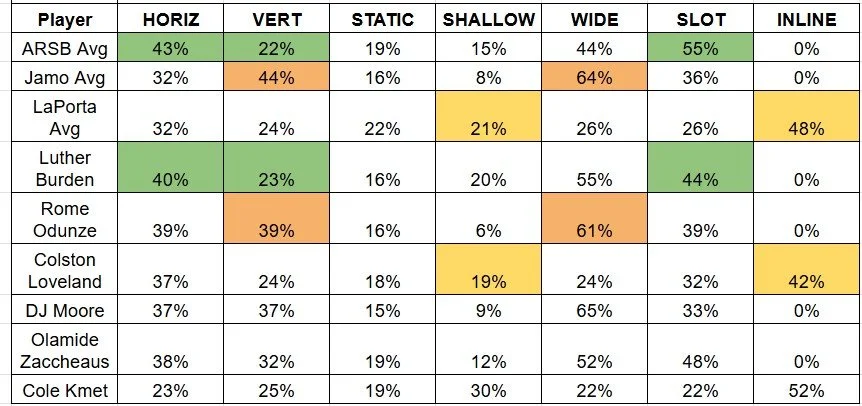
While this is certainly informative and starts to paint a picture, I don't think the full-season data tells the entire story, especially when we already know how much Burden and Loveland's roles grew as the season went on.
So I broke everything down by week to see if their usage shifted and, more importantly, how it shifted. I broke the season into three windows; Weeks 1–6, 7–12, and 13–18. One thing to keep in mind is that Rome only played one game from Weeks 13–18, so Weeks 7–12 gives us the best window to compare how all three were being used at the same time.
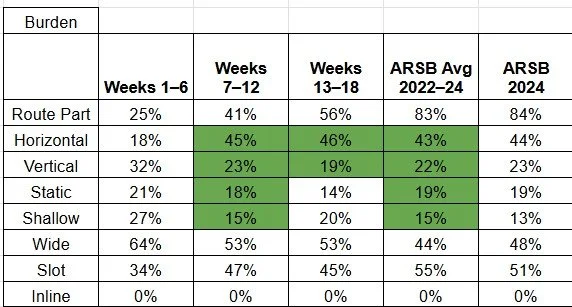
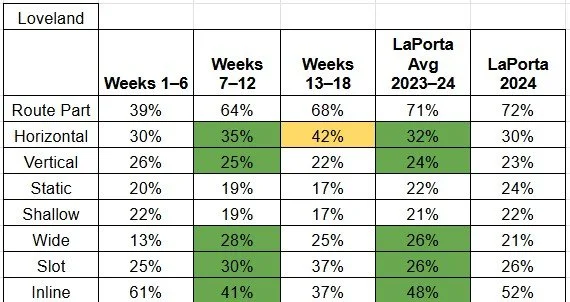
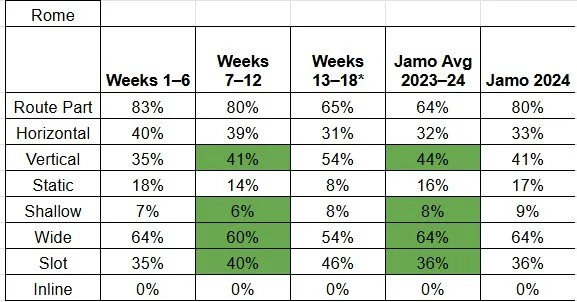
As you can see, breaking it down this way makes the similarities much stronger as the season progressed. These were some of my biggest takeaways:
Luther Burden: There is a clear route-usage similarity to ARSB, especially as Burden's role grew. By the middle and end of the season, his horizontal, vertical, and shallow usage all started looking much more like the ARSB role.
Rome Odunze: Rome has a pretty clear usage similarity to Jameson Williams. His wide usage is similar, his shallow usage is similar, and he carries the most vertical-heavy role of the three.
Colston Loveland: Loveland definitely has similarities to LaPorta, but there was one thing that really stood out. By Weeks 13–18, 42% of Loveland's routes were horizontal. That's basically ARSB-level horizontal usage and well above what we typically saw from LaPorta.
I originally thought Rome only playing one game during that week 13-18 window may have played a part in that, so I went back and looked at LaPorta's usage when Jameson Williams was out or very limited (<20% route share) in 2023. Even then, LaPorta was only around 32% horizontal.
While Burden has a very strong profile for the ARSB role, he also wasn't playing nearly as much as Loveland. It’s possible Ben Johnson didn't think he was ready or maybe the week 16 injury impacted his plan. But, Johnson was ready and willing to use Loveland in this role, as a rookie, in one of the most valuable parts of the route group in his offense. This shows me he had the trust from his coach and the ability to perform in this role.
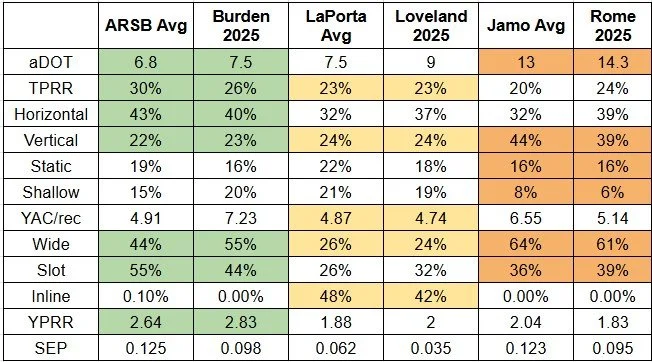
To put everything together as close to one visual, this is probably the best table I can show to explain why I believe Luther Burden is being developed for the ARSB role, Rome Odunze fits the Jameson Williams role, and Colston Loveland looks like a more versatile and potentially more dangerous version of the LaPorta role.
The similarities aren't perfect, but when you look at aDOT, TPRR, route tree, alignment, YAC, YPRR, and separation together, the roles start to become pretty clear to me.
The very last thing I did was test this statistically. I used Aitchison distance to measure how similar each Bears player's route tree and alignment were to the three Lions roles. Since route tree and alignment are both distributions, Aitchison distance allows us to compare the overall shape of the usage instead of cherry-picking one or two percentages that happen to look similar.
The lower the number, the more similar the usage.
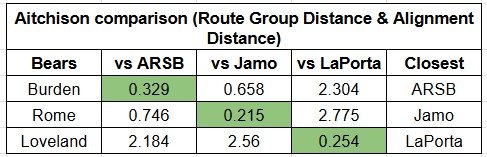
If you notice, Burden still appears somewhat close to Jamo in the Aitchison comparison. That is almost entirely because of alignment. His alignment distance to Jamo was only 0.236, but his route-tree distance was 1.079.
We know that alignment alone does not appear to define these roles. We already saw ARSB shift from a more slot-heavy role to nearly a 50/50 split between the slot and out wide, while his route tree remained remarkably consistent.
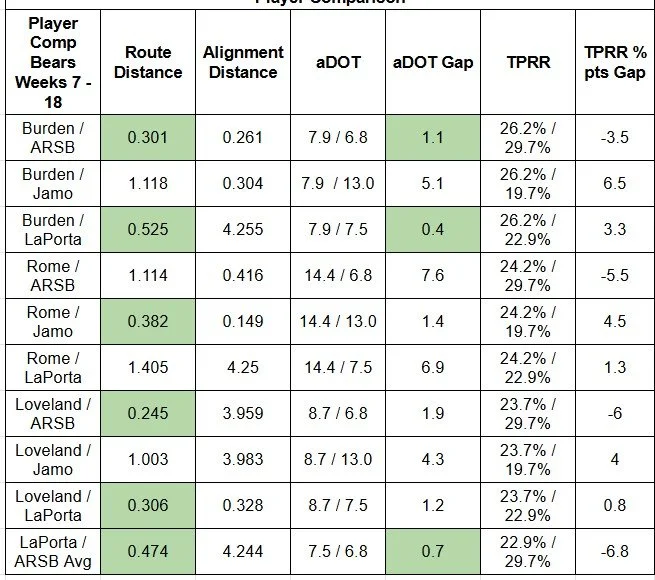
For this comparison, I care much more about the routes being run, aDOT, and the targets a player is earning within that role. If you aren't convinced yet below, is my final comparison using route group distance, alignment distance, aDOT, TPRR between weeks 7-18 for the Bears.
My final takeaways:
Rome Odunze has the strongest comparison to the Jameson Williams role. The vertical usage, wide/slot alignment, shallow usage, and aDOT all point to him playing this role. When I looked at the entire profile together, I didn't find a stronger statistical role connection anywhere else in this analysis.
Luther Burden still has the strongest overall case to take the Amon-Ra St. Brown WR role. His route tree became increasingly ARSB-esque as the season progressed, while his aDOT and TPRR also support the comparison. However, there is one pretty important wrinkle, from Weeks 7–18, Loveland's route tree was actually closer to ARSB's than Burden's was.
I added LaPorta/ARSB as a comparison to see if some of this was simply natural overlap between the two route trees, and there was. LaPorta's route-tree distance from ARSB was 0.474. That makes Loveland's similarity less surprising, but not irrelevant. Loveland's Weeks 7–18 distance from ARSB was just 0.245, meaning his route tree was considerably more ARSB-like than LaPorta's historical baseline.
Colston Loveland obviously still most closely matches LaPorta, but I think he's much more than just a wildcard at this point. Johnson was already giving him substantially more horizontal-route usage than we typically saw from LaPorta. By the end of the season, 42% of Loveland's routes were horizontal, basically ARSB territory. Even in the 2023 games I looked at when Jamo was out or limited, LaPorta never approached that level of horizontal usage.
I don’t think Loveland needs to become ARSB to hurt Burden. If he keeps eating into that work, it could impact Burden's ceiling.
I also don't think it's outlandish that Ben Johnson leans further into Loveland if he believes Burden isn't ready for a full-time role. Loveland was already playing more than Burden late in the season and getting valuable parts of the route group. Especially in the playoffs.
With all that being said, I still think the data strongly suggests Ben Johnson is going to put Luther Burden into the ARSB role. The question for me is no longer whether Burden can eventually occupy that role. I believe he can. The bigger question is whether he can command enough of it from Loveland (I also believe this is a yes). His route participation and route usage in the first couple of weeks will be the most telling.
If I had to rank the production of these three pass catchers for the upcoming year, it would be Luther Burden, Colston Loveland, and Rome Odunze in that order.
Burden is the ceiling play with an increased route share (could very well finish as a WR1), Loveland seems like he will have a solid floor with potential ceiling based on how Burden plays, and Rome is set to be last in the pecking order of priority based on value and usage.
I hope you found this article valuable. Good luck this year, now go steal a championship!